
Infrastructure as code (IaC) is the practice of defining and provisioning cloud infrastructure resources using versionable config files. It replaces manual infrastructure management processes with repeatable automation that lets you improve deployment velocity and governance.
Tools such as Terraform, Pulumi, and OpenTofu are the foundation of IaC, but successful adoption requires more than just the solutions themselves. IaC outcomes also depend on how well your tools are operated and how deeply they are embedded in your team’s working habits.
In this article, we explore the challenges that block IaC adoption. We then set out a ten-step roadmap and the best practices that keep it working after rollout. You will learn how to make the operational and cultural changes that determine whether IaC actually improves your DevOps workflows.
What we’ll cover:
TL;DR
- An IaC adoption strategy is the plan that takes you from manual provisioning to code-defined infrastructure, covering tooling, pipelines, governance, and team ownership.
- Most adoption efforts fail on operations and ownership, not on syntax. Tools alone do not produce automated workflows.
- Start with a maturity assessment, set success criteria, then prove the model on development and staging environments before touching production.
- Plan observability, policy enforcement, and drift detection before your first apply, not after.
- Expect three to twelve months to reach steady state, depending on how much automation you already have.
What is an IaC adoption strategy?
An IaC adoption strategy is a plan for moving infrastructure provisioning from manual, ticket-driven processes to version-controlled code. It defines which tools you standardize on, how changes get reviewed and applied, who owns what, and how you measure whether the change worked.
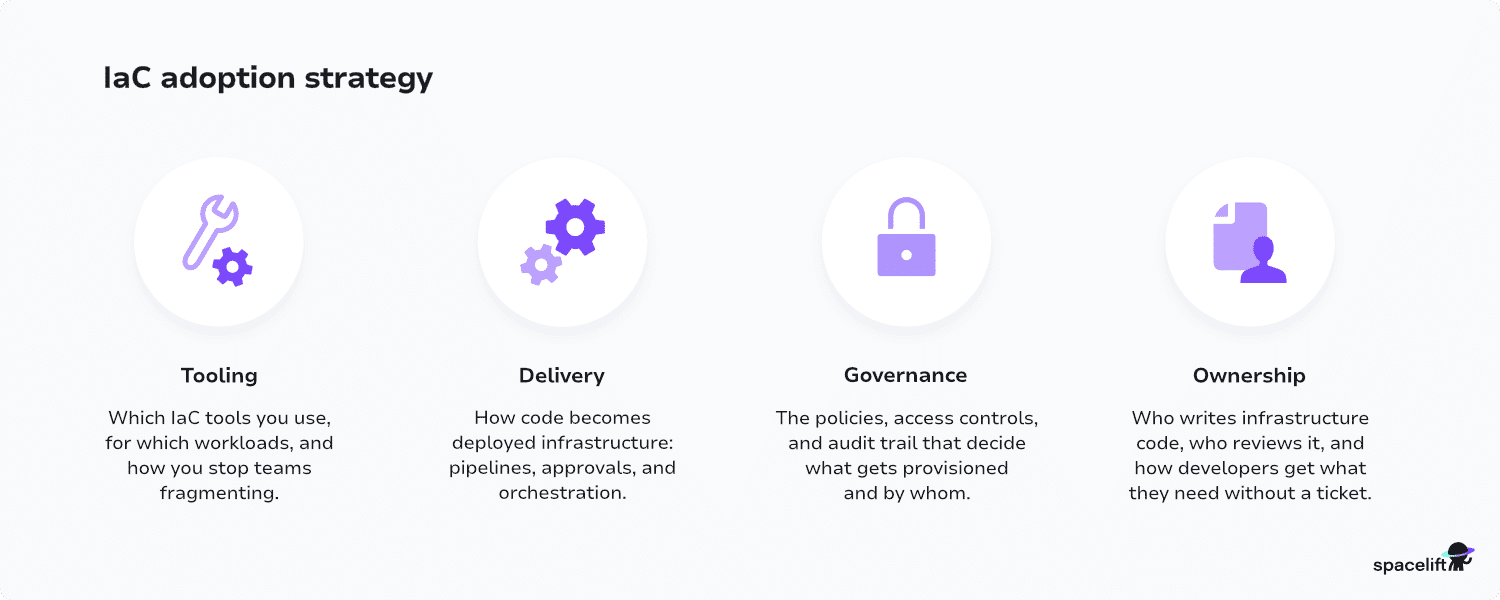
It covers four things:
- Tooling: Which IaC tools you use, for which workloads, and how you avoid fragmenting across teams
- Delivery: How code becomes deployed infrastructure: the pipelines, approvals, and orchestration that run between commit and apply
- Governance: The policies, access controls, and audit trail that decide what gets provisioned and by whom
- Ownership: Which teams write infrastructure code, which teams review it, and how developers get what they need without filing a ticket
Remember that writing Terraform is a task, whereas adopting IaC is an operating model change. Teams that treat it as the former end up with config files nobody trusts and a platform team still running applies by hand.
How long does IaC adoption take?
The timeline for your IaC adoption is determined by where you start.
If you already run CI/CD pipelines and your team is comfortable with Git-based review, IaC is an extension of what you do. You should have low-risk environments running through code within a couple of months, and broad coverage within a quarter.
If infrastructure is provisioned manually by a small group of specialists, budget for training and process design before you write any config. Reaching steady state usually takes six to twelve months, and most of that time goes into changing how people work rather than into the code itself.
What are the biggest challenges in IaC adoption?
IaC adoption is often treated as a purely technical exercise: Pick an IaC tool, write some config files to describe your infrastructure, and then run commands like terraform apply to provision your cloud resources.
However, if your workflows are going to hold up, you need your infrastructure management processes, governance systems, and team capabilities working together. Otherwise, you’ll get bottlenecks instead of velocity.
IaC tools aren’t enough on their own to build fully automated infrastructure workflows. They must be backed by reliable CI/CD pipelines that apply changes automatically after you commit your IaC files.
You also need management layers for what happens after provisioning, so you can see deployed resources and detect configuration drift. Using IaC without them leads to environments that quietly stop matching what your code says.
Adoption also gets derailed by legacy infrastructure, skills gaps, and team cultures resistant to change. Ignore these and you either delay the rollout or ship IaC tooling nobody uses. The problems compound as you grow, so start with a structured strategy built around where your team actually is today.
IaC adoption roadmap: step by step
Now we’ve outlined why IaC adoption efforts often fail to run smoothly, let’s look at how you can build a strategy that works first time. The following ten steps will guide you through crafting an implementation plan that ensures IaC becomes an integral part of your team’s workflows, not just yet another tool.
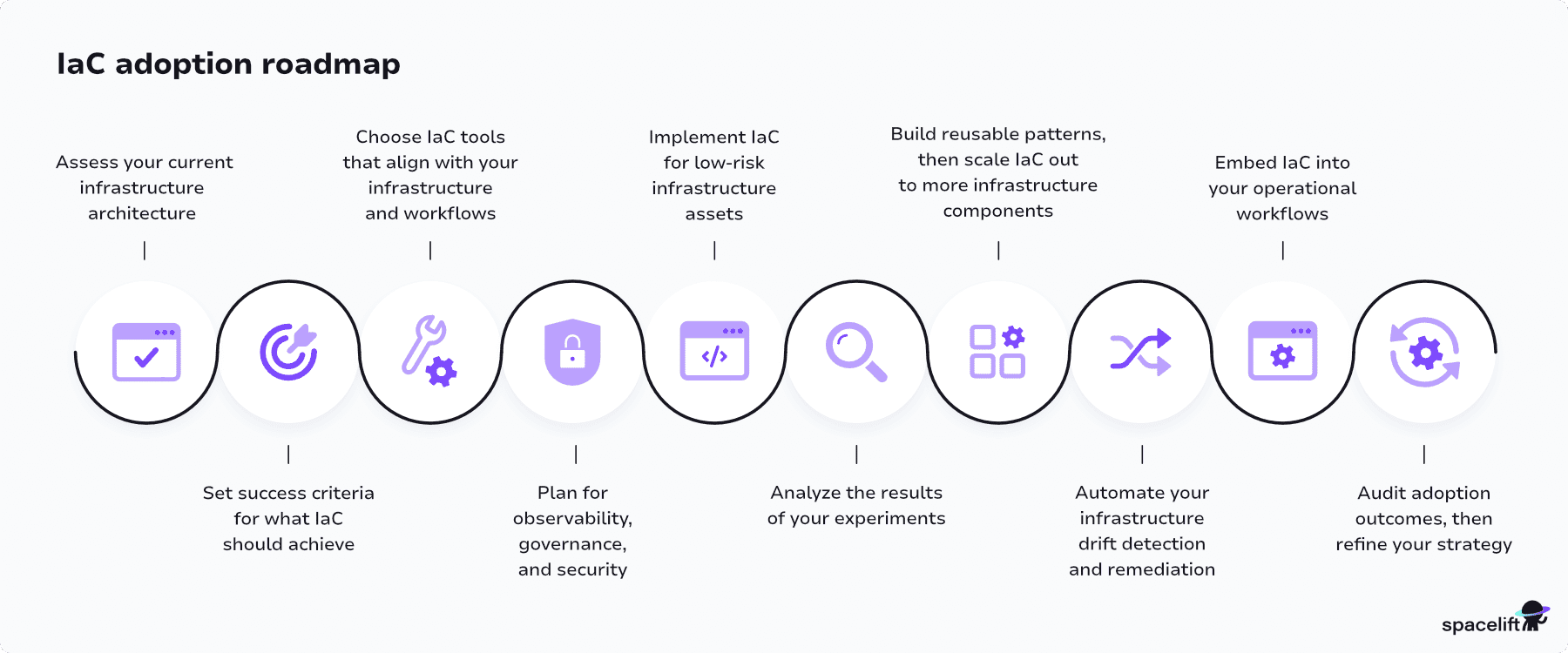
Step 1. Assess your current infrastructure architecture
Start by assessing the maturity of your existing infrastructure management processes. Identify which providers and platforms you use, how resources are provisioned, and the pain points that operators face. These could be inconsistencies within environments, slow deployment times, or a lack of visibility into what’s running in your cloud accounts.
These insights provide data for shaping your IaC strategy. If your workflows already include a degree of automation, then implementing IaC could be a straightforward evolution. But if you rely on a handful of specialists to provision infrastructure manually, you’ll likely need to plan for a period of training and restructuring before you start full-scale adoption.
Step 2. Set success criteria for what IaC should achieve
IaC is more likely to succeed if it’s oriented around specific objectives. Your strategy should have a clear purpose grounded in the pain points you identified during your earlier assessment.
For example, your long-term aim could be to reduce instances of configuration drift, or make it easier for developers to self-service new staging environments.
Concrete success criteria also prepare your team to accept the change. If people understand why change is happening and what it will achieve, then they’re more likely to buy into it. This makes it easier to create an environment where IaC’s value can be optimized.
Step 3. Choose IaC tools that align with your infrastructure and workflows
Once you’ve decided on your strategy’s aims, you can begin choosing tools that are genuinely aligned with your actual needs. Focus on finding the solutions that have the best fit with the cloud providers and infrastructure types you use, as well as your existing CI/CD and governance systems.
Where possible, try to standardize on a single tool for each use case. This will help keep your workflows consistent so they’re easier to maintain. However, don’t be afraid to build specialized processes for workloads that have unique operational requirements.
In practice, that usually means splitting by layer. Terraform or OpenTofu for cloud resources, Helm or Kustomize for Kubernetes workloads, and Ansible for OS-level configuration on VMs. Forcing one tool across all three is where teams start writing wrappers around their own tooling.
Standardizing too early creates more problems than it solves because your teams get limited to the lowest common denominator of features that fit every scenario.
Read more: How to Run an IaC Platform POC
Step 4. Plan for observability, governance, and security
With your core tools decided, you can progress to planning how you’ll gain visibility into your deployed resources. It’s important to do this before you actually start using IaC so you don’t lose sight of what’s happening in your environments after they’re provisioned.
Aim to gather the metrics provided by your cloud providers, IaC tools, and infrastructure management platforms into unified dashboards within an external observability solution. Once you can monitor your entire infrastructure fleet in one place, it’ll be easier to see what’s happening and make data-driven decisions.
At this point, you should also define your IaC governance policies and build the mechanisms that enforce them. Integrate policy as code into your CI/CD pipelines to control who approves changes and which security checks must pass before resources get provisioned. Live guardrails tfrom day one stop bad habits before they form.
Your first policy should be something uncontroversial, like denying storage buckets created without encryption, or instance types outside an approved list. You are testing that the enforcement path works, not writing your final ruleset.
Step 5. Implement IaC for low-risk infrastructure assets
By this stage, the basic framework of your IaC strategy should be in place. Now’s the time to start testing it by building small-scale experiments around low-risk workloads.
Begin by writing IaC configs for non-critical infrastructure such as development and staging environments. Starting with these resources allows you to safely validate your chosen tools, processes, and governance systems work as expected, without risking disruption to live deployments. The goal is to surface any workflow or skills gaps early, while mistakes can still be easily resolved.
Reasonable first candidates are a staging VPC, an artifact bucket, development DNS records, and non-production IAM roles. Production databases and shared networking can wait, since other teams depend on both.
Step 6. Analyze the results of your experiments
After you begin your implementation, you should regularly observe its outcomes and compare them with the success criteria you identified earlier.
Ask questions and analyze data to identify whether the experiment has been a success: Did provisioning times actually improve? Are your deployment pipelines reliable? Have teams complained about any new pain points? Making assumptions could lead to misplaced confidence that creates problems as you scale your adoption.
If everything’s looking good, continue with your strategy. But if not, now’s the time to go back and make adjustments before you proceed any further.
Objectively evaluate how your end-to-end workflows are performing across operational processes, governance controls, and their technical implementations.
Step 7. Build reusable patterns, then scale IaC out to more infrastructure components
With your initial experiments complete, you can now extend your IaC rollout to additional teams, projects, and infrastructure components. From this point onwards, your focus should be on maintaining consistency as you scale. This means building reusable components to reduce the amount of ongoing maintenance work required.
Use IaC modules, CI/CD pipeline inputs, and infrastructure configuration templates to help teams scaffold new resources faster, without duplicating work.
These practices also strengthen governance by reducing the number of individual patterns that need testing and auditing for vulnerabilities.
Step 8. Automate your infrastructure drift detection and remediation
The expansion of your IaC footprint increases the likelihood of drift in environments. To prevent this taking hold, you should implement drift detection and remediation systems at the earliest possible opportunity. Automating these functions will minimize the time that inconsistencies exist in your environments.
Start by instrumenting your infrastructure so you can accurately compare the states of deployed resources to what your IaC configuration describes. Set up alerts so operators are informed when potential drift is found, such as by periodically running your IaC tool’s change planner and then sending the results to a Slack channel.
From here, implement mechanisms for resolving drift, such as by opening a new PR to reapply the correct state. Infrastructure orchestration platforms can help simplify this process.
Step 9. Embed IaC into your operational workflows
By this point, your strategy should have produced dependable systems backed by observability, governance, and drift management controls. You are close to IaC being part of every workflow.
Complete the process by developing, reviewing, and deploying infrastructure changes through the same Git and CI/CD processes your developers already use. Connect your IaC tools and infrastructure management platforms to the wider DevOps loop, by using your IaC configs to provision infrastructure for E2E tests triggered by your product pipelines, for example.
Step 10. Audit adoption outcomes, then refine your strategy
IaC adoption doesn’t end with the initial implementation. You may now be using IaC in your day-to-day workflows, but your strategy should continue to evolve with your organization’s changing DevOps needs.
Focus on analyzing KPIs, collecting feedback, and auditing pipeline activity to understand what’s working well and design any necessary improvements. This should be an ongoing process that all stakeholders can influence.
Best practices for successful IaC adoption
The roadmap above sets out the basic framework you should follow as you implement IaC. However, this roadmap alone doesn’t mean you are set forever. Your requirements will likely change over time as you adopt new tools, refine your strategy, and discover issues in your approach.
As you scale your IaC strategy across your organization, following these best practices will help ensure your processes stay maintainable long-term:
1. Encourage cross-discipline ownership
IaC is not just for operations teams. Developers, security specialists, and business leaders need to be involved with the adoption process too so they understand how the IaC rollout will affect their day-to-day processes. Mature IaC systems could let devs provision preconfigured environments on-demand, for example, whereas security teams should be aware that IaC files need auditing to detect potential vulnerabilities.
2. Prioritize consistency and scalability over workflow speed
It’s tempting to optimize for the fastest infrastructure provisioning methods, but this often sacrifices safety. Consistency is key to achieving reliable scalability, so focus first on building repeatable infrastructure management processes that can be deployed easily across different teams.
3. Treat your infrastructure processes like product ones
IaC is most powerful when your infrastructure and product changes follow the same basic processes. Lean on your CI/CD pipelines to ensure changes are reviewed, tested, and validated as they’re committed, instead of deferring audits until changes are already live. This improves consistency throughout the DevOps lifecycle. Developers can use their existing skills to prepare ad-hoc infrastructure updates.
4. Build feedback loops that promote continuous improvement
Your IaC strategy needs to evolve over time with your team’s requirements, but this won’t happen unless you build feedback loops that reveal where improvements are actually needed. Track metrics such as provisioning times, infrastructure spend, and pipeline activity to extract this data from the DevOps lifecycle.
Similarly, regularly surveying developers and operators to learn about their day-to-day experience will help you establish a cycle of continuous improvement that reflects everyday pain points.
5. Use IaC maturity to drive further DevEx improvements
Having mature IaC-driven infrastructure management workflows creates new opportunities to further improve the DevOps loop. For instance, you could combine IaC and platform engineering to simplify developer self-service access or help unify multicloud environments. IaC is most valuable when it’s viewed as a gateway to next-level efficiency improvements, not a finishing line in itself.
How Spacelift supports IaC adoption at scale
Scripts and pipelines can automate tasks, but they can’t deliver governance, visibility, or safe self-service. That’s the gap a purpose-built orchestration platform fills.
Spacelift replaces homegrown plumbing with infrastructure orchestration built for platform teams, including:
- Policy as code with Open Policy Agent (OPA): Control approvals, restrict the resources teams can create, validate configuration parameters, and define how runs behave when pull requests are opened or merged. Guardrails travel with every deployment instead of living in a script someone forgot to update.
- Multi-IaC workflows: Orchestrate OpenTofu, Kubernetes, Ansible, Pulumi, CloudFormation, Terraform, and other tools from one control plane. Model dependencies between workflows and share outputs across them, so you stop wiring tools together by hand.
- Governed self-service infrastructure: Use Templates to give developers a curated catalog they deploy from by filling out a form. Inputs are validated before anything runs, and every version is pinned to a VCS commit for repeatable results. Platform teams define what can be deployed and how, so developers self-serve without learning the underlying IaC. Blueprints remain available when you just need an independent, editable stack.
- AI-assisted provisioning with Spacelift Intelligence: An Infrastructure Assistant that understands your stacks, state, and runs, so you can ask questions, diagnose failed runs, and create policies in plain language. It pairs with Intent, an agentic deployment model that provisions non-critical infrastructure from natural language, no code required, while your policies, credentials, and audit trail still apply.
- Integrations with third-party tools: Connect Spacelift to the tools your teams already use, and extend governance across them. For example, you can integrate security tools into your workflows using Custom Inputs.
Spacelift also lets you run private workers inside your own infrastructure, so you can execute workflows within your security perimeter. Read the documentation to learn more about configuring private workers.
Try Spacelift by creating a trial account or booking a demo.

As a software company that uses data and AI to make the meat industry more optimized and sustainable, Völur knew that transitioning to infrastructure as code (IaC) would enhance their engineering team’s productivity and speed. Since becoming a Spacelift customer in July 2023, the team has discovered that Spacelift’s infrastructure management platform provides an exceptionally reliable process to achieve the engineering culture they want to build.
Key takeaways
Successful IaC adoption requires methodical work to implement your tools, establish repeatable operational processes, and transform your team’s culture. Clear objectives and scalable workflows allow you to extend the benefits of IaC throughout your organization, without losing sight of governance.
Adoption should be grounded in your team’s current infrastructure management maturity. If you already have extensive DevOps automation, it is usually easier to implement IaC through integrations with your existing CI/CD solutions. However, if you’re starting from a clean slate, it’s best to work in small steps and review the results after each change.
Still unsure how to get started with real-world IaC adoption? Check out Spacelift to automate your infrastructure management without the headache of manual configuration. Spacelift runs your IaC tools, enforces your governance policies, and detects and resolves drift so your environments stay compliant.
Solve your infrastructure challenges
Spacelift is a flexible orchestration solution for IaC development. It delivers enhanced collaboration, automation, and controls to simplify and accelerate the provisioning of cloud-based infrastructures.
Frequently asked questions
How do I start adopting IaC?
Begin with a small, low-risk workload such as a staging environment or a single service, commit its configuration to a Git repository, and provision it with a mainstream tool like Terraform or OpenTofu before gradually expanding coverage to production systems.
Which IaC tool should I choose?
For multicloud, declarative workflows, Terraform remains the most widely adopted option, covering AWS, Azure, GCP, and hundreds of providers, with OpenTofu serving as the open-source drop-in alternative. Choose Pulumi if your team prefers real programming languages (Python, TypeScript, Go), or CloudFormation, Bicep, or CDK if you are committed to a single cloud provider.
What's the difference between IaC adoption and IaC maturity?
Adoption measures how much of your infrastructure is actually defined in code, whereas maturity reflects how far your practice has progressed across automation, governance, observability, and security integration, meaning consistency and control, not just coverage.