

Self-service provisioning is the practice of allowing developers to deploy new infrastructure components independently, without involving operations teams. It reduces friction in development workflows by eliminating inter-team dependencies. This allows engineers to work more autonomously, improving throughput and DevEx.
In this post, we’ll explain self-service provisioning and discuss how it benefits DevOps productivity and infrastructure management. We’ll finish by explaining how to start implementing self-service provisioning in your own teams.
What we’ll cover:
What is self-service provisioning?
Self-service provisioning is the use of automated tools and Golden Paths by developers to create new infrastructure on demand.
Previously, developers may have needed to contact operations teams to provision new compute instances, database servers, or test environments. Self-service provisioning gives engineers tools that let them safely create new infrastructure resources on their own, including databases, Kubernetes namespaces, ephemeral environments, secrets, and observability tooling.
| Before self-service provisioning | With self-service provisioning | |
| How infrastructure is requested | Developers contact operations teams manually. | Developers use automated tools and golden paths on demand. |
| Speed | Slow — dependent on ops team availability | Fast — infrastructure created at the exact time it’s needed |
| Who provisions | Operations/infrastructure teams | Developers themselves, via prebuilt workflows |
| Knowledge required | Deep understanding of cloud accounts and configs | Minimal — developers just input name, components, and versions |
| Risk of errors | Higher — manual processes, inconsistent configs | Lower — workflows are templated and centrally governed |
| Compliance & guardrails | Hard to enforce consistently | Built-in — platform teams can reject non-compliant requests |
| Tooling | Direct cloud console access (credentials shared) | IaC, CI/CD, and Internal Developer Platform (IDP) tools |
| Maintenance | Spread across teams | Centralized — maintained by platform teams |
Successful self-service provisioning systems are automated, structured, and easy for infrastructure operators to govern. Self-service does not mean handing developers credentials to your cloud provider’s console: Letting developers provision infrastructure in this way could cause errors, inconsistencies, and compliance breaches.
Instead, self-service infrastructure provisioning leverages infrastructure as code (IaC), CI/CD, and Internal Developer Platform (IDP) tools to give developers access to prebuilt provisioning workflows. Platform teams typically maintain the workflows provided.
With this model, developers don’t need to understand exactly what each workflow does, or which cloud accounts it involves. They can simply use the provided services to provision the infrastructure they need, at the exact time they need it.
For example, your platform team could provide a templated service that lets developers deploy fresh environments by simply inputting a name, a list of components to deploy, and their versions. By configuring the service centrally, platform teams can also easily enforce guardrails to reject misconfigured or non-compliant developer requests.
What are the benefits of self-service provisioning?
Self-service provisioning offers clear advantages for development, infrastructure, and platform teams. At its core, it shifts responsibility for provisioning and approval tasks from operators to developers and automated processes — improving agility and enabling teams to collaborate more efficiently without waiting on each other.
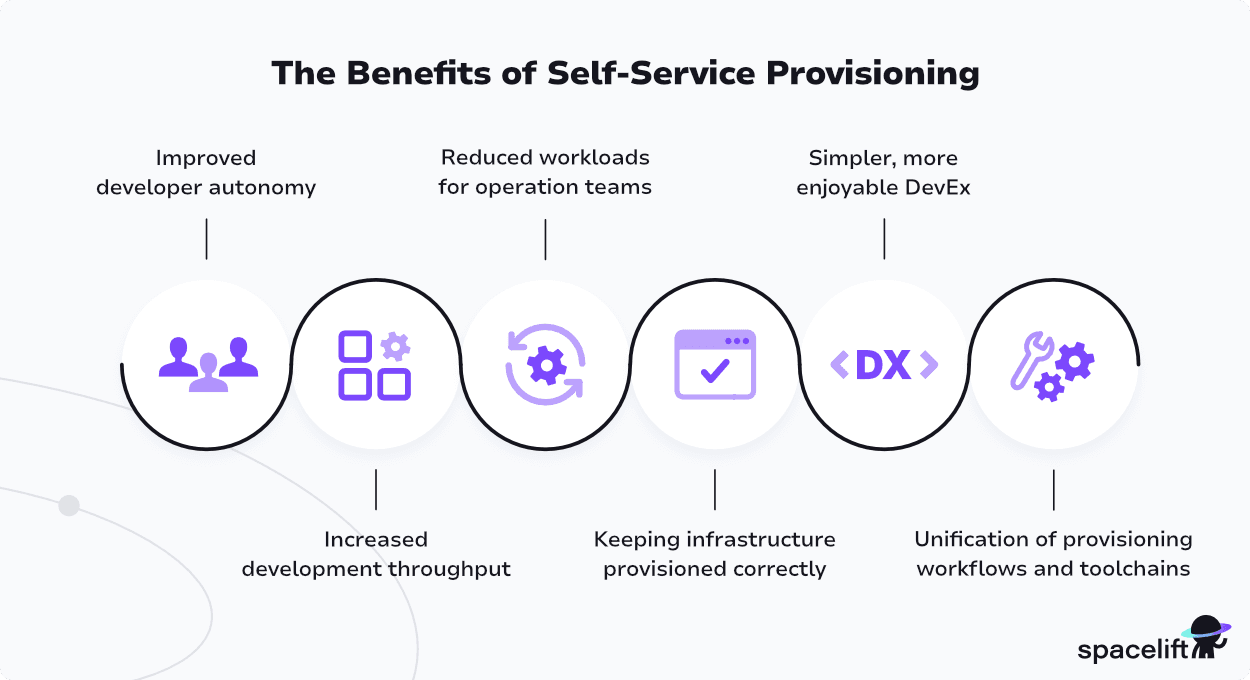
Here are six key benefits of self-service provisioning:
1. Improved developer autonomy
Enabling developers to provision their own infrastructure gives them more autonomy. They can create the resources they need on demand, allowing them to continue progressing without being blocked.
Autonomy is one of the main contributors to positive DevEx as it lets developers feel more in control of their own working environment. This in turn, leads to long-term productivity and satisfaction.
Self-service provisioning also helps nurture a culture of independent experimentation. It empowers developers to quickly test new ideas, without constantly justifying their plans to infrastructure teams. Using self-service provisioning in this way may sound risky, but correctly configuring security, compliance, and cost management guardrails ensures governance requirements can still be maintained.
2. Increased development throughput
Development throughput increases when developers can provision their own infrastructure on-demand. They can spin up new environments for feature branches, run integration test suites easily, and avoid the bottlenecks that occur when operations teams are busy. It reduces the need for context switching and ensures that the provisioned resources are correctly configured to the developer’s needs the first time.
Increased throughput ultimately means faster time-to-market, so your organization also gains a competitive edge. Hence, embracing self-service provisioning can help your entire organization get more done in less time.
3. Reduced workloads for operation teams
Making infrastructure provisioning a self-service task means operations teams can stay focused on high-impact work such as improving reliability, optimizing costs, and planning scalability improvements.
Ordinarily, handling developer provisioning requests can be disproportionately time-consuming, so it makes sense to offload this repetitive work through self-service automation.
Self-service provisioning also helps reduce the complexity of other infrastructure management processes. It reduces duplication by centralizing access to provisioning tasks through unified platforms. This makes it easier for operators to implement important changes, such as security policy updates.
4. Keeping infrastructure provisioned correctly
Self-service provisioning standardizes how infrastructure is deployed. Unifying provisioning workflows helps prevent misconfigurations and inconsistencies from occurring, so your infrastructure’s less likely to drift from its expected state. This improves service reliability, protects you from compliance risks, and reduces the risk of incidents.
Even though self-service gives developers the power to deploy their own infrastructure components, the guardrails embedded in self-service workflows provide certainty that your environments will always be correctly configured.
5. Simpler, more enjoyable DevEx
Granting developers the ability to self-serve infrastructure makes for a simpler, more rewarding DevEx environment because they are less dependent on other teams and don’t need to be as familiar with complex infrastructure concepts.
With self-service, developers simply use the infrastructure provisioning templates and services platform engineers provide. This makes it easier for them to stay focused on product-level innovation, enabling them to consistently deliver their best work.
6. Unification of provisioning workflows and toolchains
The automation involved in self-service provisioning helps combine workflows across different infrastructure components, services, and cloud providers. This reduces complexity and strengthens governance processes. Customizable, templated workflows are also easy to adapt to new requirements, such as if you add a new service that requires similar infrastructure to an existing one.
You can get these benefits with conventional infrastructure automation approaches too, but adding a self-service layer ensures everyone follows the same process. It means one set of provisioning tools and processes will always be used, whether workflows are initiated by developers, platform teams, or SREs.
How to implement self-service provisioning
Implementing self-service provisioning requires wrapping automated tools into a cohesive process that’s easily accessible to developers. It’s important to take a methodical approach that’s grounded in what developers actually need, as this will determine the success of your implementation.
Here’s what to consider as you get started.
Step 1. Analyze your current provisioning processes
Begin by analyzing where developers experience the most friction in their existing infrastructure provisioning processes. Ask what they struggle with and where delays occur. Talking with developers and operators should reveal which infrastructure components are requested most often, guiding you towards the workflows that should be made self-service first.
Step 2. Automate provisioning operations using IaC
Next, use IaC tools to codify your infrastructure provisioning processes. IaC solutions like Terraform, Pulumi, and CloudFormation provide the basic automation you need for self-service workflows. They allow provisioning operations to proceed without manual intervention, ensuring consistency and repeatability.
Step 3. Build self-service Golden Paths using platform engineering tools
Once you’ve created your IaC configurations, you can wrap them in templated self-service access paths. Use solutions such as Backstage and Port to build Internal Developer Platforms, service catalogs, and developer portals that enable transparent developer access to your IaC tools.
These solutions let you present a curated view of your self-service provisioning workflows.
For example, your platform could provide templated services to “create a test environment” or “provision a staging database instance.” Developers can then trigger available provisioning tasks in just a few clicks, eliminating the need for them to run IaC tools manually or have their own cloud credentials.
Step 4. Implement policy-based guardrails to ensure stable governance
Effective, continuous governance plays a crucial role in keeping self-service provisioning workflows safe and secure. Embed policy-as-code tools, role-based access controls, and cost management solutions within your self-service workflows to ensure robust enforcement of your internal rules.
For instance, you might use Open Policy Agent (OPA) to scan finalized IaC templates before they’re deployed. This allows you to block the provisioning of misconfigured resources that have missing tags, incorrect security settings, or unauthorized instance types.
Step 5. Document, educate, and monitor
Self-service provisioning workflows need to be both discoverable and easy for developers to use. This means you must prepare clear documentation and onboarding guides so everyone knows how to use the provisioning services you’ve created.
Providing guidance on what’s available will help ensure developers actually adopt self-service workflows, instead of continuing to ping operations teams. As you launch your strategy, regularly monitor usage to understand which workflows are having the greatest effects on productivity.
A simple alternative: orchestrated self-service provisioning with Spacelift
Implementing self-service provisioning can feel daunting, but this doesn’t have to be the case. If you’re already using IaC to manage your infrastructure, you can easily add a self-service provisioning layer using Spacelift.
Spacelift is purpose-built for infrastructure orchestration. With developer self-service built-in, the platform lets you quickly create powerful templated workflows around your existing IaC tools.
Spacelift Templates are reusable IaC configurations that developers can deploy on-demand. You can customize the inputs to a Template each time it’s used, letting developers self-serve resources that’ll be configured to their needs.
Spacelift also includes precise policy-based governance and automated drift detection, keeping platform teams in control.
If you want to use a product that greatly enhances the lives of your platform team members, create a free account with Spacelift today, or book a demo with one of our engineers.

Global payments platform Checkout.com committed itself to the goal of “IaC for everything,” and Spacelift delivered, offering a platform that teams could start using independently with minimal configuration — all within the constraints of the regulated environment Checkout.com operates in.
Best practices for successful self-service provisioning
Self-service infrastructure provisioning systems only succeed when they’re reliable, easy to use, and universally adopted by your teams. Collect regular feedback from developers and platform teams to track what’s working and where problems are occurring.
Here are five best practices that’ll help you meet these requirements.
- Use service catalogs to simplify discovery of self-service provisioning workflows – Service catalogs let you consolidate access to all of your different self-service provisioning workflows in one place. They make your services visible to developers so they spend less time hunting for resources.
- Leverage policy-as-code to enforce approval and compliance requirements – Policy-as-code tools simplify the process of defining and enforcing security and compliance rules. Embedding policy tests in your self-service provisioning pipelines provides robust protection to stop misconfigured changes from reaching your infrastructure.
- Provide service templates to help developers customize provisioned infrastructure – Offering selective service customization options lets developers configure new infrastructure components to meet their individual needs. Include templated inputs that developers can change before they deploy, such as to specify the region or instance type for provisioned compute resources.
- Implement automated infrastructure cleanup processes to prevent old resources becoming forgotten – Enabling developer self-service means many more resources will be created in your cloud accounts. This can lead to resource wastage and excess costs if resources aren’t cleaned up when they’re no longer needed. Tag components with their creation and modification times so you can automate the process of identifying and removing redundant resources.
- Standardize access to provisioning tools – Self-service provisioning and Internal Developer Platforms (IDPs) closely complement each other. With an IDP, you can unify all your infrastructure provisioning processes, governance tools, and service catalogs. IDPs create long-term productivity and collaboration improvements by simplifying developer access to your complete DevOps toolchain.
Key points
Self-service provisioning enables developers to create the infrastructure they need on-demand. It provides developers with structured, automated processes they can use to provision resources, even when they’re not infrastructure specialists.
Creating service catalogs of prebuilt provisioning workflows lets you increase engineering throughput and build a more enjoyable developer experience. While it might seem like you’re giving developers too much control, self-service provisioning actually improves governance too: You can centrally manage your compliance controls and approval policies, ensuring every resource is properly protected.
Solve your infrastructure challenges
Spacelift is a flexible orchestration solution for IaC development. It delivers enhanced collaboration, automation, and controls to simplify and accelerate the provisioning of cloud-based infrastructures.
Frequently asked questions
What does self-provisioning mean?
Self-provisioning lets users request and deploy resources, like cloud instances or access credentials, through a portal or API without needing IT or ops teams to intervene manually. It’s a key enabler of developer self-service, reducing ticket queues and accelerating delivery cycles.
Why is self-service provisioning important for DevOps teams?
Self-service provisioning lets developers spin up infrastructure on demand without waiting for manual approval or ticketing workflows. It removes bottlenecks, shortens lead times, and keeps teams focused on building rather than waiting. Combined with guardrails like cost limits and approved templates, it enables speed without sacrificing governance.
What tools are used for self-service provisioning?
Self-service provisioning typically relies on tools like Terraform, Pulumi, or AWS Service Catalog to let teams request and deploy infrastructure without manual intervention. Spacelift sits on top of these tools as an orchestration layer, adding policy enforcement, approval workflows, and access controls that make self-service safe at scale. Backstage is commonly used as the developer portal frontend.
How do I get started with self-service provisioning?
Start by choosing an infrastructure automation tool (Terraform or Pulumi are common choices), then wrap it in a service catalog or portal like Backstage, ServiceNow, or Spacelift. Define approved templates for common resources, enforce guardrails via policies, and connect everything to a CI/CD pipeline so provisioning requests trigger automated workflows.
What security risks can emerge with self-service provisioning?
Self-service provisioning shifts infrastructure control to developers, which increases the attack surface if guardrails aren’t enforced. Common risks include overly permissive IAM roles, unencrypted storage, publicly exposed resources, and shadow infrastructure that bypasses audits.