Infrastructure orchestration automates workflows for provisioning, configuring, and governing infrastructure. It ensures your resources are always properly prepared to run your services.
In this guide, we’ll take a detailed look at the benefits of infrastructure orchestration. We’ll highlight how it differs from standard infrastructure automation strategies, then discuss some of the top tools and techniques you can use to get started.
What is infrastructure orchestration?
Infrastructure orchestration is the automated coordination of end-to-end infrastructure workflows to ensure multiple tasks and tools run in the correct sequence without manual intervention. It goes beyond basic automation by linking provisioning, configuration, access control, state management, and monitoring into a single controlled process.
In practice, successful infrastructure operations depend on multiple automated workflows running in the correct sequence. For example, creating a new environment requires you to provision infrastructure components, store their states, set up correct access control policies, and then enable continuous monitoring for drift and other anomalies. Infrastructure automation manages this process so each stage happens reliably, without any human intervention.
What is the difference between infrastructure orchestration and infrastructure automation?
Infrastructure automation is about doing the work< of provisioning and configuring infrastructure (creating servers, networks, IAM, installing packages, applying configs) while orchestration is about coordinating the work (the order, dependencies, timing, retries, and workflows across many automated tasks/systems).
Infrastructure orchestration is a step up from standard infrastructure automation. Only orchestration connects processes together to eliminate human involvement in the infrastructure lifecycle.
Orchestration solutions increase the speed, resilience, and scalability of your infrastructure workflows by automatically running the correct processes at the correct time.
In comparison, conventional infrastructure automation solutions usually focus on individual tasks, such as running a single IaC tool against a pre-prepared cloud account. They don’t consider the broader context surrounding your infrastructure.
What is the difference between infrastructure orchestration and cloud orchestration?
In practice, cloud orchestration answers “how do we assemble cloud services,” whereas infrastructure orchestration answers “how do we run infrastructure changes safely at scale.”
Cloud orchestration usually focuses on coordinating cloud-provider services — how you create, connect, and operate resources like networks, compute, IAM, and managed databases inside a given cloud.
Infrastructure orchestration is broader: it coordinates the end-to-end workflow of infrastructure change across tools and environments, including ordering and dependencies, stateful runs, policy as code, approvals, audit trails, and drift visibility, so teams can move quickly without losing governance.
Understanding the benefits of infrastructure orchestration
Implementing infrastructure orchestration lets you efficiently manage your cloud infrastructure at scale. Coordinating all infrastructure management processes as higher-level workflows helps de-risk your operations. It also eliminates the delays that happen when changes become stuck between lifecycle stages.
Key benefits of infrastructure orchestration include:
- Seamless management of distributed architectures: By coordinating when different tasks run, infrastructure orchestration ensures microservices get deployed in the correct order. The orchestrator reliably creates dependencies such as networking resources and authentication components before the services that use them.
- Dependable visibility and control for complex environments: Infrastructure orchestration works across your entire cloud landscape, giving you improved visibility into your environments. It also standardizes how changes are made so you can prevent oversights and misconfigurations.
- Less complexity and fewer repetitive manual tasks: Standardized automation means less complexity as actions are applied in fewer places. Orchestrating workflows across infrastructure tools and providers also lets human operators stay focused on designing new changes to suit application needs. The orchestrator takes care of deploying the updated state.
- Simpler promotion and approval workflows: Orchestrators simplify the process of promoting changes between environments when different conditions are met. Because the orchestrator understands your infrastructure’s state, it can more safely promote new deployments to production after verifying a successful release to staging.
- Improved service reliability and lower cost of operations: Infrastructure orchestration increases reliability by ensuring there’s a consistent deployment process for every change. This means there are fewer places for errors to creep in. The combination of automation, consistency, and high-level workflow awareness can also lead to efficiency improvements that save operating costs.
- Continuous enforcement of security policies: Orchestrators simplify the process of building policy gates into key points in your workflows. As orchestration sits above individual processes, you can centrally configure policy engines like Open Policy Agent (OPA) and HashiCorp Sentinel to set conditions for moving changes between stages.
These advantages make infrastructure orchestration an increasingly popular choice for larger organizations working with complex cloud architectures. While orchestration can’t solve every problem, the pattern lifts infrastructure tasks out of silos so you can more easily govern the what, where, and when of your deployments.
How to implement infrastructure orchestration: tools & techniques
Building an infrastructure orchestration system from scratch requires many different tools and technologies to work together. The aim is to integrate all your infrastructure management tasks into a single cohesive system.
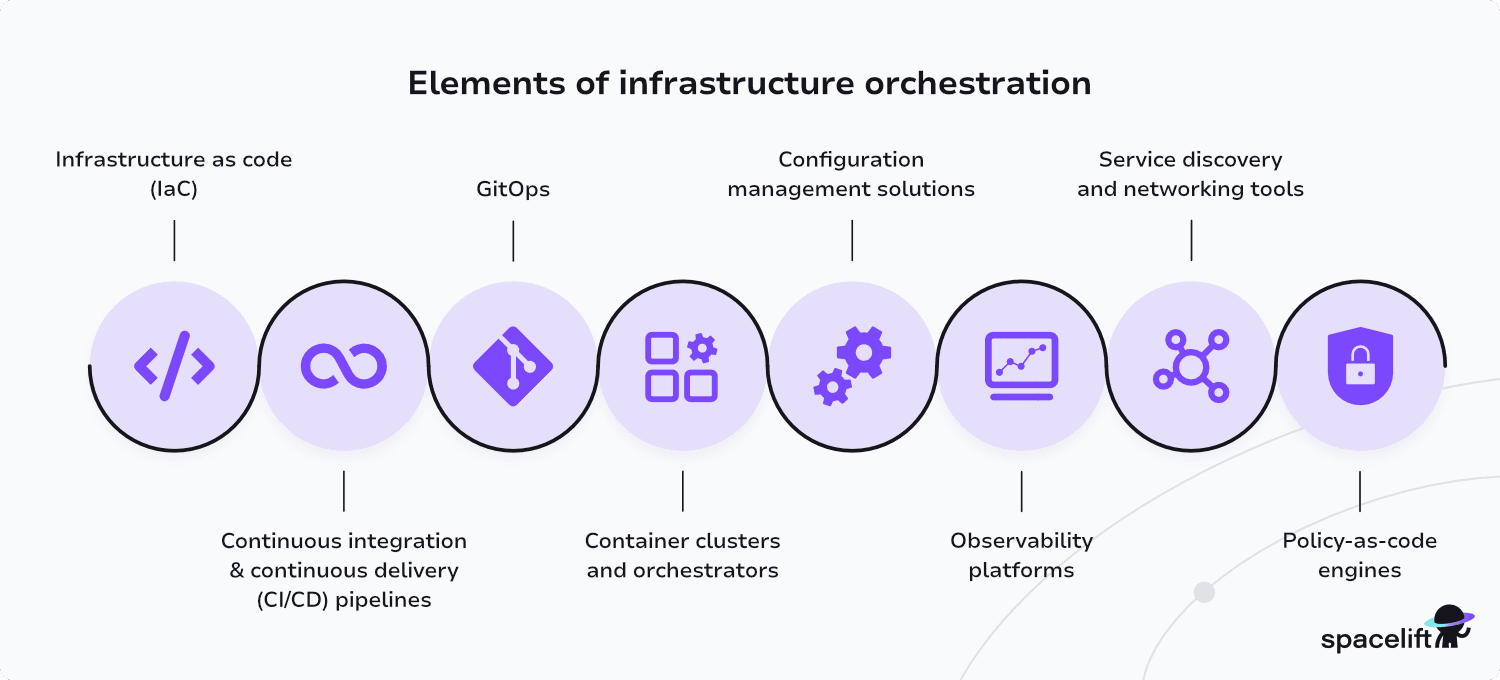
The following components are usually involved:
- Infrastructure as code (IaC): IaC is a core concept in infrastructure orchestration. It uses code to automate provisioning and configuration processes. Orchestrators can then verify that your live resources are correctly configured.
- Continuous integration & continuous delivery (CI/CD) pipelines: Infrastructure orchestration isn’t exactly the same as CI/CD, but the two concepts are closely linked. CI/CD pipelines provide a framework for running automated processes in response to trigger events like pushing or approving IaC changes.
- GitOps: GitOps is the use of versioned files in Git repositories to manage operations. It meshes with IaC and CI/CD, helping form the basis of infrastructure orchestration solutions. With GitOps, your infrastructure’s state automatically updates whenever you change the IaC files in your repository.
- Container clusters and orchestrators: Container orchestrators like Kubernetes apply orchestration concepts to container deployments. They automate the process of creating, administering, and scaling containers. This complements infrastructure orchestration by letting you operate apps and infrastructure using similar principles, with container platforms also helping abstract low-level infrastructure resources.
- Configuration management solutions: Configuration management tools like Ansible automate how new infrastructure components are prepared for use. They handle tasks such as installing software packages, changing settings, or setting up networking rules ready to serve your apps. Orchestrating these tasks ensures they run automatically after your IaC tools provision new resources.
- Observability platforms: Visibility into deployed resources is an essential part of infrastructure orchestration. Without it, it’s easy to lose sight of what’s running in each environment. Using observability tools like Grafana to automatically collate infrastructure metrics, cloud provider insights, and IaC activity gives you a holistic view in one place.
- Service discovery and networking tools: Service meshes like Istio and Linkerd automate how microservices find and communicate with each other. While it sits a layer up from infrastructure, planning service discovery within your orchestration strategy helps remove day-2 tasks from your workflows. It ensures the different parts of your infrastructure can route network traffic efficiently.
- Policy-as-code engines: Policy-as-Code solutions like Open Policy Agent (OPA) automate real-time decision-making processes based on criteria defined in logic-driven code files. They create a framework for reliably enforcing critical security and compliance rules. Protect your infrastructure by embedding policy tests within your orchestrated workflows, such as during CI/CD pipelines or within GitOps processes.
These topics are good starting points for implementing infrastructure orchestration. Together, they allow you to automate, govern, and monitor your cloud environments. But you must invest work to connect each solution so changes can flow smoothly between platforms.
Purpose-built infrastructure orchestrators solve this problem by providing ready-to-use workflows. At Spacelift, our infrastructure automation platform automates your IaC tools, Ansible playbooks, drift detection, and policy enforcement, all in one solution. You can achieve your infrastructure orchestration needs without any manual configuration — just connect your IaC repositories and cloud accounts, then configure policies and enable self-service access.
How to improve your infrastructure orchestration with Spacelift
Spacelift is an infrastructure orchestration platform that helps you provision, configure, and govern infrastructure in a single workflow.
With Spacelift, you can run infrastructure as code (IaC) and configuration workflows at scale, with consistent CI/CD across cloud providers, without turning your platform team into a bottleneck. Because Spacelift supports tools like Terraform, OpenTofu, Ansible, and Pulumi, you can standardize multi-IaC workflows and integrate them into your internal developer portal (IDP). You also get clear visibility into your infrastructure resources, plus the ability to enforce policies and guardrails.
You can use Spacelift as a foundation layer for your IDP by creating stacks for different teams, environments, or workflows. Each stack encapsulates your source code, infrastructure state, and deployment configuration. You can queue, trigger, cancel, and inspect runs in the Spacelift UI—so you can check the health of your infrastructure at a glance.
Use stack dependencies to model complex environments and share outputs between stacks. Other components, like Blueprints, give you more ways to simplify self-service provisioning.
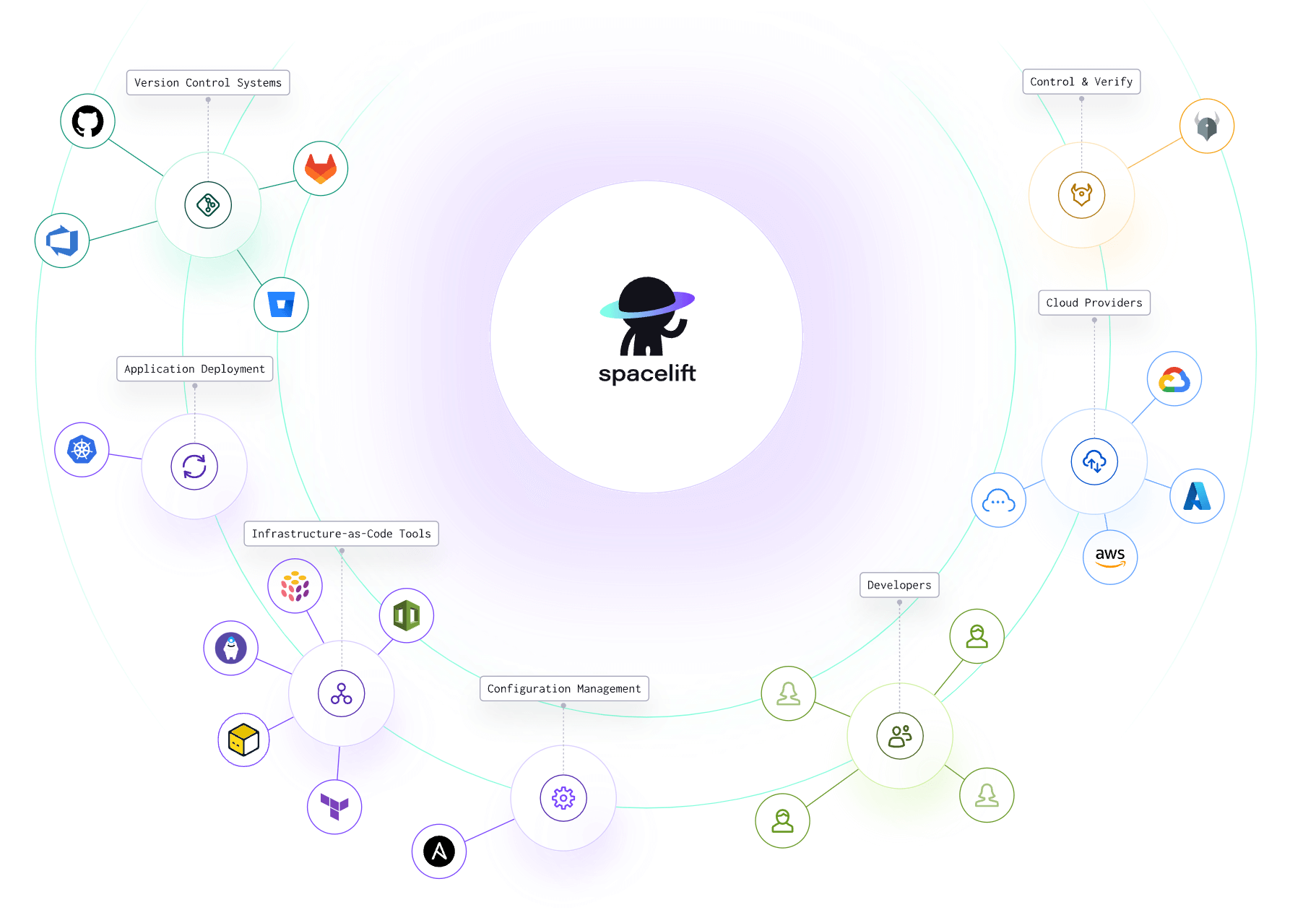
With Spacelift, you get:
- Policies to control which resources engineers can create, which parameters are allowed, how many approvals a run needs, what happens when a pull request is open, and where notifications go
- Stack dependencies to orchestrate multi-step workflows and share outputs between stacks, for example, provisioning EC2 instances with Terraform and configuring them with Ansible
- Self-service infrastructure via Blueprints, so developers can ship application changes faster without sacrificing governance
- “Creature comforts” like contexts (reusable containers for environment variables, files, and hooks), plus support for running arbitrary code
- Drift detection with optional remediation
Best practices for infrastructure orchestration success at scale
The following best practices support infrastructure orchestration success in large-scale environments. Keeping these tips in mind will ensure your orchestration strategy stays dependable and performant as you grow.
1. Leverage IaC to automate and standardize infrastructure provisioning processes
IaC is the keystone of every infrastructure orchestration system. Storing infrastructure configuration as code makes it accessible to automated tools.
Orchestration solutions can invoke your IaC tools to apply changes, detect drift, and quickly roll back any problems. This removes tedious hands-on management while defending against misconfigurations and inconsistencies.
2. Use GitOps to version, test, and audit your IaC templates
IaC needs to mesh with GitOps to make infrastructure orchestration manageable at scale. Storing IaC files in Git repositories enables orchestrators to easily identify new changes. It also means you can revert to older versions if there’s an issue, or audit past changes that have occurred in your environments.
Similarly, you can test your changes using linters and static analysis tools before they’re deployed to your cloud account.
3. Embed observability and security controls in your workflows
Infrastructure orchestration spans the entire infrastructure management lifecycle, so observability and governance controls should be baked in at every stage. Track metrics such as deployment durations, drift frequency, and daily workflow activity to understand how orchestration is affecting business outcomes.
Stay ahead of potential risks by adding security checkpoints using policy-as-code rules, enabling RBAC-based access management, and implementing automated vulnerability scans. These capabilities are commonly found in infrastructure orchestration platforms, letting you enforce that required checks run before changes reach your environments.
4. Implement automated alerts for deployment failures, drift, and real-time anomalies
Enabling automated alerts in your orchestration system keeps you informed of emerging issues. For example, infrastructure management solutions can notify you when new drift is detected, letting you promptly fix the discrepancy before it disrupts your operations.
Because orchestrators have high-level visibility over your infrastructure stack, they can also help correlate insights such as increased resource utilization after a deployment.
5. Enable auto-scaling to align resource allocations with actual demand
Auto-scaling dynamically adjusts infrastructure resource allocations based on live usage. Enabling auto-scaling helps you optimally balance performance and cost effectiveness, making your infrastructure operations more sustainable at scale. Orchestrators can tune auto-scaling parameters to match real-time demand, enabling continual refinement throughout your stack’s life.
6. Create self-service platforms to serve developer needs
Infrastructure orchestration opens new opportunities to simplify developer interactions with infrastructure. By automating end-to-end operational workflows, orchestrators allow team members to self-serve tasks such as launching a new dev environment, then cleaning it up after use.
Publishing these tasks as one-click actions in an internal developer platform (IDP) gives developers a single destination to find and run supported processes.
Key points
Infrastructure orchestration expands the use of automation to span entire end-to-end workflows. It coordinates infrastructure provisioning and maintenance activities, ensuring your resources are always ready to use. This reduces the risk of tasks failing, being forgotten, or running out of order when you’re operating cloud infrastructure at scale.
Ready to implement infrastructure orchestration in your own environments? Check out Spacelift to get started. Our platform lets you provision, configure, and govern your infrastructure all in one solution. Spacelift blends speed and control so you can safely ramp up infrastructure innovation at scale.
Solve your infrastructure challenges
At Spacelift, we understand that you need a platform that not only helps you with infrastructure provisioning, configuring, and governing but also fosters collaboration and increases developer velocity.
Frequently asked questions
What is the difference between IaC and orchestration?
Infrastructure as code (IaC) defines infrastructure resources declaratively, while orchestration coordinates the execution and lifecycle of those resources and services. In practice, IaC focuses on what infrastructure should exist, whereas orchestration focuses on how systems and processes run together. For example, IaC might provision a Kubernetes cluster, while orchestration tools like Kubernetes itself or Ansible manage application deployment, scaling, and coordination within that cluster.
When do you need infrastructure orchestration?
You need infrastructure orchestration when managing multiple interdependent resources at scale requires consistent provisioning, coordination, and lifecycle control. It becomes necessary once manual scripts or single-resource automation can no longer reliably handle ordering, dependencies, and state across environments.
Is infrastructure orchestration only for Kubernetes?
No, infrastructure orchestration is not limited to Kubernetes, although Kubernetes is one of the most visible orchestration platforms today. Orchestration refers to coordinating and managing infrastructure resources, services, and workflows across systems, not just container clusters. In practice, Kubernetes is often one component within a larger orchestration strategy, where infrastructure orchestration provisions the environment and Kubernetes orchestrates the workloads running on top.
How does infrastructure orchestration improve security?
Infrastructure orchestration improves security by enforcing consistent, version-controlled configurations and automated policy checks, which reduces misconfigurations and unauthorized changes. It also strengthens auditability and incident response through repeatable deployments, immutable infrastructure patterns, and centralized logging and access controls.