

IaC and DevOps tools accelerate the software delivery lifecycle by automating tedious tasks that nobody enjoys doing. They let developers remain focused on innovation instead of manually preparing infrastructure and deployments. Not only does this improve throughput, it also simplifies the developer experience.
Yet in practice, introducing new tools often prompts developer pushback. Whether due to perceived complexity, fear of change, or a lack of documentation, it’s easy for toolchain improvements to go unused. In this article, we will unpack why this happens and then share ten best practices for winning buy-in from your team.
Why do teams resist new IaC/DevOps tools?
DevOps is a cultural shift towards shared responsibility, collaboration, and continuous improvement. While these principles form the foundation of every DevOps system, automated tools also play a crucial role.
However, although they provide a framework for successfully implementing DevOps processes, it’s crucial that the underlying culture is already in place. Otherwise, teams may naturally resist these tools, even though they’re intended to make day-to-day processes easier.
Pushback is often caused by uncertainty surrounding why new tools are required or how they should be used. These problems are exacerbated by the introduction of new tools without developer input in the decision-making process.
For instance, IaC tools enable faster and safer infrastructure management, but this may not be immediately apparent to developers and operators who’re simply instructed to use them. Without context, it may seem as though the tools are just adding complexity and preventing direct control.
As we’ll see below, you can solve these issues by aligning tool selection processes with real engineering needs. Collaboratively choosing tools that solve everyday problems increases the likelihood that teams will buy into the project. You should then ensure everyone’s equipped to fully use the new tools, such as by providing clear training and documentation.
Teams resisting new IaC or DevOps tools can also be a sign of an immature DevOps lifecycle. Engineers may be so reliant on their existing processes that new tools simply can’t be introduced successfully.
Technical challenges like this one should be addressed by first refining your wider DevOps strategy, before committing to adopting specific tools.
How to win team buy-in for new DevOps tools
Getting buy-in for new tools can feel like a battle, but it doesn’t have to be. Making small changes can let you reposition your argument and remove adoption friction. This creates more cohesive team environments.
Here are ten best practices for bringing everyone along on the path to modern DevOps tooling.
1. Start with real problems, not trendy tools
Nobody wants change for the sake of it. It’s always easier to win buy-in when your proposal solves real engineering problems, rather than simply following the latest buzz. If you ask developers to change how they work because something’s new or popular, expect skepticism.
Focus on the issues your teams are actually facing. Talk to developers and operators about what currently slows them down, and listen for recurring themes.
Then back those conversations with data. Regularly monitor engineering metrics such as deployment rate, incident frequency, and the time changes spend in each DevOps lifecycle stage. Together, these will show you where the real problems lie — and where new tools could genuinely help.
2. Involve all team members from the earliest stages
Once you’ve identified a problem, start exploring how new tools could address it with the teams who’ll actually use them. Involve developers, operators, and other stakeholders early to ensure their needs and concerns shape the plan from the outset.
Use this phase to gather requirements, preferences, and perceived risks. Open communication here means people can prepare for workflow changes before they occur, rather than having tools suddenly forced on them. When teams feel included in the decision, they’re much more likely to buy in.
3. Allow team members to influence tool selection
After you’ve agreed on what your new IaC or DevOps tools need to achieve, it’s time to choose specific solutions. Compromise will be unavoidable, but it’s important to respect the diverse preferences and experiences of others.
Canvas opinions from across the team and ask why people prefer a given option. Their reasoning can reveal constraints or opportunities you hadn’t considered and may refine your original plan.
For example, some engineers might favor Terraform for its ecosystem, while others may point to their existing Pulumi experience, which could speed up adoption. Hearing and acknowledging these viewpoints keeps people engaged in the process and increases buy-in, even if the final choice isn’t everyone’s first pick.
4. Avoid over-engineering and excess complexity
Teams are reluctant to adopt tools that feel cumbersome or complicated. If a solution adds extra steps, requires intricate configuration, or introduces yet another dashboard to check, you should expect resistance.
Opt for the simplest tool that reliably solves the problem. Focused, stable solutions reduce cognitive load and keep workflows consistent across the DevOps lifecycle. When engineers feel the toolchain is predictable and low-maintenance, they’re far more likely to support it.
By contrast, stacking multiple complex platforms increases context-switching and mental overhead. The more energy people spend working around tools, the less willing they’ll be to embrace new ones.
5. Accelerate tool adoption timelines
Long, drawn-out migrations create uncertainty. Teams end up juggling both old and new systems, which slows delivery and erodes confidence in the change.
Where possible, build a small, rapid proof of concept first. Let teams see the tool in action, using real workflows and real data. This makes the value concrete, reduces doubts, and surfaces problems before they can cause major disruption.
Getting something working quickly, even if it’s limited in scope, reassures developers that the change is real, controlled, and moving forward. That momentum goes a long way toward sustaining buy-in.
6. Proactively eliminate friction from adoption processes
Toolchain pushback often derives from uncertainty: People don’t know how or when to use the new tool, or what constitutes good performance.
Remove that friction upfront. Before rollout, provide clear documentation, short training sessions, and simple configuration examples. Show developers how this fits into their existing workflows, not just how the tool works in theory.
If you proactively answer “How do I start?” and “What does success look like?” you’ll avoid a lot of post-launch confusion and frustration, and make it easier for teams to buy in.
7. Define clear ownership standards for new tools and processes
Developers are wary of changes that might quietly expand their workload. A common source of resistance is not knowing who owns the new tool once it’s in production.
Set clear ownership from the start. Assign named owners or teams, define their responsibilities, and ensure everyone knows who to contact when something breaks or needs an update.
When it’s obvious who’s accountable, developers feel safer adopting the tool. They know they’re not silently taking on another maintenance burden.
8. Celebrate successful adoption & create internal tool advocates
It’s easy to focus on what went wrong with a new tool and forget what’s working. Make a point of highlighting successful adoptions of IaC platforms, CI/CD systems, or observability tools. Show where they’ve reduced incidents, sped up delivery, or simplified workflows.
Identify early adopters who genuinely like the new setup and give them a voice. Ask them to share short demos, tips, or before-and-after stories with their peers. When benefits are explained by colleagues rather than just leadership, teams are more likely to trust the change and support future rollouts.
9. Continually monitor the effects of success
To sustain buy-in, you need proof that the tools are delivering value. Track the impact of changes using concrete metrics, such as deployment frequency, incident rate, or time to recover, and compare results before and after adoption.
If self-service infrastructure or policy as code has improved these numbers, make that visible. Use DevOps metrics to demonstrate ROI and guide your next improvements. Highlight outcomes that matter to individuals, too: developers spending less time fixing pipeline issues, or operators handling fewer late-night incidents.
That’s the kind of evidence that keeps teams on board with future changes.
10. Collect regular feedback, then iterate as required
Winning buy-in isn’t a one-time event. Even after launch, people can lose confidence if the tool causes new bottlenecks or diverges from the original plan.
Protect against this by collecting regular feedback from users, especially early adopters. Look for recurring issues and act quickly to adjust workflows, configs, or documentation. Closing the loop demonstrates that concerns are heard and addressed, even if the rollout feels initially rough.
Keeping teams informed about what’s changing and why helps them stay invested in the process rather than quietly abandoning the new tool.
Planning the rollout for new IaC/DevOps tools
Rolling out a new infrastructure as code or DevOps tool is largely an adoption issue. You should experience the best results when you treat rollout like any other engineering change — define the outcome, reduce risk with a pilot, then scale in repeatable waves.
Start by selecting one concrete use case and a small set of success metrics that you can measure quickly (for example, faster approvals, fewer manual steps, or clearer audit trails). At the same time, lock in the non-negotiables: SSO and roles, least-privilege access, and the basic guardrails you already enforce in reviews, expressed as policy as code where it makes sense.
Next, run a pilot with a team and workload that reflects reality — multiple environments, real dependencies, and enough activity to surface edge cases. Use what you learn to standardize a Golden Path (templates, naming, workflow defaults), then migrate in waves based on shared patterns, such as business unit, cloud account, or repo structure. Keep each wave small enough that you can recover quickly if something breaks.
Finally, support the first few migrations with practical enablement, short how-tos, office hours, and a clear escalation path, and track adoption with a handful of indicators (how much IaC is going through the new workflow, time from PR to apply, drift frequency, and recurring failure modes). Continue iterating until the new workflow becomes the default.
Why should you include Spacelift in your DevOps tech stack?
Spacelift is an infrastructure orchestration platform that increases your infrastructure deployment speed without sacrificing control. With Spacelift, you can provision, configure, and govern with one or more automated workflows that orchestrate Terraform, OpenTofu, Terragrunt,
The platform enhances collaboration among DevOps teams, streamlines workflow management, and enforces governance across all infrastructure deployments. Spacelift’s dashboard provides visibility into the state of your infrastructure, enabling real-time monitoring and decision-making, and it can also detect and remediate drift.
You can leverage your favorite VCS (GitHub/GitLab/Bitbucket/Azure DevOps), and executing multi-IaC workflows is a question of simply implementing dependencies and sharing outputs between your configurations.
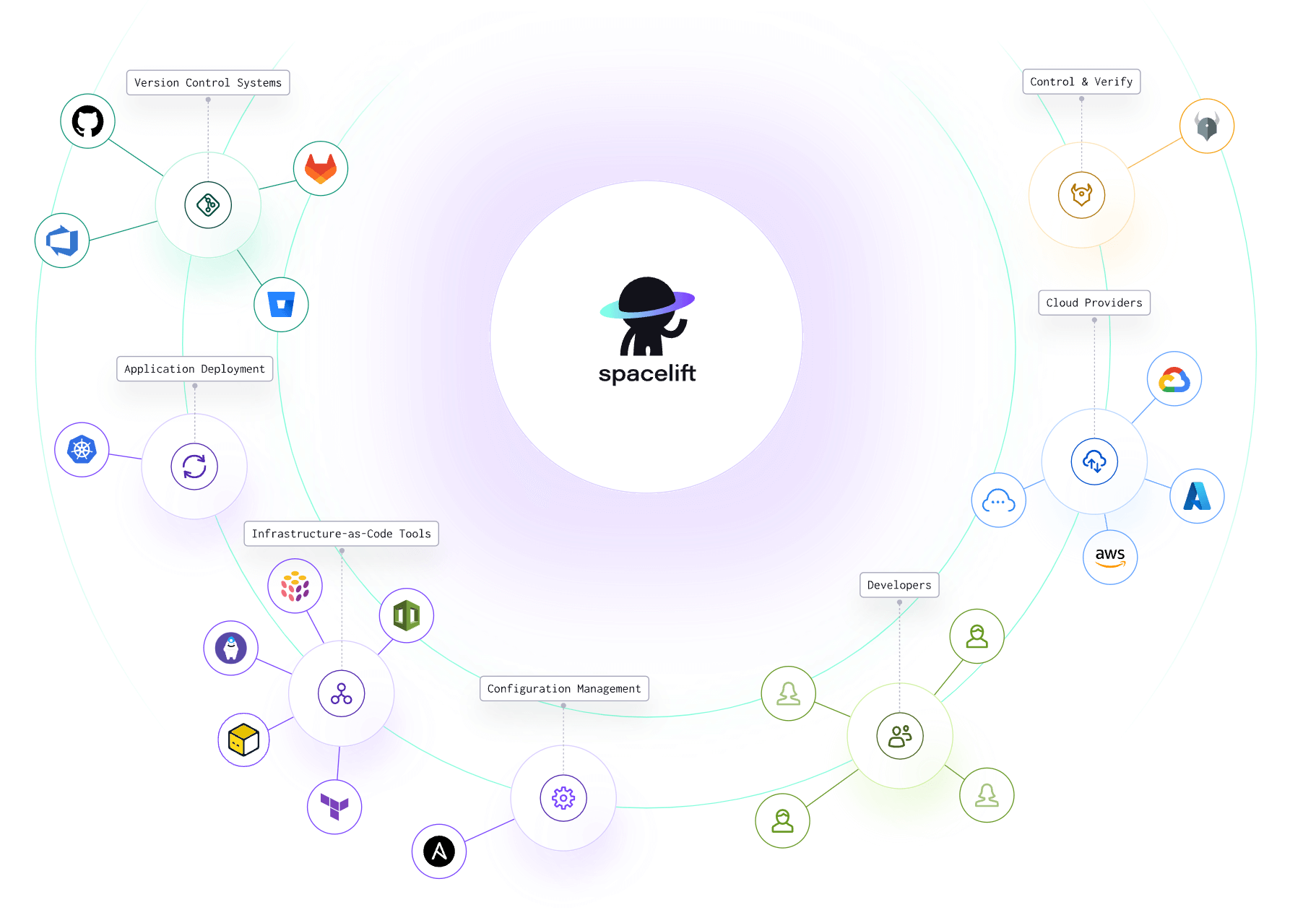
With Spacelift, you get:
- Policies to control what kind of resources engineers can create, what parameters they can have, how many approvals you need for a run, what kind of task you execute, what happens when a pull request is open, and where to send your notifications
- Stack dependencies to build multi-infrastructure automation workflows with dependencies, having the ability to build a workflow that, for example, generates your EC2 instances using Terraform and combines it with Ansible to configure them
- Self-service infrastructure via Blueprints, enabling your developers to do what matters – developing application code while not sacrificing control
- Creature comforts such as contexts (reusable containers for your environment variables, files, and hooks), and the ability to run arbitrary code
- Drift detection and optional remediation
Do you plan to implement DevOps in your organization? Or maybe you are seeking ways to improve your processes? Book a demo with our engineering team to discuss your options in more detail.
Key points
Securing team buy-in for DevOps toolchain changes can be challenging. It can be frustrating to see new tools go unused, but it’s important to understand why developers are hesitant to adopt them. The real reason is often a simple one, such as missing documentation or uncertainty about why the solution is required.
The strategies discussed above will help you win buy-in without forcing tools upon team members. Remember that adoption will be most successful when there’s genuine collaboration, iterative improvement, and a sense of shared investment in the tools you choose. The newest, most popular, or most advanced solution won’t necessarily be the right one for your team.
Solve your infrastructure challenges
Spacelift is a flexible orchestration solution for IaC development. It delivers enhanced collaboration, automation, and controls to simplify and accelerate the provisioning of cloud-based infrastructures.
Frequently asked questions
Why do engineers resist new IaC or DevOps tools?
Engineers resist new IaC or DevOps tools due to workflow disruption, steep learning curves, and unclear ROI. Tool fatigue and overlap with existing solutions add friction, especially if integration is complex or long-term support is uncertain. Even better tools face pushback without clear benefits.
Should we replace all our existing DevOps tools at once?
No, replacing all existing DevOps tools at once is risky and rarely recommended. It disrupts workflows, increases migration complexity, and often leads to integration failures or team resistance.
A phased approach is more stable: prioritize tools with clear pain points or poor ROI, then incrementally adopt replacements. This enables validation at each stage, facilitates smoother onboarding, and allows for rollback if needed. Retaining tools that still meet current needs also avoids unnecessary overhead.
How to measure the success of new DevOps tooling?
The success of new DevOps tooling is measured by its impact on delivery speed, system reliability, and team efficiency. Key metrics include:
- Deployment frequency: A higher frequency indicates improved automation and confidence.
- Lead time for changes: Shorter lead times show streamlined pipelines.
- Change failure rate: A lower rate signals more stable deployments.
- Mean time to recovery (MTTR): Faster recovery reflects better observability and rollback capabilities.