
Immutable infrastructure is infrastructure that can’t be changed after it’s created. It adjusts infrastructure management so that deployments replace components, rather than modifying them in place. The practice defends against infrastructure inconsistencies, making your environments more reproducible.
In this guide, we will examine immutable infrastructure and its benefits. We’ll also discuss the risks and tradeoffs involved, then share tips for building your own immutable infrastructure architecture. Let’s begin by examining what immutable infrastructure really means.
What is immutable infrastructure?
Immutable things cannot be changed. In technical terms, they’re read-only. Therefore, immutable infrastructure describes resources such as compute nodes, load balancers, storage volumes, and security policies that can’t be modified after they’re created. Immutability also extends to the components that run your app, such as using a new read-only container to operate each release.
Mutable vs immutable infrastructure
Most traditional infrastructure is mutable: Servers can be freely reconfigured with new software packages, patches, and configuration changes, for example.
But in an immutable environment, none of these operations is permitted. To apply changes, you must create new resources with the updated configuration, then remove the old components.
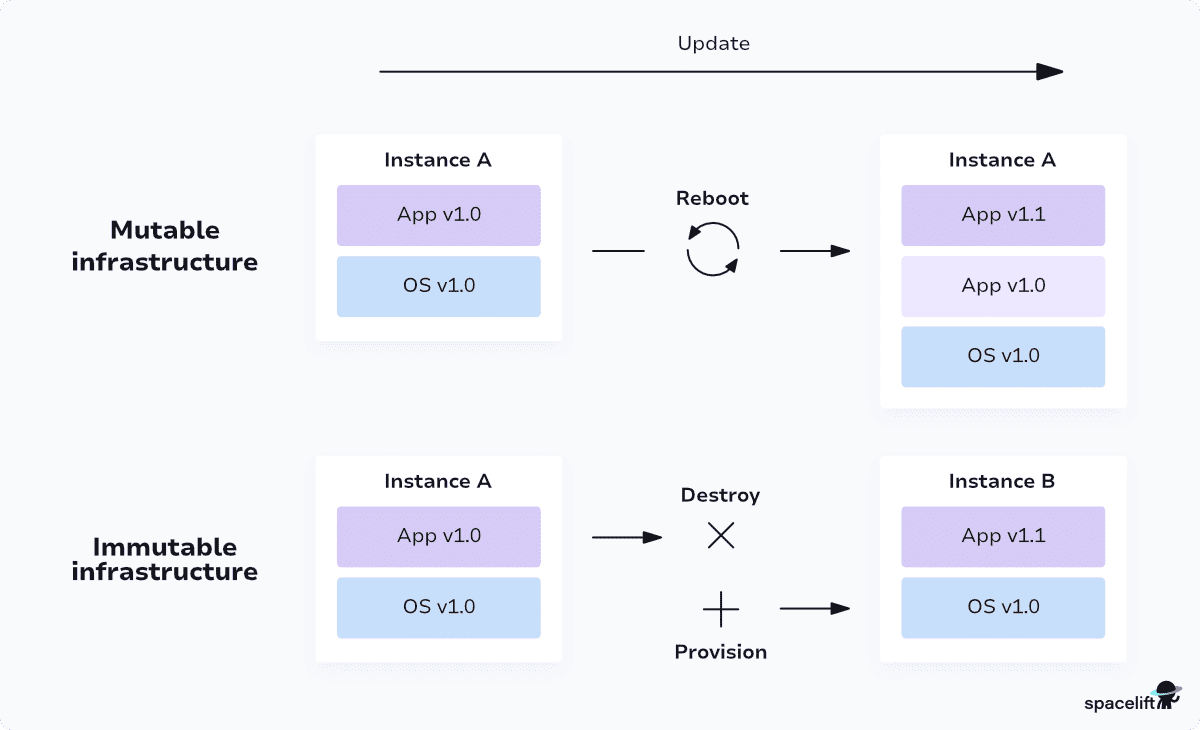
The process of recreating resources offers several advantages compared with mutating long-lived ones. For instance, having new deployments replace existing components, rather than modifying them in place, allows the new and old environments to briefly coexist. This enables advanced rollout strategies, such as canary and blue-green releases.
Immutability also simplifies how operators audit infrastructure for misconfigurations. Unlike in mutable environments, immutable components can’t drift from their expected state. This prevents common errors from occurring.
For example, whereas mutable infrastructure could let admins accidentally disable live security policies, this isn’t possible when the resources are immutable. As a result, there are fewer risks to audit.
Understanding immutable infrastructure benefits
The benefits of immutable infrastructure are most obvious at scale. Here, environments can contain thousands of resources. Without proper management, their configurations can easily drift from each other. This causes errors, inconsistencies, and security breaches.
Immutable infrastructure neatly prevents this problem. It turns deployments into distinct actions that apply atomically. Infrastructure doesn’t have to be in a specific state before it’s updated: New releases simply provision a new set of resources, based on the current expected state.
The primary benefits of immutable infrastructure are reliability, consistency, and reproducibility, but it offers many other advantages. Here’s a summary of the main ways in which the strategy delivers stronger DevOps processes.
1. No drift
No configuration drift means safer operations.
Because immutable resources can’t change post-creation, they’re protected from the silent drift that affects mutable environments. Any changes must be made via specific, auditable actions that record a new version history. This improves safety and accountability throughout the DevOps lifecycle.
2. Standardized operational processes
Immutable infrastructure facilitates the standardization of management processes. Instead of manually updating resources, immutable workflows normally rely on automated CI/CD-driven tooling to create replacement deployments. Passing all changes through this pipeline prevents inconsistencies caused by human error and tooling conflicts.
3. Easier debugging
Restricting the ways in which infrastructure can change reduces the number of factors that need to be checked when incidents occur. You are already familiar with the states of the resources in your environment, so you can instantly rule out problems such as drift and transient misconfigurations.
Because immutable infrastructure is reproducible, you can also easily start fresh environments for debugging purposes. For instance, you could use your IaC configs to bring up a new staging deployment, or try running a faulty container image on your own workstation.
4. Tighter security protections
Immutability has security benefits too. Preventing environments from changing means there are fewer ways for malware to enter them. Enforcing immutability at the filesystem level, such as by using read-only container images, stops new malware from arriving and may restrict what embedded payloads can achieve.
Even if a resource is compromised, it’ll be replaced after your next deployment. This helps contain the effects of breaches and effectively lowers security risks.
5. Ensures a clear rollback path
Immutable infrastructure closely complements GitOps-powered change management processes.
The same workflows you use to apply new infrastructure changes also let you restore older versions. You just need to revert the Git commit in your repository, then run your deployment pipeline: your infrastructure resources will then be replaced with new instances running the old configuration. This improves resilience during complex incidents, such as when multiple changes must be reverted to restore an earlier state.
6. Fewer maintenance overheads
Limiting what can change, as well as how changes occur, means fewer overheads to manage in your infrastructure processes. You can stay focused on solving operational requirements, instead of managing deployments and checking for drift.
Immutability keeps you in control, allowing you to reliably enforce compliance requirements even in large-scale environments.
Immutable infrastructure: Risks and trade-offs
Switching to immutable infrastructure comes with risk. It represents a significant architectural shift with implications for application design, operating processes, and broader DevOps workflows.
Key immutable infrastructure issues and trade-offs include:
- Imposing cultural changes on developers and operators: Immutability requires DevOps teams to accept that they can no longer directly change infrastructure resources. This demands new workflows and a cultural shift.
- Depending on a dedicated toolchain: Immutable infrastructure depends on the use of cloud services, IaC tools, and containerization platforms that let you enforce the no-changes paradigm. Adopting these solutions can require significant upfront work.
- Adding complexity to persistent storage requirements: Immutability can complicate the management of persistent storage. Apps that need to write to a server’s local disk need refactoring to work in immutable environments. It’s best practice to treat storage as a separate resource, provisioned as dedicated external volumes.
- Introducing new debugging challenges: Immutability can add roadblocks to debugging processes. Because you can’t modify your environments, it’s not possible to temporarily change configurations or install extra debugging tools in live environments. It’s vital to enable debugging output within your infrastructure configs, include critical tools in your images, and instrument your environments so they can be monitored using external observability platforms.
- Potential impact on deployment times: Immutable architectures can increase CI/CD build and deployment times. Instead of applying config changes and code releases to existing servers, you need to provision replacement infrastructure resources and build new deployment artifacts such as container images. This may limit your maximum deployment frequency.
- Affecting storage and network bandwidth use: Similarly, immutable components may increase storage and network utilization. New compute nodes may need to fetch network resources after they start, for instance, and preparing new images for each release also creates additional network transfers. This bandwidth usage can stack up at scale.
You should plan how you’ll address these drawbacks as you design your immutable infrastructure layout. Immutability is not suitable for every scenario, so try to balance the benefits against your own operational needs.
While immutability is often a good fit for new cloud-based systems at scale, it can be less appropriate for smaller teams that’d prefer to avoid the upfront complexity. Implementing immutable infrastructure for legacy applications and environments can also be challenging.
How to implement immutable infrastructure?
Immutable infrastructure has unique implementation requirements. Operating an immutable architecture is normally only viable when you have a fully automated infrastructure deployment pipeline.
It also usually requires the use of cloud computing services and virtualized environments, although immutable operating systems like Talos can be used to assemble immutable systems on-premises.
Key components in immutable infrastructure workflows include:
- Infrastructure as code (IaC): IaC tools such as Terraform, OpenTofu and Pulumi let you express the desired state of your infrastructure in code files. They allow you to version changes and reproduce them in different environments. Changing the identifiers given to resources in your configs will cause old immutable resources to be replaced with new ones when you run your IaC tool.
- Continuous Integration & Continuous Delivery pipelines (CI/CD): CI/CD solutions such as GitHub Actions and Jenkins provide a framework for automating the process of applying changes to your infrastructure. Running your IaC tools within a CI/CD pipeline enables you to standardize deployment processes, enforce compliance tests, and remove risky developer interactions with infrastructure resources.
- GitOps solutions: GitOps is the practice of automating infrastructure provisioning and configuration tasks based on the states of files in a Git repository. GitOps tools combine IaC and CI/CD to continually update your infrastructure as you change the IaC files in your repository. It keeps your immutable infrastructure resources synced with the state described in your repository.
- External storage volumes and databases: Complete immutability depends on filesystems being fixed in a read-only state. To achieve this, stateful apps must be capable of writing persistent data to external storage volumes. You can then provision your volumes as independent cloud infrastructure resources.
- Container tools and orchestrators: The use of container tools such as Kubernetes and OpenShift can simplify the implementation of fully immutable architectures. Containers are a good fit for immutability because they’re inherently isolated, reproducible, and composed from thin filesystem layers. They let you precisely control filesystem content and reliably start new deployments from a clean state.
Implementing immutable infrastructure requires all these components to work together. By configuring infrastructure as code, versioning changes, and automating deployments, you can transition from updating resources to replacing them with new deployments.
However, you must also separate your applications, infrastructure components, and datastores into microservices that keep persistent data separate from the immutable parts of your environment.
Best practices for implementing immutable infrastructure
Here are a few final best practices to consider as you build immutable infrastructure:
- Version every change: Versioning each of your infrastructure deployments using a Git workflow enables you to easily roll back to previous releases. The ability to see how your infrastructure has changed over time can also help you reproduce problems that were only observed in specific deployments.
- Test your rollback process: Regularly testing your rollback process ensures that you can effectively deal with real incidents. Try reverting to a previous commit, then verify that your deployment pipeline has replaced your infrastructure components so they match the older state.
- Separate data from infrastructure components and apps: Data generated by your apps is mutable, so it must be separated from your underlying infrastructure. Use external storage volumes and database services to store persistent data.
- Plan for debugging needs: Immutable infrastructure prevents you from modifying infrastructure configs and installing debugging tools on the fly. It’s crucial to plan how you’ll mitigate this risk so you can efficiently respond to incidents. For instance, you may choose to collect more log data by default.
- Enforce robust governance policies: Modelling infrastructure as short-lived, immutable resources creates new risks. Anyone with access to your IaC repositories or CI/CD pipelines could silently replace components without necessarily raising suspicion. Use role-based access control (RBAC), policy as code, and regular infrastructure audits to prevent and detect potential breaches.
Keeping these tips in mind will help you achieve success with immutable infrastructure.
How to solve your infrastructure challenges with Spacelift
Spacelift is an IaC orchestration platform that uses GitOps to automate CI/CD for your infrastructure components. It supports OpenTofu, Terraform, Terragrunt, CloudFormation, Pulumi, Kubernetes, and Ansible.
The power of Spacelift lies in its fully automated hands-on approach. Once you’ve created a Spacelift stack for your project, changes to the IaC files in your repository will automatically be applied to your infrastructure.
Spacelift’s pull request integrations keep everyone informed of what will change by displaying which resources will be affected by new merges. Spacelift also allows you to enforce policies and automated compliance checks that prevent dangerous oversights from occurring.
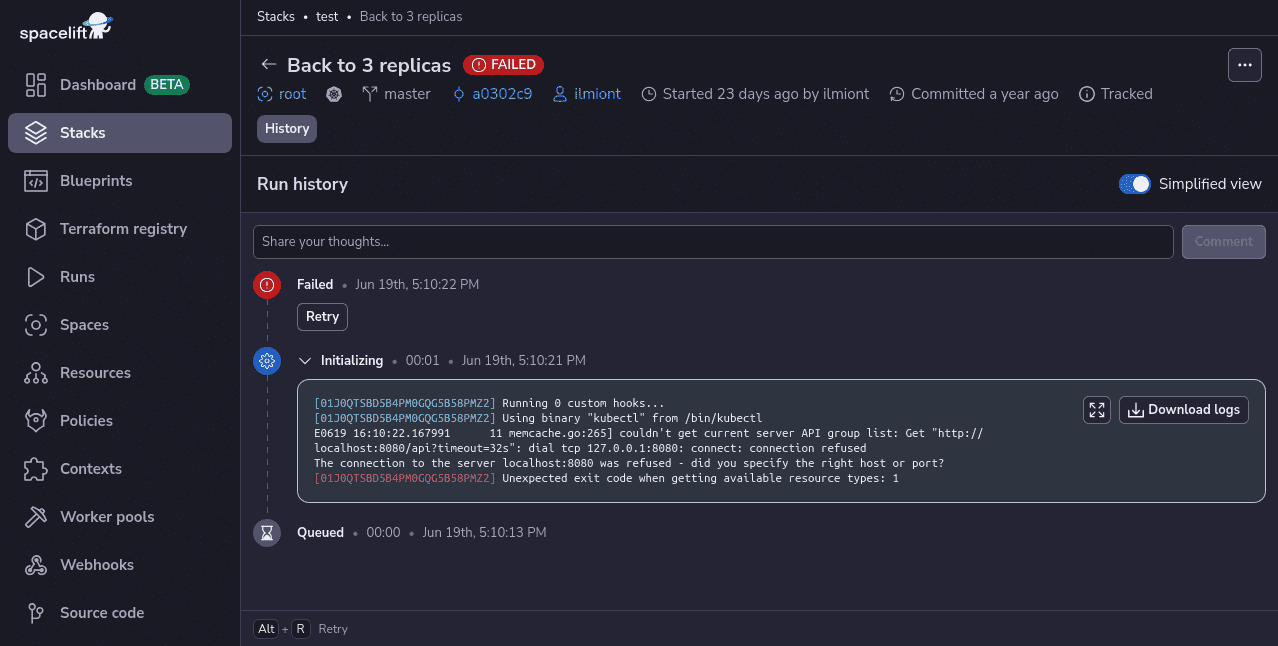
Spacelift includes drift detection capabilities that periodically check your infrastructure for discrepancies compared to your repository’s state. It can then launch reconciliation jobs to restore the correct state, ensuring your infrastructure operates predictably and reliably.
With Spacelift, you get:
- Policies to control what kind of resources engineers can create, what parameters they can have, how many approvals you need for a run, what kind of task you execute, what happens when a pull request is open, and where to send your notifications
- Stack dependencies to build multi-infrastructure automation workflows with dependencies, having the ability to build a workflow that, for example, generates your EC2 instances using Terraform and combines it with Ansible to configure them
- Self-service infrastructure via Blueprints enabling your developers to do what matters – developing application code while not sacrificing control
- Creature comforts such as contexts (reusable containers for your environment variables, files, and hooks), and the ability to run arbitrary code
- Drift detection and optional remediation
If you want to learn more about what you can do with Spacelift, check out this article.
Key points
Immutable infrastructure protects environments by preventing resources from being modified in-place. It keeps your infrastructure reproducible, consistent, and secure at scale. Adopting an immutable architecture helps eliminate drift and reduce infrastructure management overheads, but it can be difficult to implement in existing systems.
Robust automated tools, including IaC, CI/CD, and GitOps platforms, provide a starting point for building immutable infrastructure workflows. These solutions let you configure your expected infrastructure states, then update your cloud accounts when resources change. You also need strong policy-driven governance controls to prevent accidental deployments that could replace essential components.
Ready to adopt immutable infrastructure? Explore Spacelift to automate your infrastructure provisioning, configuration, and governance processes on a single platform. Our solution enables you to visualize your immutable components, enforce policies, and see which resources will be replaced during new deployments. Get started with a free trial or book a demo with our engineering team today.
Solve your infrastructure challenges
Spacelift is a flexible orchestration solution for IaC development. It delivers enhanced collaboration, automation, and controls to simplify and accelerate the provisioning of cloud-based infrastructures.
Frequently asked questions
What does immutable mean in simple terms?
In simple terms, immutable means something that cannot be changed after it’s created. In the context of immutable infrastructure, it refers to servers or components that are never modified after they’re deployed. If something needs to be updated or fixed, a new version is built and deployed instead of changing the existing one.
What tools and practices support immutable infrastructure?
Immutable infrastructure is supported by tools and practices that replace rather than modify existing systems. Key tools include:
- Terraform/OpenTofu: Provisions infrastructure declaratively, allowing full resource replacement during changes.
- Packer: Builds preconfigured machine images, ensuring consistent, versioned base environments.
- Docker: Encapsulates applications and dependencies into immutable containers.
- Kubernetes: Manages container lifecycles using declarative configs, enabling predictable, stateless deployments.
- Spacelift: Automates IaC workflows with policy-as-code and CI/CD integration, making it easier to manage immutable infrastructure at scale using GitOps.
- CI/CD pipelines: Trigger full redeployments on change, avoiding in-place updates.
- Blue-green or canary deployments: Replace environments or services without downtime, ensuring rollback safety.
What are the challenges of adopting immutable infrastructure?
Immutable infrastructure limits post-deployment changes, requiring full redeployments for updates or fixes, which can slow response times and demand robust CI/CD automation. It also increases complexity in debugging, logging, and integrating with legacy systems that rely on mutable configurations.
Is immutable infrastructure only for containers and Kubernetes?
No, immutable infrastructure is not limited to containers or Kubernetes. While containers naturally align with the model, the concept also applies to VMs, cloud instances, and even serverless deployments. Any infrastructure that is rebuilt and replaced rather than modified in place qualifies.
How to implement immutable infrastructure with Terraform?
Immutable infrastructure ensures consistency and reduces configuration drift by treating infrastructure as disposable. In Terraform, this is achieved by structuring configurations and lifecycle policies to favor resource replacement:
- Use create_before_destroy in the lifecycle block to ensure new resources are provisioned before old ones are removed.
- Avoid using in-place mutable operations, such as manual changes to state or unmanaged scripts that modify resources post-deployment.
- Version control your .tf files and plan changes through terraform plan to clearly see replacements.
- For complex systems, modularize infrastructure to allow safe, isolated updates and rollbacks without affecting unrelated components.