Enterprise cloud security (ECS) is how large organizations protect their data, workloads, and cloud infrastructure from misconfigurations, insider threats, compliance failures, and external attacks. Unlike traditional perimeter security, ECS is built around the assumption that infrastructure is dynamic, distributed, and shared.
Migrating to the cloud expands your attack surface in ways that legacy security tools are not designed to handle. Identity and access sprawl, misconfigured storage buckets, unmonitored API calls, and gaps between DevOps speed and security review cycles are among the most common sources of enterprise cloud breaches.
This article covers the core components of an enterprise cloud security strategy: the key threats you need to defend against, the common challenges organizations face at scale, and the best practices for building a dependable security posture across your cloud environment.
What we’ll cover:
What is enterprise cloud security?
Enterprise cloud security is the collection of policies, technologies, and controls used to protect cloud-based infrastructure, applications, and data within large organizations operating across public, private, hybrid, or multi-cloud environments.
Unlike perimeter-based models, ECS assumes threats can originate inside and outside the organization. Every access request must be verified, every workload monitored, and every configuration checked continuously rather than at a point in time.
A mature ECS program combines IAM, encryption, network segmentation, workload protection, and compliance monitoring. It also embeds security into CI/CD pipelines through shift-left practices, catching misconfigurations and vulnerabilities before they reach production.
Core enterprise cloud security requirements
Enterprise cloud security differs significantly from the regular cybersecurity processes that protect on-premises environments.
Whereas on-premises architectures are generally static, cloud environments are dynamic and often filled with short-lived ephemeral components. DevOps teams use automated pipelines and APIs to rapidly provision new infrastructure on demand.
Cloud environments can also span multiple providers and services. This expands the threat perimeter, creating entirely new security and compliance challenges. ECS addresses these problems by deeply embedding security controls throughout enterprise cloud workflows, using defense-in-depth principles.
The essential roles of ECS systems include:
- Preventing data breaches by enforcing correct encryption, access control, and secure configuration policies.
- Providing visibility into new threats and anomalous activity across infrastructure, workloads, and cloud providers.
- Guarding against misconfigurations to protect your cloud environment’s integrity.
- Maintainability environment availability by flagging potential security incidents in real-time.
- Enforcing access controls using the principle of least privilege.
- Preventing shadow IT risks by monitoring for and blocking unapproved dynamic infrastructure deployments.
- Ensuring effective cloud governance to enable the enterprise to use cloud environments efficiently while meeting applicable regulations, such as GDPR and SOC 2.
Different cloud operating models affect security needs in different ways. Public, private, hybrid, multi-cloud, and Platform-as-a-Service models each carry unique security considerations.
With public cloud operations, enterprises benefit from the shared responsibility model: the provider secures the underlying infrastructure, while the enterprise is responsible for workloads and data. Private models make the enterprise responsible for more aspects of security, but also provide more opportunities to enforce custom security controls.
Where do enterprise cloud security threats come from?
The scale, complexity, and distributed nature of enterprise cloud environments mean security threats originate from a wide range of sources – not all of them always immediately obvious.
Key threats include:
- Misconfigurations, such as object storage buckets that are inadvertently made public.
- Data leaks arising from unintentionally exposed services or missing encryption.
- Human error during infrastructure provisioning and configuration operations, or when operators lack awareness of cloud security best practices.
- Oversights caused by poor visibility, particularly in large-scale environments where several cloud providers and infrastructure platforms are used.
- Incorrect access controls that lead to overly permissive roles or that allow unchecked privilege escalation.
- Complex infrastructure architectures that make it difficult to identify, investigate, and resolve vulnerabilities due to interconnected dependencies between services.
- Social engineering and operator account hijacking, where outsiders end up acquiring direct access to cloud infrastructure resources.
ECS strategies must be designed to provide proactive protection and continuous risk mitigation across all of these threat vectors.
Key components of enterprise cloud security
Successful enterprise cloud security systems use multilayered controls to achieve complete protection. The layers work together to secure your cloud asset inventory across different verticals.
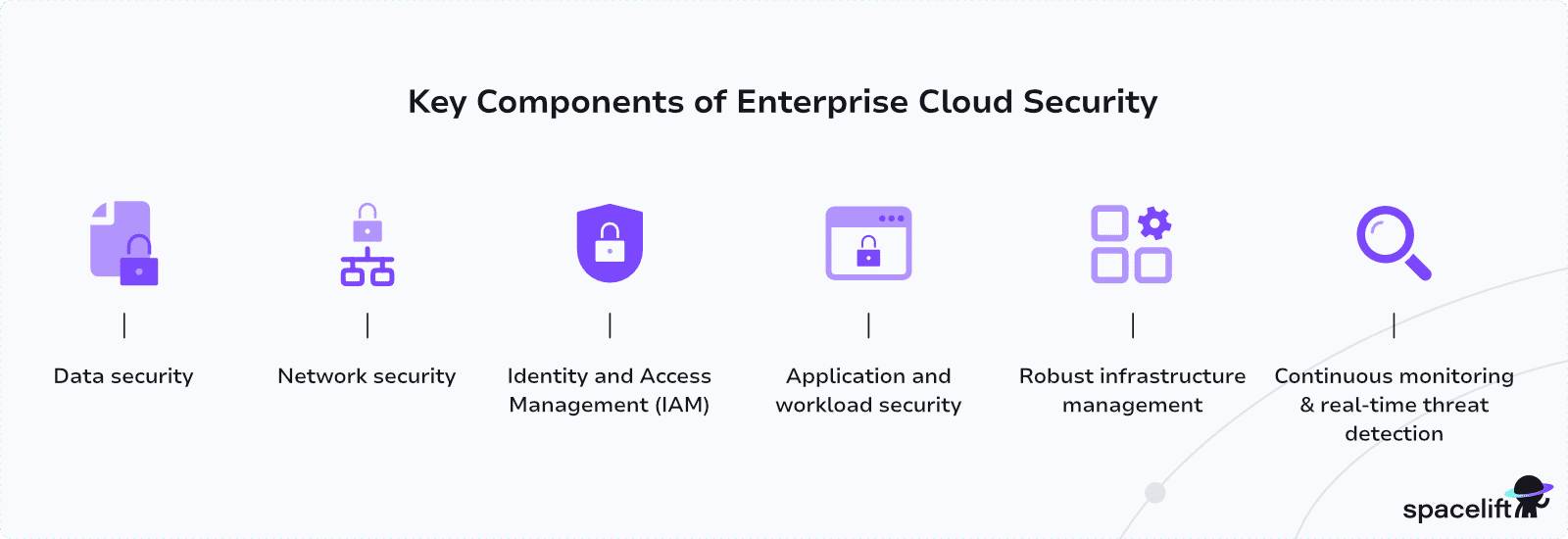
Let’s look at six key components to include in your ECS strategy.
1. Data security
Cloud data security requirements focus on the consistent use of encryption, both when data is at rest and in transit. Data security also depends on correct access controls being enforced so that only authorized users can interact with data.
Similarly, accurate classification systems must be used so that sensitive data can be correctly triaged.
Use cloud data management controls, secure databases, and centralized encryption key management solutions to safeguard the intellectual property and customer data you store in the cloud.
2. Network security
Enterprise cloud systems can have thousands of distinct network endpoints, each communicating with each other to provide services. Layered network security controls are essential to govern these communication flows.
Key controls include load balancers, firewall rules, routing policies, and private endpoints. These mechanisms maintain network quality of service and keep unrelated services isolated from each other.
Use service meshes and software-defined networking systems to implement a secure enterprise network architecture. Service meshes enable granular traffic management to prevent unauthorized access, limit exposure, and defend against lateral movement in the event of a breach.
3. Identity and Access Management (IAM)
Identity and Access Management (IAM) systems govern authentication and authorization policies. They control user access to enterprise cloud resources through role-based access control (RBAC) policies, multi-factor authentication (MFA), and security credentials such as API tokens and keys.
IAM also covers the identity providers you use to log in to cloud services, such as external OAuth providers. Centralizing identity management around a single provider simplifies management, reduces duplication, and improves accountability at scale.
4. Application and workload security
Securing enterprise cloud environments requires following security best practices at every stage of the DevOps lifecycle. Use secure coding practices, automated vulnerability scans, and supply chain security tools to protect against security threats in the cloud-native workloads you deploy. These solutions let you confidently deploy your containers, serverless functions, and build artifacts to your cloud environments.
5. Robust infrastructure management
Adoption of Infrastructure as Code (IaC)-driven automated infrastructure management systems improves enterprise security by ensuring cloud infrastructure assets are configured consistently.
You can scan for errors before you deploy, use guardrails to prevent misconfigurations, and enforce standardization of security settings across all the cloud environments you operate. It reduces the risk of human error and the omnipresent unplanned configuration drift in large enterprises.
6. Continuous monitoring and real-time threat detection
Gaining real-time visibility into your cloud landscape lets you respond to new threats as they appear. Cloud Security Posture Management (CSPM) solutions and Cloud-Native Application Protection Platforms (CNAPPs) provide automated alerting, centralized logging, and continuous analysis of anomalous activity.
Using CSPM and CNAPP tools provides clear oversight of the threats facing your enterprise. They give you the data to efficiently triage problems and plan rapid responses, before a vulnerability turns into an actual breach.
Best practices for enterprise cloud security at scale
Enterprise cloud security requires more than just automated tools. It also depends on processes being designed around security requirements from day one, throughout the entire enterprise.
While not an exhaustive list, the following five best practices will help you solve ECS challenges at scale by combining technological, human, and organizational factors.
1. Implement a zero-trust security model
Zero-trust security is a crucial part of ECS. It’s the process of shifting security to a position of no implicit trust, meaning all requests must be individually authorized and validated before they’re accepted.
Whereas legacy systems may automatically trust requests based on their origin, network location, or the identity of the user who makes them, zero-trust treats every change as suspicious until proven otherwise. It uses multi-layered access controls and IAM policies to restrict lateral movement, reducing the blast radius of security incidents.
2. Standardize infrastructure deployment processes with IaC & CI/CD
Provisioning infrastructure via IaC tools and continuous integration and delivery (CI/CD) pipelines helps ensure resources are configured consistently. You can embed security checks and vulnerability scans into your provisioning pipelines, reducing the risk of misconfigured environments.
IaC also improves standardization, repeatability, and accountability, letting you stay ahead of security needs in even the largest of enterprises.
3. Automate security and compliance checks using policy-driven guardrails
At enterprise scale, you can’t afford to rely on manual security checks. Policy-as-Code tools provide an automated framework for centrally defining security rules, then continuously enforcing them throughout the DevOps lifecycle.
Integrating policy engines and IaC static analysis solutions like Open Policy Agent (OPA), HashiCorp Sentinel, and Checkov into CI/CD pipelines lets you prevent non-compliant configurations from ever being deployed. This mitigates entire classes of security threats, such as those posed by misconfigured workloads and insider risks.
4. Regularly audit and test security controls
Regularly auditing and testing your security controls helps you identify gaps before they cause incidents. Combining automated monitoring tools, periodic manual checks, and active penetration tests lets you fully assess the state of your security landscape in practice, not just in theory.
Tests and audits also help you demonstrate compliance with applicable regulatory requirements, such as GDPR, CCPA, HIPAA, and PCI DSS.
5. Fully assess how new technologies affect security before you adopt
New technologies have the potential to transform development workflows, but they can also introduce novel risks that derail enterprise-level security. Whether it’s AI, a new cloud platform, or the next big thing, ensure you always conduct a thorough security evaluation before you start using new tools.
Aim to target risk assessments so they provide data that highlights potential hotspots where you need additional security protection. Look out for risks such as unique user access patterns, new integrations with existing systems, and potential data exposures.
As part of this work, it’s worthwhile setting standardized evaluation criteria that can consistently guide your tool selection process.
How to improve enterprise cloud security with Spacelift
A platform like Spacelift can help your organization manage cloud infrastructure more efficiently.
Spacelift is the infrastructure orchestration platform built for the AI-accelerated software era. It manages the full lifecycle for both traditional infrastructure as code and AI-provisioned infrastructure, supporting tools like OpenTofu, Terraform, Ansible, Pulumi, Kubernetes, and CloudFormation.
Security is one of Spacelift’s top priorities, with features such as policy as code, encryption, Single Sign-On (SSO), MFA, and private worker pools built into the product. Spacelift is SOC 2 Type II audited and provides compliance and security artifacts, including GDPR resources and its DPA, through the Spacelift Trust Center.
It is also the first IaC orchestration platform to receive FedRAMP authorization, delivering flexible, policy-driven automation to federal agencies and contractors seeking secure, compliant infrastructure workflows.
The power of Spacelift lies in its fully automated approach. Once you’ve created a Spacelift stack for your project, changes to the infrastructure as code files in your repository are automatically applied to your infrastructure.
For non-critical workloads like tests, POCs, and demos, Spacelift Intelligence adds an AI-powered layer that enables natural language provisioning, diagnostics, and operational insight, so developers can request infrastructure without writing configuration code while platform teams retain full governance and visibility.
Spacelift’s pull request integrations keep everyone informed of what will change by displaying which resources are going to be affected by new merges. Spacelift also allows you to enforce policies and automated compliance checks that prevent dangerous oversights from occurring.
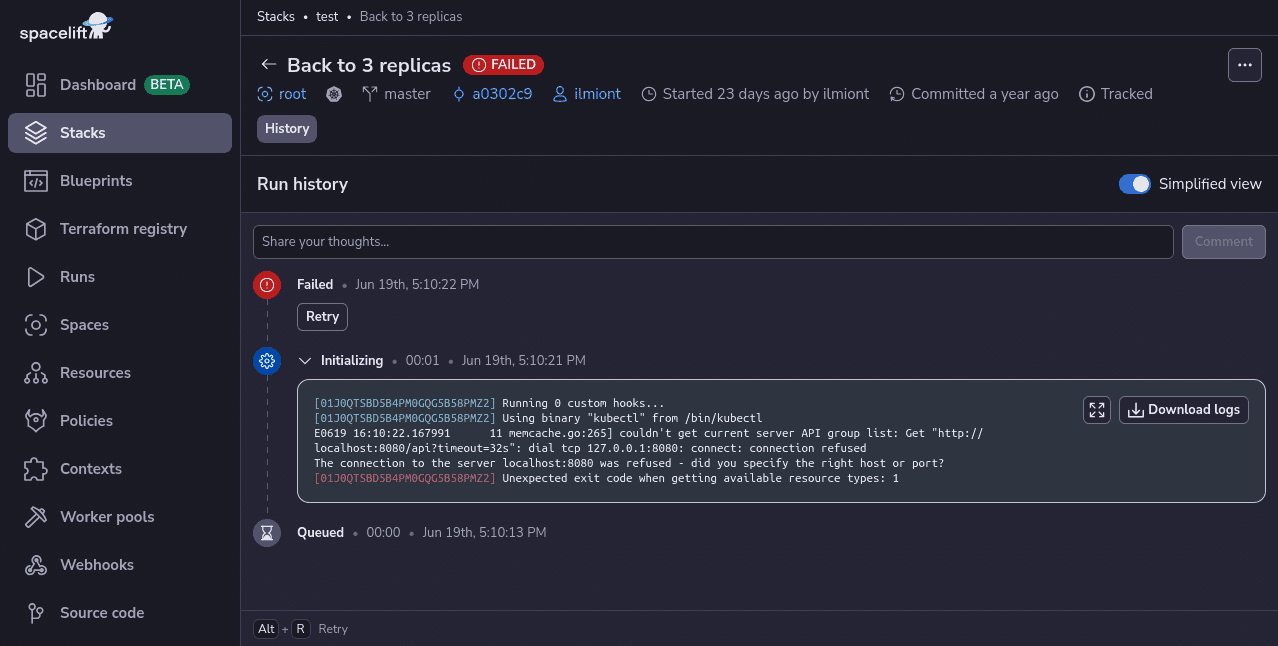
Spacelift includes drift detection capabilities that periodically check your infrastructure for discrepancies compared to your repository’s state. It can then launch reconciliation jobs to restore the correct state, ensuring your infrastructure operates predictably and reliably.
With Spacelift, you get:
- Policies to control what kind of resources engineers can create, what parameters they can have, how many approvals you need for a run, what kind of task you execute, what happens when a pull request is open, and where to send your notifications
- Stack dependencies to build multi-infrastructure automation workflows with dependencies, having the ability to build a workflow that, for example, generates your EC2 instances using Terraform and combines it with Ansible to configure them
- Self-service infrastructure via Blueprints and Templates, enabling your developers to do what matters — developing application code while not sacrificing control
- Creature comforts such as contexts (reusable containers for your environment variables, files, and hooks), and the ability to run arbitrary code
- Drift detection and optional remediation
If you want to learn more about Spacelift, create a free account today or book a demo with one of our engineers.
Key points
Effective enterprise cloud security is not a single tool or policy but a layered system spanning identity, workload protection, data security, network controls, and continuous compliance. The organizations that get it right treat security as an ongoing operational discipline rather than a one-time deployment.
- Cloud security requires visibility across every layer of the stack, from IAM policies and API calls to network traffic and runtime workload behavior.
- Misconfigurations are the leading cause of cloud breaches, making automated policy enforcement and shift-left practices non-negotiable at enterprise scale.
- Zero-trust principles, continuous monitoring, and defense-in-depth together form the foundation of a resilient cloud security posture.
- As your cloud footprint grows, integrating security tooling directly into your infrastructure automation and CI/CD pipelines is what keeps pace with deployment velocity.
Keep infrastructure moving at AI speed
Spacelift Intelligence keeps platform teams ahead. Fuse traditional IaC and GitOps pipelines with an AI deployment model and a powerful Infrastructure Assistant.
Frequently asked questions
How is enterprise cloud security different from traditional cybersecurity?
Traditional cybersecurity protects a fixed perimeter around on-premises infrastructure, while enterprise cloud security must secure dynamic, distributed environments where infrastructure is provisioned on demand, identities are the new perimeter, and the attack surface changes continuously.
What are the biggest risks in enterprise cloud environments?
The most common risks are misconfigurations, excessive permissions, insecure APIs, lack of visibility across multi-cloud environments, and failure to detect compromised identities before lateral movement occurs.
What is the shared responsibility model in cloud security?
The shared responsibility model divides security duties between the cloud provider, who secures the underlying infrastructure, and the customer, who is responsible for securing their data, identities, workloads, and configurations running on top of it.
How do enterprises secure multi-cloud environments?
Enterprises typically use a cloud-native application protection platform (CNAPP) or a centralized cloud security posture management (CSPM) tool to enforce consistent policies, visibility, and compliance across AWS, Azure, and GCP from a single control plane.