Multicloud is the use of multiple cloud providers within a single IT architecture. The model improves operational flexibility, resiliency, and redundancy, but it also creates new challenges for developers and infrastructure teams.
In this article, we’ll cover nine common problems with multicloud operations, explain why they happen, and share strategies for fixing them. By the end, you’ll know where multicloud architectures usually break and what to put in place before they do.
What we’ll cover:
TL;DR
Multicloud promises flexibility and redundancy, but usually breaks on fragmented deployments, scattered observability, unpredictable costs, inconsistent security, and configuration drift. The teams that get it right unify tooling with IaC and CI/CD, centralize observability and security, and apply FinOps across providers.
Multicloud infrastructure: The promise vs the reality
Multicloud infrastructure promises to offer a compelling range of benefits. Distributing your operations across multiple cloud providers lets you mix and match the best services from across the cloud ecosystem, so you can balance performance, cost, and reliability.
Yet in practice, multicloud architectures often fall short. Too often, the reality is fragmentation, observability blind spots, and runaway complexity. Instead of making operations more efficient, these challenges hinder the day-to-day maintenance of your environments.
Failure isn’t inevitable, though. With the right strategy and tools, you can avoid the pitfalls and build multicloud environments that live up to their promise. It starts with recognizing where problems can occur so you can build mitigations into your implementation plan.
Challenges of multicloud setups
Here are nine of the most critical challenges you might encounter when operating a multicloud architecture, along with the methods you can use to solve them.
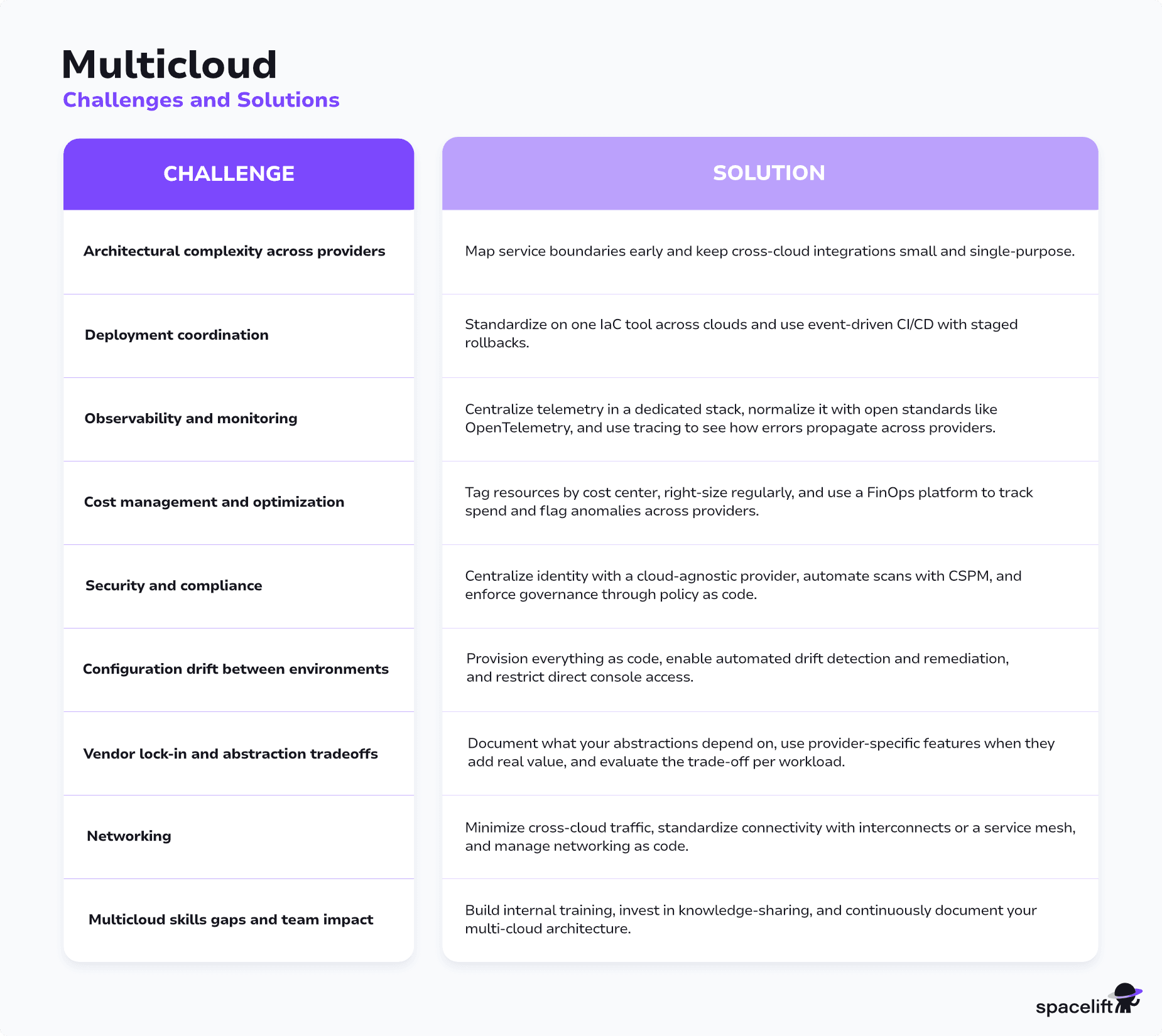
It’s common for several of these problems to appear together because many stem from the same root cause: it’s hard to retain effective oversight of your operations when distributing resources between clouds, unless you proactively implement dedicated management systems.
1. Architectural complexity across providers
Increased architectural complexity is one of the most obvious and immediate drawbacks of multicloud environments. When you’re operating services that span multiple providers, you need to handle inter-provider dependencies and take care of any cloud interoperability issues. These problems simply don’t exist in single-cloud scenarios.
Connecting services across clouds can require custom integration layers to help abstract differences found in individual providers’ platforms. This lengthens implementation timelines and risks services becoming too tightly coupled.
To prevent this from happening, it’s crucial to map your entire cloud landscape and clearly define which services should connect with each other. This will guide you towards producing efficient infrastructure designs that help reduce complexity.
Mitigation tips
- Define clear service boundaries to avoid unnecessary overlaps between clouds.
- Keep custom integrations small, portable, and flexible, with each providing a specific piece of functionality.
- Clearly document the constraints and limitations within provider interfaces, to help developers and operators navigate any remaining complexity.
2. Deployment coordination
Multicloud architecture fragments deployment workflows. Launching a new release requires you to coordinate deployments across each of your providers. CI/CD pipelines must be orchestrated so they use the right IaC tools, credentials, and configurations at each point. This creates intricate systems of interlinked pipelines that can cause confusion and duplication.
Deployment processes that span multiple cloud providers must accommodate the need to deploy dependencies first, reconcile timing differences between clouds, and handle rollbacks when partial failures occur.
For instance, operations in one cloud may succeed, while others may fail. You need tools capable of detecting and resolving these issues to prevent resources across providers from becoming stuck in inconsistent states.
Mitigation tips
- Aim to standardize deployment tooling where possible, such as by using the same IaC solution for each cloud.
- Use event-driven CI/CD features, including parent-child pipelines, trigger pipelines, and webhooks, to coordinate deployments between clouds.
- Implement consistent deployment orchestration and rollback strategies to limit the impact of failures, such as by staging rollouts across clouds using blue-green or canary releases.
3. Observability and monitoring
It’s notoriously challenging to achieve unified visibility into multicloud environments.
Different providers have their own monitoring tools, logging systems, and event frameworks. Metrics, logs, and traces need to be correlated across providers in order to holistically assess your infrastructure’s health.
Distributing resources among multiple clouds also makes it more likely you’ll encounter monitoring blind spots. Missing alerts can lead to minor incidents escalating, causing further problems down the line. Incident response becomes less effective when data is missing or spread across multiple monitoring services.
Mitigation tips
- Feed all cloud provider metrics and logs to a dedicated observability stack (e.g., Prometheus, Grafana, and the Elastic Stack).
- Use detailed traces and telemetry to inspect how errors propagate across providers.
- Leverage open observability standards to normalize collected data (e.g., OpenTelemetry and Jaeger).
4. Cost management and optimization
Multicloud can lower your costs over the long term. But navigating multiple billing systems and pricing models often makes those savings hard to realize. And because each provider structures its costs differently, forecasting your budget is harder still.
Multicloud can also actively thwart efforts to optimize costs at scale. Data egress fees between clouds and the risks of resource duplication can quickly eat into the potential savings, for example. These risks are best addressed by implementing centralized cost-monitoring platforms that let you track costs and set budgets across all the cloud providers you use.
Mitigation tips
- Tag all resources with their respective cost centers to enable accurate budget analysis.
- Regularly right-size resources to prevent runaway spending.
- Use FinOps platforms to centrally monitor costs and flag anomalous budget overruns.
5. Security and compliance
Maintaining security throughout multicloud environments is both critical and complex. Different providers have their own security models, each with similar intentions but different implementations. Identities, access control rules, network policies, and compliance standards must be applied independently to each provider.
These issues mean you can easily end up with policies that either overlap or have missing coverage in certain clouds. With multicloud environments having an inherently larger attack surface, this increases the risk of your infrastructure harboring hidden vulnerabilities and compliance failings.
You must also independently audit and certify the security controls in each cloud, increasing the workload placed on security teams.
Mitigation tips
- Centralize identity management using a dedicated identity provider that sits outside any single cloud.
- Use CSPM (Cloud Security Posture Management) solutions to automate scans for misconfigurations and vulnerabilities.
- Implement policy-as-code tools to standardize how governance policies are applied and configured in each cloud.
6. Configuration drift between environments
Drift is a constant threat even with a single cloud provider. With multiple clouds in play, it can quickly create major inconsistencies that undermine your architecture’s integrity. If services in one cloud depend on services in another being available, drift in either environment can break both.
Drift is also more likely in multicloud systems, because there are more places for changes to occur. That could be a provider update, or an operator inadvertently making a manual change to provider-specific configuration.
Defend against the threat by using infrastructure orchestration platforms to automate drift detection and remediation on a regular schedule.
For example, an engineer opens an AWS security group port from the console to debug a production incident and forgets to revert the change. The Terraform configuration still shows the original rule, so the live infrastructure no longer matches code, and the gap can sit undetected for weeks until the next planned change surfaces a confusing diff.
The same scenario in Azure plays out through NSG rules with different priority and direction semantics, which means a team running both clouds needs drift detection that understands both models, not just one.
Mitigation tips
- Provision all infrastructure using IaC so you can detect drift by comparing environments to known state files.
- Enable automated drift detection and resolution capabilities within infrastructure management platforms.
- Limit direct access to cloud provider dashboards to prevent unauthorized changes.
7. Vendor lock-in and abstraction tradeoffs
Multicloud is often perceived as reducing vendor lock-in, but designing systems that are actually fully portable across providers is often unrealistic. With each provider offering its own unique features and APIs, it’s not always possible to build an abstraction layer for every service.
Attempting to do so risks producing a lowest-common-denominator architecture, where you can’t glean the full potential value of any provider.
Yet at the same time, relying too heavily on cloud-specific services unavoidably increases your architecture’s dependency on that cloud. It’s best to strike a cautious balance between abstraction and specialization by identifying how different parts of your system align with cloud provider capabilities. Aim to make services portable where you can, but don’t be afraid to lean on provider-specific features when they offer unique value tailored to a specific function.
Mitigation tips
- Document how your abstraction layers work and what they rely upon.
- Selectively use provider-specific features to unlock the true power of multicloud.
- Analyze the benefits and tradeoffs of abstractions on a per-workload basis.
8. Networking
Multicloud networking is one of the hardest parts of running workloads across providers. Each cloud has its own VPC or VNet model, peering options, DNS conventions, IP management, and security group semantics, and reconciling those differences while keeping performance, security, and cost under control is genuinely difficult.
Cross-cloud latency and bandwidth bottlenecks degrade performance for chatty services, and data egress fees quickly erode the cost benefits multicloud is supposed to deliver.
Even basic connectivity between AWS and Google Cloud often requires dedicated interconnects (AWS Direct Connect, Azure ExpressRoute, Google Cloud Interconnect), site-to-site VPNs, or SD-WAN — each with its own overhead. DNS resolution, identity-aware routing, and traffic policy enforcement also become harder to keep consistent.
Consider a typical workload split between AWS and Google Cloud: a service running on EKS that needs to write events to BigQuery. Every gigabyte leaving AWS hits standard data transfer-out pricing (on the order of $0.09 per gigabyte at the lower tiers), before accounting for the added latency of traversing the public internet or a dedicated interconnect.
Multiply that across a handful of chatty services and the egress bill alone can outweigh whatever compute savings the multicloud split was supposed to deliver.
Mitigation tips
- Minimize cross-cloud traffic by co-locating tightly coupled services and using event-driven patterns when data must cross providers.
- Standardize cross-cloud connectivity with dedicated interconnects or a service mesh so routing, encryption, and observability behave consistently.
- Manage VPCs, peering, firewall rules, and DNS through infrastructure as code to keep network configurations consistent and auditable.
9. Multicloud skills gaps and team impact
Implementing and maintaining multicloud architectures requires specialist DevOps skills. Operators must develop their expertise across multiple cloud platforms, so training programs become longer. It can also be hard to find new talent as comparatively few engineers possess detailed knowledge of multiple cloud platforms.
Multicloud affects internal processes in other ways, too. For example, robust documentation practices must be followed to clearly define the boundaries between services and cloud providers.
Mitigation tips
- Develop internal training programs to upskill engineers on the benefits, best practices, and limitations of various clouds.
- Invest in knowledge-sharing initiatives to help specialized teams share their expertise.
- Continually document changes in your multicloud architecture.
Best practices to overcome multicloud operational complexity
The issues discussed above can all derail multicloud systems if left unchecked, but you can avoid them by keeping a few simple best practices in mind. Follow these tips to keep your multicloud architecture on track at scale.
- Unify your cloud tooling – Consolidating cloud infrastructure provisioning, configuration, and governance tools helps prevent fragmentation from occurring. While it won’t be possible to eliminate every difference between providers, using the same services to manage each cloud is a key way to improve standardization and cut toolchain complexity.
- Automate and standardize deployments using IaC and CI/CD – IaC and CI/CD solutions enable repeatable, scalable infrastructure deployments across the cloud providers you use. They accelerate provisioning operations and reduce risk by letting you automate, version, and audit your cloud configurations.
- Leverage platform engineering to abstract multicloud complexity – Leaning on platform engineering techniques to build internal developer platforms (IDPs) and portals can make multicloud systems more accessible within everyday workflows. IDPs let you expose simplified interfaces to underlying infrastructure, making it easier for developers to release services that need to be distributed across multiple cloud providers.
- Combine observability, security, and compliance controls in centralized multicloud management platforms – Aggregating observability data from different cloud providers into a centralized platform enables clear visibility into cloud activity. Similarly, dedicated cloud management platforms and infrastructure orchestration solutions allow you to continuously enforce security and compliance controls so you can strengthen your governance processes.
- Utilize FinOps techniques to track cloud costs across providers – FinOps is the practice of strategically optimizing cloud operational costs. Techniques such as right-sizing cloud instances, signing up for savings plans, and accurately attributing costs to specific teams help ensure budgets are used effectively, even when resources are spread among several providers.
Why use Spacelift to improve your cloud infrastructure management?
Spacelift is the infrastructure orchestration platform built for the AI-accelerated software era. It manages the full lifecycle for both traditional infrastructure as code and AI-provisioned infrastructure across AWS, Azure, Google Cloud, and on-premises environments, working with tools such as OpenTofu, Terraform, CloudFormation, Kubernetes, Pulumi, Ansible, and Terragrunt. Teams use their favorite tools without compromising functionality or efficiency.
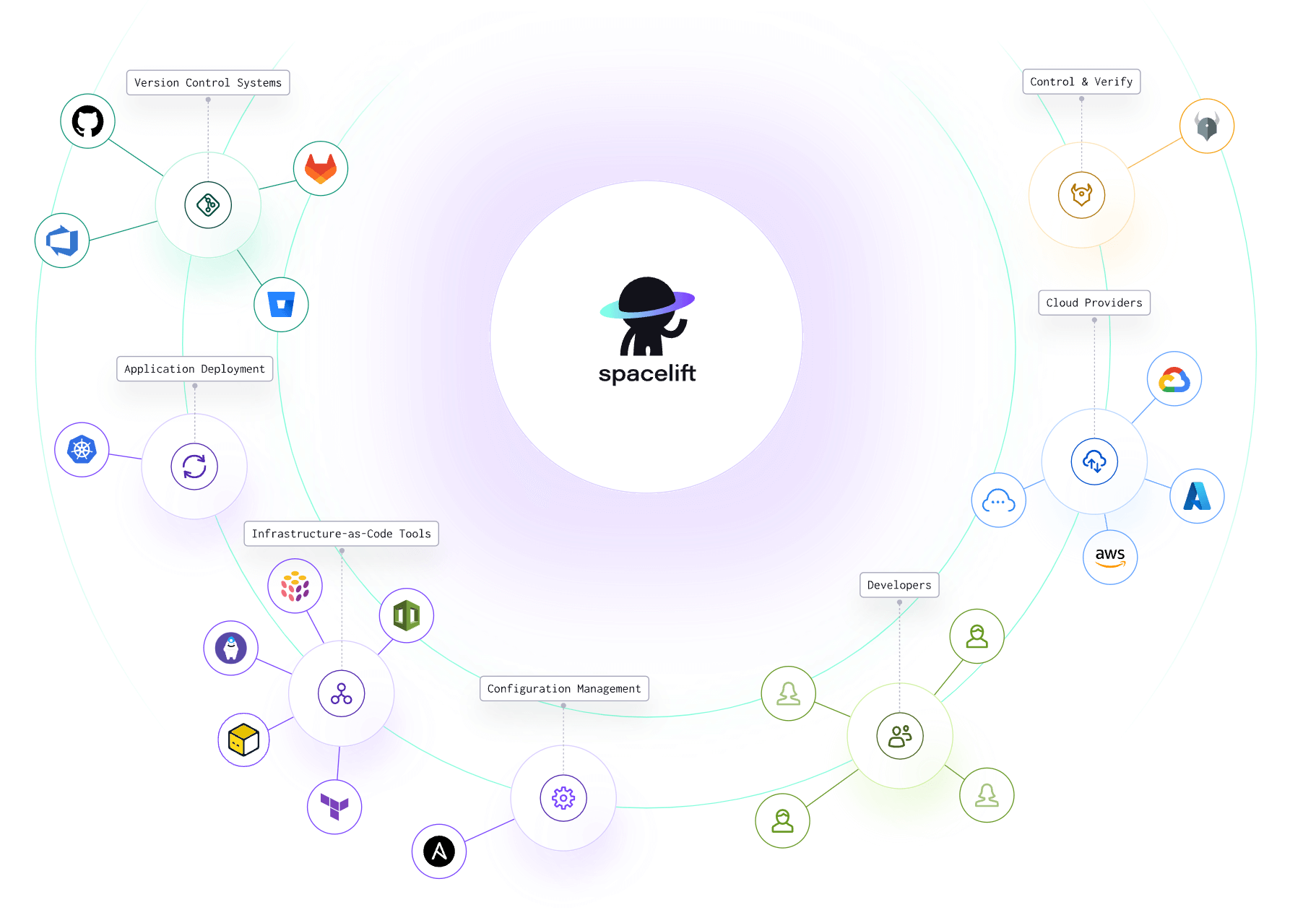
Spacelift provides a unified interface for deploying, managing, and controlling cloud resources across multiple providers. It is API-first, so whatever you can do in the interface, you can do via the API, the CLI it offers, or the OpenTofu/Terraform provider.
The platform enhances collaboration among DevOps teams, streamlines workflow management, and enforces governance across all infrastructure deployments. Spacelift’s dashboard provides visibility into the state of your infrastructure, enabling real-time monitoring and decision-making. It can also detect and remediate drift.
Native cloud integrations with AWS, Azure, and Google Cloud use dynamic credentials to generate short-lived access tokens, eliminating the need for long-lived static credentials across your multicloud estate.
You can leverage your favorite VCS (GitHub/GitLab/Bitbucket/Azure DevOps), and executing multi-IaC workflows is a question of simply implementing dependencies and sharing outputs between your configurations.
With Spacelift, you get:
- Policies to enforce guardrails: what engineers can deploy, which approvals a run needs, what happens when a pull request is open, which tasks can run, and where notifications go.
- Stack dependencies to orchestrate multi-step workflows. For example, provision EC2 instances with Terraform, then configure them with Ansible.
- Self-service infrastructure via Blueprints and Templates, giving developers Golden Paths without sacrificing governance.
- Reusable contexts for environment variables, files, and hooks, plus the ability to run custom code when you need it.
- Drift detection with optional remediation across every cloud provider in your environment.
- Spacelift Intelligence, an AI-powered layer for natural language provisioning, diagnostics, and operational insight across both traditional and AI-driven workflows.
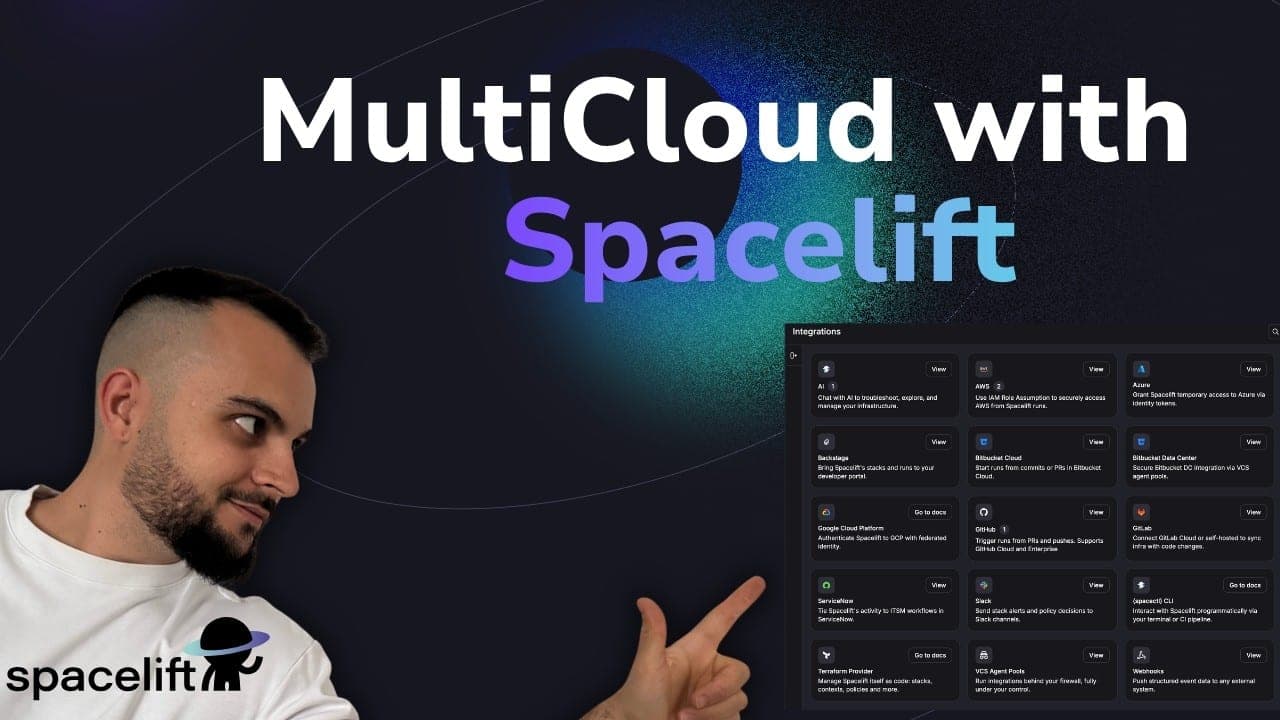
Multicloud governance falls apart the moment your access reviews and compliance audits have to happen three separate times. The video below shows how Spacelift pulls AWS, Azure, and GCP into one control plane:
If you want to learn more about Spacelift, create a free account today or book a demo with one of our engineers.
Key points
Multicloud environments can cause many different operational challenges, from difficulty coordinating deployments across clouds, to missing visibility into security and compliance risks. These problems stem from the fundamental incompatibilities found within different cloud providers’ infrastructure.
multicloud architectures are inherently more complicated than those that use a single provider, but implementing the right tools and processes can mitigate the extra friction involved.
Unifying deployment toolchains, centralizing observability and security controls in dedicated platforms, and purposely investing in your teams’ skillsets makes it possible to build multicloud systems that actually live up to their promise.
With careful planning and deliberate execution, you can successfully scale across providers to achieve real-world flexibility, cost efficiency, and redundancy improvements.
Keep infrastructure moving at AI speed
Spacelift Intelligence keeps platform teams ahead. Fuse traditional IaC and GitOps pipelines with an AI deployment model and a powerful Infrastructure Assistant.
Frequently asked questions
What are the biggest challenges of multicloud environments?
The biggest challenges include operational complexity from managing different provider tools and APIs, fragmented security and identity controls, unpredictable costs driven by egress fees and duplicated services, and skill gaps across teams supporting AWS, Azure, and Google Cloud simultaneously.
What are the main multicloud security challenges?
Key issues are inconsistent IAM policies across providers, fragmented visibility from siloed logging and monitoring tools, an expanded attack surface, and difficulty enforcing uniform encryption, compliance, and data residency controls as workloads cross regions and regulatory boundaries.
What are the biggest multicloud networking challenges?
Cross-cloud latency, bandwidth bottlenecks, and high egress costs top the list, alongside inconsistent networking protocols, peering models, and security configurations between providers, which complicate routing, interoperability, and reliable connectivity between distributed workloads.