Cloud cost governance is the process of monitoring, controlling, and optimizing cloud spending. It revolves around structured processes and systems that let you track budget allocations and usage, then enforce guardrails to prevent overspending.
Having a resilient cloud cost governance strategy is a crucial requirement for successful cloud operations at scale. It allows you to align development objectives and technical priorities with business-level financial requirements.
In this article, we’ll explain the benefits of cloud cost governance and discuss the key components to include in cost governance frameworks. We’ll wrap up with a summary of some best practices for operating cloud cost governance systems day to day.
What we’ll cover:
TL;DR
Cloud cost governance is the combination of policies, visibility tools, and automated controls that keep cloud spending predictable at scale. The core challenges are late visibility, unclear ownership, and manual enforcement, all of which compound as infrastructure grows. Effective governance embeds cost controls directly into provisioning workflows rather than reviewing spend after the fact.
What is cloud cost governance?
Cloud cost governance is how you manage the costs that accumulate from using cloud infrastructure. It moves a step beyond simple cost tracking: Cost governance is a cohesive discipline that spans business-level financial needs, policy-based cost controls, and automated optimization systems.
Common cloud cost governance tasks include:
- Setting cost controls and budgets to meet organizational needs
- Gaining visibility into costs, across different teams and services
- Flagging cost anomalies in real-time
- Right-sizing resources, selecting payment models, and optimizing savings plans
- Balancing workloads and deployments to stabilize cost and performance
- Implementing policy-based guardrails to prevent overspending
By automating and standardizing these processes, cost governance systems remove the risk of runaway spending that can occur when you’re operating cloud environments at scale.
Successful cloud cost governance methods embed cost controls directly into your existing development and deployment workflows, making budget breaches far more unlikely. This improves development stability and makes cloud operations more sustainable.
Why cloud cost governance matters at scale
Cost is the limiting factor for most organizations using cloud infrastructure. While cloud offers the potential to scale endlessly, affordability is a limiting factor. This means budgets must be allocated in a way that maximizes value to the business.
Cloud cost governance strategies are centralized frameworks that define how this happens. They build bridges between development and finance teams, enabling greater accountability and precise cost attribution. Cost governance tools give deep insights into spending within individual cost areas, highlighting where budget overruns and anomalies are originating.
Similarly, taking a structured approach to cost governance makes cost forecasts and plans more accurate. Continued enforcement of cost guardrails through policies prevents overspending, so you can be more confident that costs incurred in production will align with your initial estimates.
Accurate forecasts enhance the sustainability of your operations by letting you predict increases in costs before they happen, providing more time to fine-tune workloads or tweak pricing models.
Cloud cost governance also make infrastructure management easier by automating key cost control processes. Operations teams have traditionally managed costs by reviewing bills and creating written rules for team members to follow, but these approaches don’t scale to the demands of large environments.
Dedicated cost governance systems provide automated alerts and hands-off policy enforcement, reducing the risk of human error. This also ensures cost controls apply consistently across different environments.
Common challenges in cloud cost governance
Even teams with mature infrastructure practices struggle to keep cloud costs predictable. The problem is rarely a lack of awareness. It’s that cost governance touches every layer of the stack, and the gaps tend to compound.
- Visibility comes too late. Most teams don’t see the cost impact of an infrastructure change until the monthly bill arrives. By then, the oversized instance or forgotten test environment has been running for weeks. Without real-time feedback tied to the provisioning workflow, engineers make decisions in the dark.
- Ownership is unclear. Shared accounts, inconsistent tagging, and inherited resources make it difficult to attribute costs to the teams responsible for them. When nobody owns the spend, nobody optimizes it.
- Governance is manual and reactive. Cost policies often live in spreadsheets or wikis rather than in code. Reviews happen after the fact, if they happen at all. This makes enforcement inconsistent and hard to scale across teams, accounts, and regions.
- Non-critical workloads fly under the radar. Test environments, proof-of-concept stacks, and demo infrastructure tend to accumulate quietly. They’re easy to spin up and easy to forget, especially when there’s no automated lifecycle management or expiration policy in place.
- Speed and cost discipline feel like opposites. Developers need fast access to infrastructure. Finance and platform teams need guardrails. Without a way to embed cost controls directly into provisioning workflows (through policy as code, approval gates, or resource tagging enforcement) organizations default to one extreme or the other: slow and controlled, or fast and expensive.
Platforms like Spacelift help close some of these gaps by enforcing policies at the orchestration layer, giving teams visibility into what’s running and who changed it, and supporting governance without slowing down delivery. But tooling is only part of the answer. Practices are equally important.
How to implement cloud cost governance: Key components to include
Implementing cloud cost governance at scale depends on several different tools, processes, and practices working together. Here are the six key components that form the foundation of successful cost governance strategies:
1. Visibility into cloud costs
End-to-end cost visibility is the bedrock of cloud cost governance. It allows you to accurately track usage and spending across your environments, teams, and services.
Use centralized dashboards and dedicated cost-monitoring tools, such as Kubecost and InfraCost, to track real-time costs for your infrastructure. You can then identify trends, see which cost areas represent the highest expenditures, and make proactive decisions to optimize your budgets.
2. Consistent resource tagging
Cost governance controls are only effective when costs can be accurately attributed to the teams and projects that generate them. Ensuring all resources are tagged using consistent schemas is a simple step towards improving accountability.
One way to achieve this is to use your IaC tools to tag resources with identifiers as part of your deployment pipeline. You can then use policy-driven pre-deployment checks in a CI/CD pipeline to block untagged resources that would lead to unattributed spending. This keeps cost allocation reports accurate and simultaneously improves accountability.
3. Budgets and forecasts
Budgets and forecasts provide critical guardrails for governing your cloud spending. Budgets prevent ambiguity when deciding whether overspend is actually occurring, while forecasts provide vital data for aligning the expected costs of different technical approaches with permissible financial targets.
Budget-setting is often a task for business leaders and financial departments, but measurement and enforcement need to take place at the technical level. Use the budgeting features available within infrastructure cost monitoring platforms to cap the spending of different teams and flag when usage is on course to breach permissible thresholds.
4. Real-time cost anomaly alerts
Cost changes aren’t always caused by specific operational actions. At scale, unexpected anomalies can occur for many different reasons: For instance, workloads may experience a fault that causes high CPU utilization, in turn causing auto-scalers to deploy additional infrastructure nodes.
Implementing real-time cost anomaly alerts allows you to quickly spot misconfigurations and deal with inefficient scaling changes. Look for cost management platforms that learn from historical consumption patterns to flag discrepancies as they occur.
5. Continual policy enforcement via guardrails
Automated guardrails let you continually enforce cost governance policies at the point of infrastructure provisioning. Embedding policy-as-code solutions like Open Policy Agent (OPA) or Terrascan in your IaC workflows allows you to detect and block incorrect configurations that could impact costs, such as when new resources use unapproved hardware tiers or would exceed the parent team’s budget allocation.
Guardrails like these are instrumental in transitioning cloud cost governance from traditional reactive models to a more proactive, in-the-loop standpoint.
Automated enforcement of centrally configured policies ensures consistent long-term compliance, while actively preventing key causes of spending overruns.
6. Infrastructure and deployment management standardization
Standardizing your infrastructure provisioning process using IaC and CI/CD ensures ongoing compliance with your cloud cost governance requirements. Standardization guarantees every deployment follows the same approved pipeline, preventing the use of unmanaged changes that could bypass your cost controls.
IaC-based deployment also helps defend against infrastructure drift. Drift is usually considered in misconfiguration and security terms, but it’s also a key budgetary risk factor.
When you’re manually managing resources, it’s easy to make subtle mistakes that affect costs — such as choosing the wrong grade of object storage or assigning objects to a different network that triggers egress fees. Deploying using IaC gives you more opportunities to catch these errors and prevent unapproved resource changes.
Best practices for effective cloud cost governance
The cost governance components discussed above represent the key technical pillars to include in your strategy. However, successful cost governance is also influenced by many other factors from across the DevOps lifecycle.
Here are five best practices to keep in mind as you implement your cost governance systems.
- Establish clear cost ownership for every resource: Ensuring all new resources have a designated owner helps protect against waste caused by ghost assets. Tagging owners on each resource means you can accurately attribute spending to budgets, or identify the right contact if you’re unsure whether components are still needed.
- Continually monitor costs (and investigate any issues early): Regularly monitoring costs throughout your billing period is an important part of effective governance. It lets you verify that your controls are working and keeps you informed of any usage spikes before they derail your budgets.
- Always analyze the context surrounding cost changes: Properly investigate the context around increased spending to prevent potentially harmful knee-jerk reactions. For instance, growth in user signups after a sale may temporarily increase infrastructure spending, but might not necessarily require any ongoing mitigation.
- Plan how changes will affect costs when designing system architectures: Assessing the cost impacts of new changes during design stages reduces the risk of unexpected budget breaches. Making early provision for cost considerations avoids expensive reworks and ensures chosen solutions are efficient, sustainable, and compatible with your cost governance structure.
- Promote cost-conscious team cultures: Fostering a cost-aware culture throughout your organization is key to effectively governing costs at scale. Engineers, product managers, and business leaders should all understand how their decisions affect spending. This helps bake responsible cost governance into everyday workflows.
These tips may sound simple, but they’re often overlooked at scale. Remember that cost governance is much more than just reducing costs: It should provide a cohesive picture of your cost landscape. Only then can you make informed financial decisions that properly balance business and development needs.
How to improve your infrastructure governance with Spacelift
Spacelift is the infrastructure orchestration platform built for the AI-accelerated software era. It manages the full lifecycle for both traditional infrastructure as code (IaC) and AI-provisioned infrastructure, working with tools such as OpenTofu, Terraform, CloudFormation, Kubernetes, Pulumi, Ansible, and Terragrunt. Teams use their preferred tools without compromising functionality or efficiency, while Spacelift handles orchestration, governance, and visibility across every deployment.
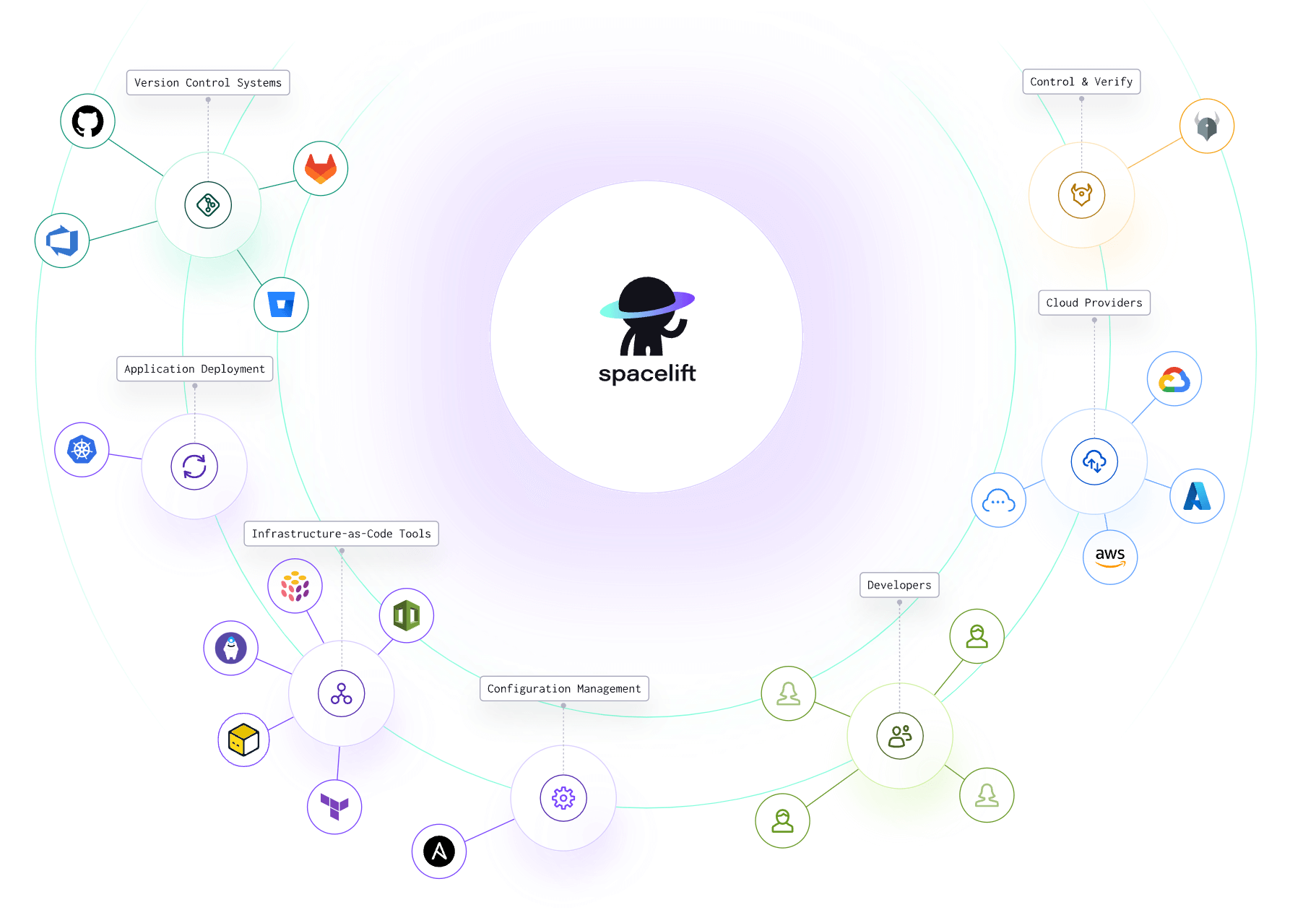
Spacelift provides a unified interface for deploying, managing, and controlling cloud resources across various providers. It is API-first, so whatever you can do in the interface, you can do via the API, the CLI it offers, or the OpenTofu/Terraform provider.
The platform enhances collaboration among DevOps teams, streamlines workflow management, and enforces governance across all infrastructure deployments. Spacelift’s dashboard provides visibility into the state of your infrastructure, enabling real-time monitoring and decision-making. It can also detect and remediate drift.
Spacelift supports a two-path deployment model: a rigorous IaC and GitOps path for production and mission-critical workloads, and a faster Intent path for non-critical work like tests, POCs, and demos. With Intent, developers provision infrastructure using natural language through the LLMs they already use, while the same policies, guardrails, and audit trails apply across both paths.
Spacelift Intelligence adds an AI-powered layer for natural language provisioning, diagnostics, and operational insight across both traditional and AI-driven workflows, helping you deliver secure, compliant infrastructure at scale.
You can leverage your favorite VCS (GitHub/GitLab/Bitbucket/Azure DevOps), and executing multi-IaC workflows is a question of simply implementing dependencies and sharing outputs between your configurations.
With Spacelift, you get:
- Policies to control what kind of resources engineers can create, what parameters they can have, how many approvals you need for a run, what kind of task you execute, what happens when a pull request is open, and where to send your notifications.
- Stack dependencies to build multi-infrastructure automation workflows with dependencies, having the ability to build a workflow that, for example, generates your EC2 instances using Terraform and combines it with Ansible to configure them.
- Self-service infrastructure via Templates and Blueprints, enabling your developers to do what matters: developing application code without sacrificing control. Templates let you define reusable, parameterized infrastructure patterns that teams can provision through a simple, governed interface.
- Reusable contexts (containers for your environment variables, files, and hooks) and the ability to run arbitrary code.
- Drift detection and optional remediation.
If you want to learn more about Spacelift, create a free account today or book a demo with one of our engineers.
Key points
Cloud cost governance is the practice of using structured systems to control cloud spend. It ensures costs are visible, predictable, and governed by consistent rules that prevent budget breaches and unexpected anomalies.
Implementing cloud cost governance requires you to combine automated cost management systems with team-level changes that produce a cost-aware culture. It sits within broader cloud governance and IT cost optimization initiatives, allowing you to avoid excess spending as you scale your cloud operations.
Ready to learn actionable strategies for reducing your cloud bills? Check out our guide to cloud cost optimization best practices to try this year.
Keep infrastructure moving at AI speed
Spacelift Intelligence keeps platform teams ahead. Fuse traditional IaC and GitOps pipelines with an AI deployment model and a powerful Infrastructure Assistant.
Frequently asked questions
What is the cloud cost governance framework?
A cloud cost governance framework is a set of policies, processes, and controls that an organization uses to manage, monitor, and optimize its cloud spending. It defines accountability, budgets, approval workflows, and reporting standards to ensure cloud costs stay aligned with business objectives.
What is an example of cloud governance?
Enforcing a tagging policy that requires every cloud resource to carry cost-center and project tags before deployment. This ensures spending is attributable, enables accurate chargeback reporting, and prevents untracked resources from inflating budgets.
Who owns cloud cost governance?
Ownership typically sits with a FinOps team or cloud center of excellence, but it’s a shared responsibility. Finance sets budgets, engineering implements cost-efficient architectures, and leadership sponsors the governance policies that tie spending to business outcomes.
How do you measure cloud cost governance success?
Key indicators include cloud spend versus budget variance, percentage of resources properly tagged, waste reduction (unused or idle resources eliminated), cost per unit of business output, and the accuracy of forecasts compared to actual spend over time.
What tools are used for cloud cost governance?
Common tools include native platforms like AWS Cost Explorer, Azure Cost Management, and Google Cloud Billing, alongside third-party solutions such as CloudHealth, Apptio Cloudability, Infracost, and Spot by NetApp. Many organizations also use Terraform or OpenTofu to enforce cost-related policies as code.
How do tagging policies support cloud cost governance?
Tagging policies attach metadata (like team, project, or environment) to every cloud resource, making it possible to allocate costs accurately, generate per-team chargeback reports, identify untagged or orphaned resources, and enforce budgets at a granular level.
How is cloud cost governance different from FinOps?
Cloud cost governance is the enforcement layer, focused on policies, controls, and compliance around cloud spending. FinOps is the broader operational practice that combines engineering, finance, and business teams to maximize cloud value. Governance is one component within a FinOps strategy, not a synonym for it.