Government IT has traditionally been associated with slow procurement cycles, legacy systems, and stringent security requirements that can hinder innovation. But the pressure to modernize is real, and the public sector has begun adopting DevOps practices to meet citizens’ expectations for digital services.
The tooling ecosystem is finally catching up too. More solutions offer certifications such as FedRAMP authorization, air-gapped deployment options, and policy-as-code frameworks that fit perfectly with governance and compliance needs.
What we’ll cover:
TL;DR
Public-sector DevOps demands more than private-sector playbooks: strict compliance frameworks, slow procurement, and air-gapped environments add layers of complexity. DevSecOps, with infrastructure as code (IaC), policy as code, and continuous compliance validation, is the path forward.
Spacelift is the first IaC orchestration platform to achieve FedRAMP authorization, combining built-in policy enforcement, RBAC, and flexible deployment models from SaaS to fully air-gapped on-premises.
Why is DevOps needed in the public sector?
The convergence of several developments makes the modernization of software infrastructure and DevOps practices in the public sector necessary: the shift toward digital-first services, growing legacy technology debt, a widening talent gap, and the rapid acceleration of AI.
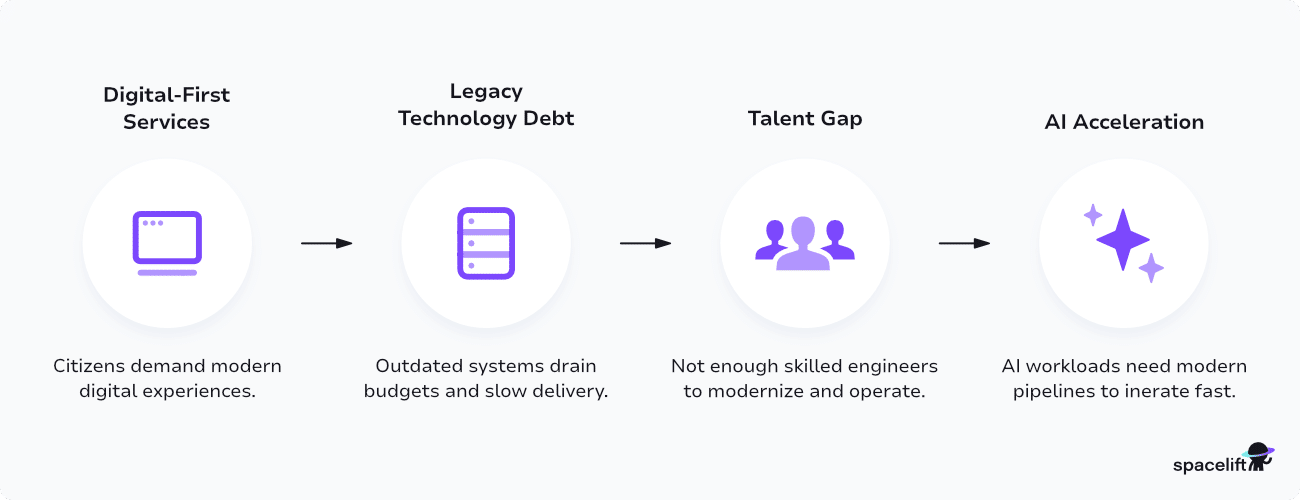
- Digital-first services. Citizens expect the same experience from government websites that they get from commercial apps. Services like filing taxes, renewing licenses, and applying for benefits need to be fast, reliable, and accessible. That requires continuous delivery, automated testing, and infrastructure that can scale. Annual releases and manual deployments cannot keep pace.
- Legacy technology debt. Agencies spend a big part of their IT budgets just keeping existing systems running. These systems are often built on legacy languages and tools, run on unsupported hardware, and are maintained by a small pool of specialists. DevOps practices like IaC and automated pipelines offer a path to gradually replace these systems.
- Talent gap. Many IT teams in the public sector lack in-house cloud and DevOps skills. DevOps automation can help smaller teams do more. It also makes government IT jobs more attractive to younger engineers unwilling to spend their careers on manual deployments and legacy technologies.
- AI acceleration. AI workloads are coming to government projects. Running ML models and AI-powered services requires modern infrastructure, automated pipelines, and the ability to iterate quickly.
Key aspects of government DevOps
Government DevOps applies the same principles of automation and continuous delivery found in the private sector but adapts them for strict public-sector compliance, security, and accountability requirements.
IaC is foundational, enabling agencies to version and audit every infrastructure change. Policy as code takes this further by encoding security controls directly into pipelines, so governance is enforced automatically rather than checked after the fact.
Continuous monitoring and auditability are non-negotiable. Every change must be traceable to satisfy frameworks like FedRAMP and FISMA, making drift detection and remediation critical.
Security is embedded throughout the lifecycle with a shift-left approach: Vulnerabilities are caught during development, not just in production, and RBAC and approval workflows ensure authorized access at every step.
Finally, flexible deployment models matter. Many government workloads require on-premises, air-gapped, or FedRAMP-authorized environments, so teams need tooling that works consistently across all of them.
The unique challenges of DevOps in the federal government
Government is not a startup. Modernization efforts need to take the many constraints and security requirements into account:
Cultural resistance
Government IT decision-makers face constraints that are absent in the private sector: larger groups of stakeholders with competing priorities, political pressure to avoid visible failures, and a bias toward proven approaches that may be decades old. Changing this culture often takes years and multiple efforts.
Compliance frameworks and complexity
Federal agencies operate under overlapping compliance requirements: FedRAMP, FISMA, NIST 800-53, NIST 800-171, and often additional agency-specific standards. Each framework adds documentation, audit requirements, and approval gates.
A deployment pipeline that works well in a commercial environment may require significant rework to meet these requirements. Automation can actually make compliance easier, not harder. But only if you design for it from the start.
Procurement complexity
Government procurement is slow by design. It is built to ensure fairness and accountability, but the side effect is that buying software can take months. Some agencies are experimenting with streamlined acquisition vehicles, but procurement remains one of the biggest bottlenecks to DevOps adoption.
Air-gapped and classified environments
Some government systems cannot touch the public internet. These air-gapped environments require tools that can run entirely isolated.
Container registries, CI/CD tools, and IaC platforms all need to work in disconnected mode. This rules out many SaaS-only tools and makes the selection process harder.
A security-first approach with DevSecOps
In government, a security-first mindset is the baseline. That is why the industry has largely moved from DevOps to DevSecOps in the context of public-sector adoption. Instead of integrating security checks at the end of a pipeline, you integrate them throughout.
Infrastructure and policy as code. IaC means your servers, networks, and storage are defined in version-controlled files. Policy as code takes it further. Your security policies, access controls, and compliance rules are also defined as code, versioned, reviewed, and enforced automatically.
When an auditor asks, “how do you enforce encryption at rest?”, the answer is stored in git, not a PDF that may or may not reflect reality.
Shift-left security. Run security scans early and often. Static analysis on every pull request and dependency scanning in CI. Scanning container images should be performed before anything reaches a registry, not after a vulnerability is found on production systems.
Continuous security and compliance validation. Modern compliance approaches no longer favor point-in-time audits but instead focus on a continuous security and compliance state. Automated compliance checks should run on every deployment.
Does this IAM policy follow the principle of least privilege? Are all data stores encrypted? These checks should block failed deployments, not just generate reports that nobody reads until audit season.
Auditability and traceability. Every change should be traceable. Who made it, when, why, and what was the state before and after. Git provides this for code changes, and your IaC platform and CI/CD system should provide it for deployments and infrastructure changes.
What to look for in DevOps tooling for the public sector
When evaluating IaC tools for government and public-sector environments, technical capability alone isn’t enough. The tool must also meet a higher bar for compliance, deployment flexibility, access control, and procurement. Here’s what to look for:
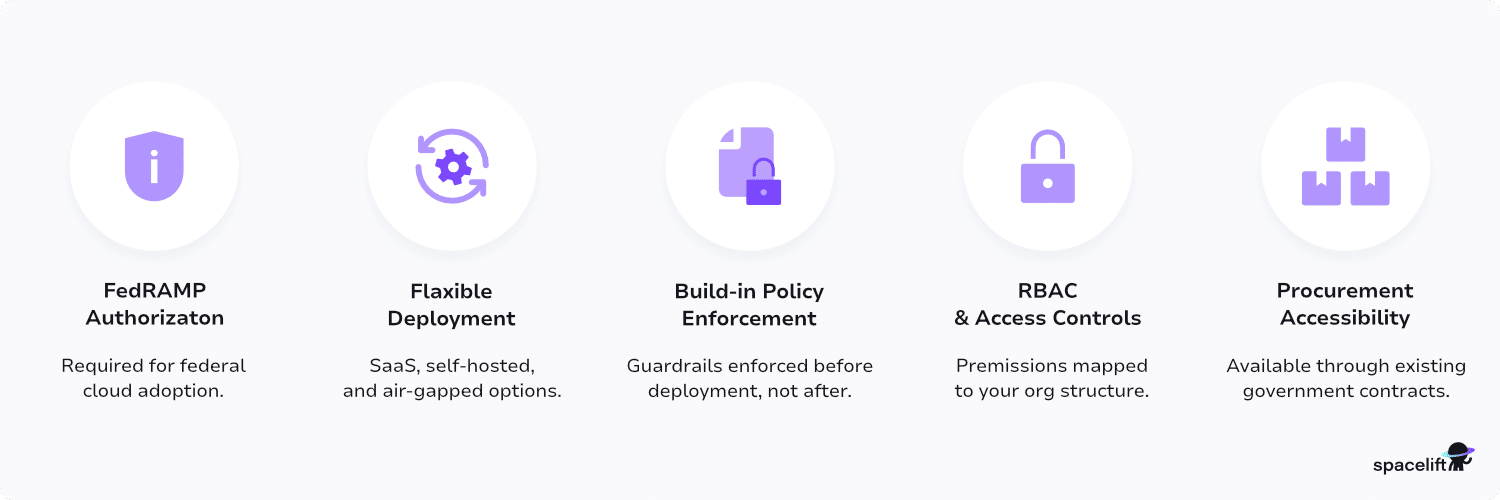
- Compliance-certified solutions: Different governments and public-sector workloads have varying compliance and certification requirements. For U.S. government workloads, FedRAMP (Federal Risk and Authorization Management Program) authorization is the minimum for any cloud-based tool used by federal agencies.It provides a standardized approach to security assessment, authorization, and continuous monitoring for cloud products and services. When evaluating tools, the first thing to check is if the vendors satisfy all the required certifications.
- Flexible deployment models. Not every agency can use SaaS. Look for tools that support on-premises deployment, air-gapped installation, and hybrid models. The tool should work the same way regardless of where it runs.
- Built-in policy enforcement. The tool should let you define and enforce policies as code. What resources can be provisioned? What configurations are allowed? What requires manual approval? Policy enforcement should happen before deployment, not after. If someone tries to deploy a public S3 bucket in a government environment, the pipeline should stop them before it becomes an incident.
- RBAC and access controls. Role-based access control together with fine-grained permissions are critical in order to map necessary controls to your organizational structure. Controls on who can approve deployments, modify infrastructure, and view secrets need to provide the necessary flexibility and security while integrating with existing identity providers.
- Procurement accessibility: Is the tool available through existing government contract vehicles, or can it be purchased through existing commercial relationships such as the AWS Marketplace GovCloud? Procurement accessibility might not seem like a technical requirement, but in government, it is often the difference between adopting a tool this quarter and adopting it in 18 months.
The first IaC orchestration platform to achieve FedRAMP certification
Spacelift became the first and only IaC orchestration platform to achieve FedRAMP authorization in September 2025. No other tool in the IaC orchestration space has reached that milestone. And IaC is the foundation of any serious DevSecOps pipeline in government.
Without a platform that can manage, govern, and enforce policies across your infrastructure code, you end up having disparate custom components that will be difficult to connect during an audit.
What Spacelift brings to government DevOps?
Spacelift is purpose-built for infrastructure orchestration, and several of its core capabilities map directly to the requirements of government DevOps teams:
- IaC tooling unification: Spacelift supports Terraform, OpenTofu, CloudFormation, Pulumi, and Ansible from a single platform. For agencies dealing with multicloud environments or teams that have standardized on different IaC frameworks across departments, this means one control plane instead of five.
- Policy enforcement: This is built in through Open Policy Agent (OPA). You can write policies that govern the entire lifecycle of an infrastructure change, from login and push through plan, approval, and trigger. Want to block any Terraform plan that provisions a public-facing S3 bucket? Write a Rego policy, and Spacelift enforces it before anything gets applied.
- Access Controls: RBAC works through what Spacelift calls Spaces, which are logical containers for stacks, shared configurations, and policies. This lets platform teams delegate partial administrative rights without giving everyone the keys to the entire infrastructure. For agencies where different teams manage different environments with different clearance levels, this maps well to how government organizations are actually structured.
- Deployment flexibility: Spacelift offers three deployment models: SaaS, self-hosted on any cloud, and fully on-premises for air-gapped environments with no external network access. The FedRAMP Moderate Authorized SaaS environment covers agencies that can operate in the cloud. For classified or air-gapped environments, the self-hosted option provides similar capabilities.
- Procurement and Availability: Spacelift partnered with Carahsoft Technology Corp as its Public Sector distributor, making the platform available through established government contract vehicles, including NASA SEWP V, ITES-SW2, and NASPO ValuePoint. If your agency already procures through any of these vehicles, adoption does not require a new contract or a lengthy acquisition process.
The partnership with Knox Systems also helped fast-track the FedRAMP authorization process. Knox uses Spacelift as its IaC platform to manage secure cloud environments across AWS, Azure, and GCP, serving as real-world validation of Spacelift’s security posture in a FedRAMP High environment.
You can try Spacelift by creating a trial account or booking a demo. The platform supports teams that want developer self-service without giving up governance, auditability, or control.
Key points
Government DevOps adoption is accelerating, but it’s more nuanced than simply following the exact model from private sector implementations. Compliance requirements are stricter and procurement is slower.
The fundamentals of DevSecOps still hold, though: Automation, version control, test-first approaches, velocity, and security as a continuous process are critical. Public sector agencies that figure this out and move accordingly will deliver better services to citizens.
Keep infrastructure moving at AI speed
Spacelift Intelligence keeps platform teams ahead. Fuse traditional IaC and GitOps pipelines with an AI deployment model and a powerful Infrastructure Assistant.
Frequently asked questions
What is government DevOps?
Government DevOps applies the same principles of automation, collaboration, and continuous delivery used in the private sector to public-sector infrastructure and software, with additional emphasis on compliance, security, and auditability.
How do DevOps in government and the private sector differ?
Government DevOps operates under stricter regulatory frameworks, such as FedRAMP, FISMA, and NIST, and typically requires more rigorous change-management approvals, audit trails, and authority-to-operate (ATO) processes than most private-sector environments.
What compliance requirements affect government DevOps?
Key frameworks include FedRAMP for cloud services, FISMA for federal information security, NIST 800-53 for security controls, ITAR and EAR for export-controlled systems, and CMMC for defense contractors — all of which mandate strict access controls, logging, and continuous monitoring.
What are some examples of DevOps in government agencies?
The U.S. Department of Defense’s Platform One delivers a DevSecOps pipeline for continuous software delivery, and the Centers for Medicare & Medicaid Services (CMS) uses cloud-native CI/CD workflows to modernize healthcare.gov and related systems.
What are the biggest blockers to government DevOps adoption?
The most common barriers are rigid procurement cycles, cultural resistance to automation, complex authorization processes like ATO, legacy systems that are difficult to modernize, and a shortage of skilled DevOps talent willing to navigate public-sector constraints.