Enterprise cloud governance is the use of structured processes, systems, and workflows to ensure compliance and accountability throughout your cloud operations. It’s how you manage your cloud resources so they remain secure, efficient, and correctly configured at all times.
Governance systems are easily stressed as you scale, so it’s important to anticipate where problems can occur. In this article, we’ll explain why cloud governance matters and highlight some common issues. We’ll then discuss practical strategies and best practices for building enterprise-ready cloud governance frameworks that can actually scale.
What we’ll cover:
What is enterprise cloud governance?
Enterprise cloud governance is the process by which enterprises enforce identity rules, security boundaries, compliance requirements, and cost controls in the cloud. It’s what enables cloud environments to be operated with confidence that every component fully meets applicable internal requirements.
Using cloud infrastructure without a governance strategy risks misconfigured resources, poor visibility in your infrastructure landscape, and security threats. Investing in a deliberate cloud governance strategy prevents this by enabling you to layer policies, automated tooling, and workflow-level controls into a cohesive, self-enforcing system.
Cloud governance operating models
Every governance system rests on an operating model that determines who sets policy, who enforces it, and how much autonomy each team keeps. Most enterprises settle on one of three structures:
- Centralized: One team owns every policy, approval, and control. Standards stay consistent, but the team becomes a bottleneck as the number of teams and requests grows.
- Decentralized: Each team governs its own resources. This preserves speed and autonomy, but it creates the inconsistent controls and blind spots described above.
- Federated: A central team defines policies and guardrails, and domain teams execute within them. You get consistent standards without forcing every change through a single queue.
What are the challenges of enterprise cloud governance?
While all organizations benefit from a cloud governance framework, the need is particularly acute at enterprise scale. With so many teams, resources, and environments to manage, operators often struggle to retain a firm grip on their infrastructure.
Where governance systems do exist, they may be fragmented, inconsistent, or dependent on vendor-specific services. These implementations either become ineffective or restrict development velocity as you scale.
Other commonly experienced cloud governance challenges include:
- Poor visibility into resources across cloud platforms and teams, leading to duplicated or forgotten assets
- Undetected infrastructure drift, where components silently end up in misconfigured states
- Inconsistent or missing IAM controls that cause users to be granted excessive infrastructure access privileges
- Inability to conduct efficient compliance audits, leading to violations of applicable regulatory frameworks such as GDPR and PCI DSS
- New bottlenecks and inefficiencies are arising within development processes due to over-reliance on manual governance checks instead of automation
- Lack of centralized budgeting, tagging, and cost optimization systems leads to frequent cost overruns
Solving these problems in a scalable way requires seeing them as related parts within a broader strategy. Aim to unify the solutions for each problem within a single governance system. Standardization grants consistent control and visibility over your entire cloud stack, making it easier to add new components as you grow.
How to build an enterprise cloud governance framework
Building a scalable enterprise cloud governance framework is a multi-step journey. It starts with understanding what you have and what you need, before you invest in tools and processes to reconcile the two.
For a governance strategy to be scalable, it must also be adaptable to future needs. This means designing your governance controls so they’re easy to extend. Too often, governance systems are tailored to a single provider currently in use. However, tightly coupled governance can become a trip hazard as your enterprise grows to span new teams, services, and cloud providers.
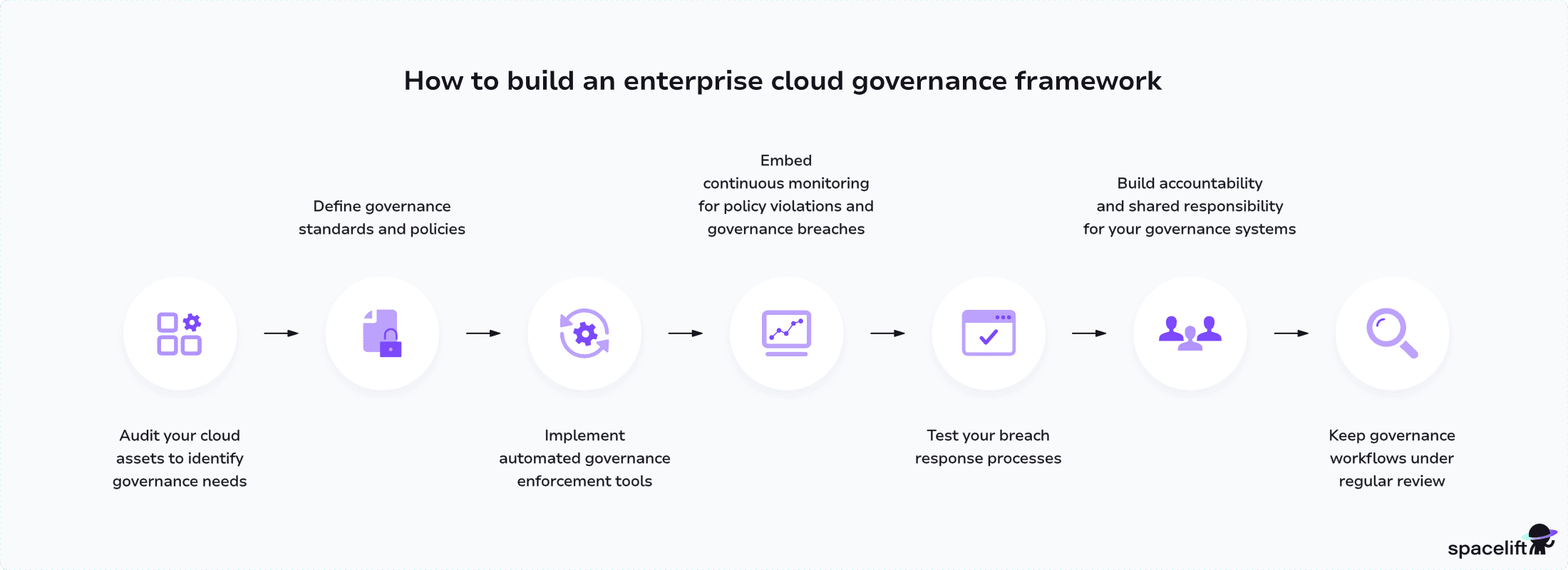
Here are seven key steps to get you started:
Step 1. Audit your cloud assets to identify governance needs
You can’t govern what you don’t know about. Hence, you should begin building your governance strategy by auditing what you already have in your cloud accounts. Creating an inventory of providers, identities, cloud resources, and workloads enables you to see the bigger picture of what you need to govern.
This exercise often reveals governance failings on its own. You may find unmanaged infrastructure, security vulnerabilities, and use of unapproved shadow IT services, for example.
Don’t be dismayed by these discoveries at this stage: They help inform your view of your threat landscape, so you’ll know what your governance strategy should defend against.
Step 2. Define governance standards and policies
Once you’ve gained visibility into your cloud assets, you can define the governance standards they need to meet. First, identify any regulatory requirements you’re bound by, such as GDPR or CCPA. Which rules apply depends on where you operate and what you run.
In the EU, the General Data Protection Regulation (GDPR) sets the data-protection floor, and newer regimes raise the bar for specific sectors: The NIS2 Directive covers cybersecurity and incident reporting for essential and important services, the Digital Operational Resilience Act (DORA) governs financial entities, and the EU AI Act adds obligations for high-risk AI systems that take effect through 2026 and 2027.
In the US, there’s no single federal privacy law, so you answer to a patchwork of state rules. California’s Consumer Privacy Act (CCPA), expanded by the California Privacy Rights Act (CPRA), set the template, and roughly 20 states now have comprehensive privacy laws in effect. Sector frameworks like HIPAA and PCI DSS, plus certifications such as SOC 2 and ISO 27001, layer on their own controls.
These frameworks will often provide a natural foundation for your own standards to build upon. You can then layer in custom internal policies that align with your business aims and unique operational needs.
Successful governance hinges on the precision and relevance of your policies. Implementing too many restrictive policies can harm development activity and limit cloud adoption.
Balance operational control and flexibility by involving different stakeholders in policy-making decisions, such as by bringing developers and security teams together to discuss infrastructure access needs. This improves the chances of your framework succeeding when it meets real-world development workflows at scale.
Step 3. Implement automated governance enforcement tools
Automating policy enforcement is essential if governance frameworks are to remain scalable in large enterprises. After you’ve defined your policy requirements, use policy-as-code solutions, CI/CD pipelines, and automated vulnerability scans to embed enforcement into everyday operations.
Automation improves consistency, reduces operational overhead, and enables your governance controls to keep pace as your cloud asset inventory grows. It also prevents your governance controls from being bypassed, providing crucial confidence that your standards will actually be enforced.
Step 4. Embed continuous monitoring for policy violations and governance breaches
Although automation enables continuous governance enforcement, it’s inevitable that some policy violations will occur occasionally. They may be needed to hotfix urgent incidents or arise from unforeseen oversights as you scale your cloud environments.
Centralizing monitoring within dedicated observability tools enables you to detect when these violations occur. Set up automated schedules to audit cloud environments for configuration drift, unauthorized access attempts, and anomalies such as cost spikes and excess resource consumption.
Automated alerting systems that can spot these patterns and send early warnings enable you to resolve problems before they escalate into larger breaches.
Step 5. Test your breach response processes
It’s important to have clearly documented response processes in place to address major governance failures. Preparing and testing these processes lets you validate your escalation mechanisms.
Remediation systems should be designed to work efficiently without compromising accountability. This could be by building automated runbooks that log when actions are performed, for example. Runbooks are a scalable way for team members to take action fast, while ensuring there’s a record of who’s doing what.
Run regular response exercises to minimize surprises during real-world governance breaches. For instance, rehearsing what to do when an over-privileged IAM account is found ensures team members will be ready to respond when that alert is fired.
Step 6. Build accountability and shared responsibility for your governance systems
Cloud governance is sometimes seen as a specialist discipline that’s best left to dedicated governance teams. However, business leaders, cloud operators, finance departments, compliance stakeholders, and DevOps engineers must all participate too.
Effective governance depends on responsibility being fairly shared between stakeholders. Each group should be accountable for how its members affect governance outcomes as they interact with different cloud resources and operational processes.
Having mutual respect for each other’s needs makes it more likely that governance initiatives will remain scalable, without becoming derailed by internal politics.
Step 7. Keep governance workflows under regular review
Enterprises never stand still; neither should your cloud governance strategy. Cloud environments and operational needs can evolve rapidly, so your governance workflows should be regularly reviewed alongside.
Use metrics and surveys to analyze how your governance controls are impacting operations. This will guide you towards making further improvements that better balance compliance, DevEx, and scalability. Iteratively developed governance frameworks tend to be more scalable than those that are launched in a single burst of activity.

The FirstCape group of wealth and asset management companies needed a consistent, flexible way to manage infrastructure across multiple platforms, teams, and brands. By adopting Spacelift, the platform team standardized infrastructure workflows, reduced manual effort, and dramatically improved run visibility without forcing every team to follow a single rigid model. Today, Spacelift enables developer self-service, clearer governance, and confidence that infrastructure changes are visible, reviewable, and consistent across the business.
Enterprise cloud governance best practices
The following best practices help build more resilient governance systems that are easier to scale:
- Build a structured system of policies, processes, and tools: Structure and consistency are two of the most critical qualities for governance systems. Unifying policies, processes, and tools within standard workflows guards against discrepancies and oversights.
- Prioritize auditability and accountability: Granular audit controls allow you to see exactly who’s doing what and when, letting you make informed decisions around risk and accountability. You can use audit data to unpick precisely what happened in the time leading up to incidents.
- Leverage automation to continually enforce your governance standards: IaC, IAM, policy-as-code, and observability tools let you embed governance enforcement into everyday development workflows. Governance teams can then focus on defining policies, instead of laboriously enforcing them.
- Ensure all teams and stakeholders understand their governance roles: Everyone has a role to play in maintaining cloud governance. Ensure each stakeholder understands their part so governance becomes a natural part of daily operations, rather than a specialist exercise.
- Tighten feedback loops to enable quick resolution of governance failures: Shorter feedback loops allow new governance risks and compliance failures to be detected faster. For instance, using CI/CD pipelines to audit IaC files as they’re committed lets you spot emerging risks before they reach live cloud infrastructure.
Keep these tips in mind as you launch your governance strategy across your enterprise. Remember that governance is more than just policies, tools, and processes. It also requires strong inter-team collaboration so stakeholders can plan common standards, then share responsibility for their implementation.
How Spacelift helps with enterprise cloud governance
A platform like Spacelift can help your organization manage cloud infrastructure more efficiently.
Spacelift is the infrastructure orchestration platform built for the AI-accelerated software era. It manages the full lifecycle for both traditional infrastructure as code and AI-provisioned infrastructure, supporting tools like OpenTofu, Terraform, Ansible, Pulumi, Kubernetes, and CloudFormation.
Security is one of Spacelift’s top priorities, with features such as policy as code, encryption, Single Sign-On (SSO), MFA, and private worker pools built into the product. Spacelift is SOC 2 Type II audited and provides compliance and security artifacts, including GDPR resources and its DPA, through the Spacelift Trust Center.
It is also the first IaC orchestration platform to receive FedRAMP authorization, delivering flexible, policy-driven automation to federal agencies and contractors seeking secure, compliant infrastructure workflows.
The power of Spacelift lies in its fully automated approach. Once you’ve created a Spacelift stack for your project, changes to the infrastructure as code files in your repository are automatically applied to your infrastructure.
For non-critical workloads like tests, POCs, and demos, Spacelift Intelligence adds an AI-powered layer that enables natural language provisioning, diagnostics, and operational insight, so developers can request infrastructure without writing configuration code while platform teams retain full governance and visibility.
Spacelift’s pull request integrations keep everyone informed of what will change by displaying which resources are going to be affected by new merges. Spacelift also allows you to enforce policies and automated compliance checks that prevent dangerous oversights from occurring.
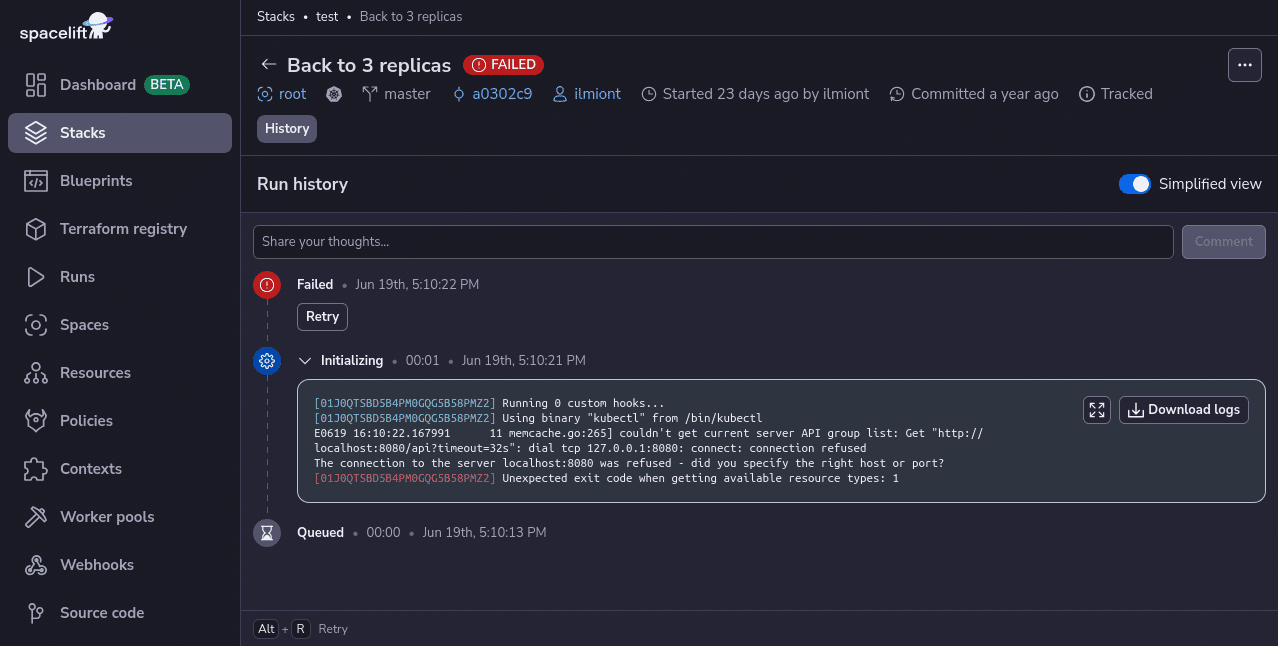
Spacelift includes drift detection capabilities that periodically check your infrastructure for discrepancies compared to your repository’s state. It can then launch reconciliation jobs to restore the correct state, ensuring your infrastructure operates predictably and reliably.
With Spacelift, you get:
- Policies to control what kind of resources engineers can create, what parameters they can have, how many approvals you need for a run, what kind of task you execute, what happens when a pull request is open, and where to send your notifications
- Stack dependencies to build multi-infrastructure automation workflows with dependencies, having the ability to build a workflow that, for example, generates your EC2 instances using Terraform and combines it with Ansible to configure them
- Self-service infrastructure via Blueprints and Templates, enabling your developers to do what matters — developing application code while not sacrificing control
- Creature comforts such as contexts (reusable containers for your environment variables, files, and hooks), and the ability to run arbitrary code
- Drift detection and optional remediation
If you want to learn more about Spacelift, create a free account today or book a demo with one of our engineers.
Key takeaways
Building scalable enterprise cloud governance systems requires coordinating cloud visibility, security, compliance, and cost management across your organization. The result improves cloud operational outcomes by reducing your exposure to threats such as data breaches and compliance failures.
Implementing effective governance systems takes time but pays off in the long-term benefits they create. Investments in governance must be seen as an enabler of enterprise cloud adoption, rather than a restrictive hindrance. Environments with the strongest governance controls are more likely to be fully automated, observable, and scalable, enabling faster innovation with lower risk.
Solve your infrastructure challenges
Spacelift is a flexible orchestration solution for IaC development. It delivers enhanced collaboration, automation, and controls to simplify and accelerate the provisioning of cloud-based infrastructures.
Frequently asked questions
What is the difference between cloud governance and cloud management?
Cloud governance is the set of policies, rules, and strategic direction that guides how an organization uses cloud resources, while cloud management is the day-to-day execution of those policies through provisioning, monitoring, cost control, and performance optimization.
What is the difference between cloud governance and cloud compliance?
Cloud governance is the internal framework of policies and controls an organization sets for how it uses its cloud resources, while cloud compliance is the act of proving those operations meet external regulations and standards such as GDPR, HIPAA, PCI DSS, and SOC 2.
How shared responsibility affects governance?
An enterprise governance framework is a structured set of policies, roles, and processes that boards and executive management use to provide strategic direction, manage risk, allocate resources, and maintain accountability. Based on guidance from ISACA, it balances conformance, including oversight and compliance, with performance, including value creation and achievement of business objectives.
What is the enterprise governance framework?
An enterprise governance framework is a structured set of policies, roles, and processes that boards and executive management use to provide strategic direction, manage risk, allocate resources, and maintain accountability. Based on guidance from ISACA, it balances conformance, including oversight and compliance, with performance, including value creation and achievement of business objectives.
What is enterprise data governance?
Enterprise data governance is an organization-wide framework of policies, roles, processes, and technologies that controls how data is collected, stored, accessed, protected, and used across the business. Aligned with standards like DAMA-DMBOK, it assigns data ownership, enforces quality and security, and aligns data practices with regulations such as GDPR and HIPAA.