
Internal Developer Platforms (IDPs) make it easy for developers to engage with complex DevOps processes. They let you safely expose infrastructure provisioning and configuration tasks, without enabling direct access to your underlying cloud accounts.
Building an IDP requires a large-scale investment. It takes considerable time to create and maintain integrations with all the cloud providers and IaC tools you use. But IDPs aren’t the only way to improve infrastructure operations: Spacelift is a complete infrastructure orchestration solution that gives you everything you need to provision, configure, and govern your environments.
In this article, we’ll explain how Spacelift compares with custom IDPs. We’ll highlight the key differences between the approaches so you can understand the limitations involved in each case.
What we’ll cover:
TL;DR
Spacelift is an infrastructure orchestration platform. An Internal Developer Platform (IDP) is a custom system a team builds, often on frameworks like Backstage or Port, to consolidate every developer workflow in one place. They overlap on infrastructure and differ on scope.
- Use Spacelift if infrastructure orchestration is the problem you need to solve and you’d rather not spend a year building the platform that solves it.
- Use an IDP if your platform needs to cover non-infrastructure work too (service catalogs, app deployments, on-call rotations, developer onboarding) and you have a dedicated team to own it long-term.
- Use both if you want the orchestration without building it and a broader developer platform without rebuilding the orchestration. Spacelift commonly sits as the infrastructure layer behind a custom IDP.
What is Spacelift?
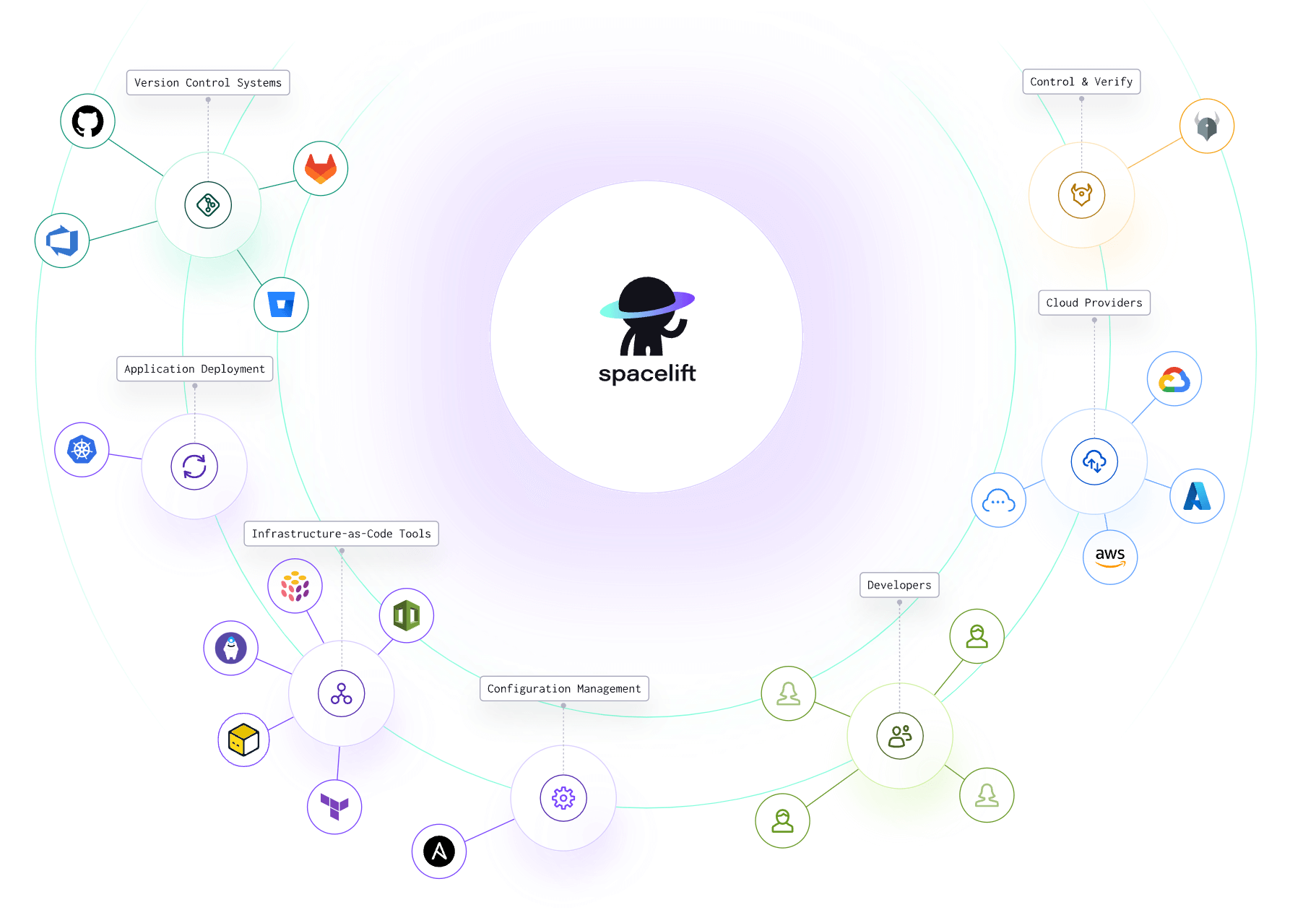
Spacelift is an infrastructure orchestration platform that unifies IaC, CI/CD, and GitOps processes in a single automated workflow. It meets the needs of developers, operators, and governance teams within one solution that’s built for both speed and security.
Spacelift is designed to become your IDP for infrastructure operations. Instead of building a platform from scratch, you can simply connect your IaC repositories and cloud accounts. Spacelift then runs your IaC tools as you make changes to your repositories.
Spacelift Intelligence brings AI across the platform. Spacelift Intent provisions infrastructure from natural language. The AI assistant handles diagnostics, drift analysis, and policy authoring.
Spacelift also includes built-in features for managing self-service developer access, enforcing governance policies, and dealing with infrastructure drift. This ensures you can make Spacelift the center of your infrastructure operations, so you don’t need to spend time setting up complex external services.
What's an Internal Developer Platform?
An internal developer platform is a set of custom tools and services that make DevOps workflows more accessible to engineers. IDPs abstract underlying complexity, automate routine tasks, and reduce context-switching by consolidating all development processes into a cohesive platform. They also simplify DevOps management by centralizing governance controls.
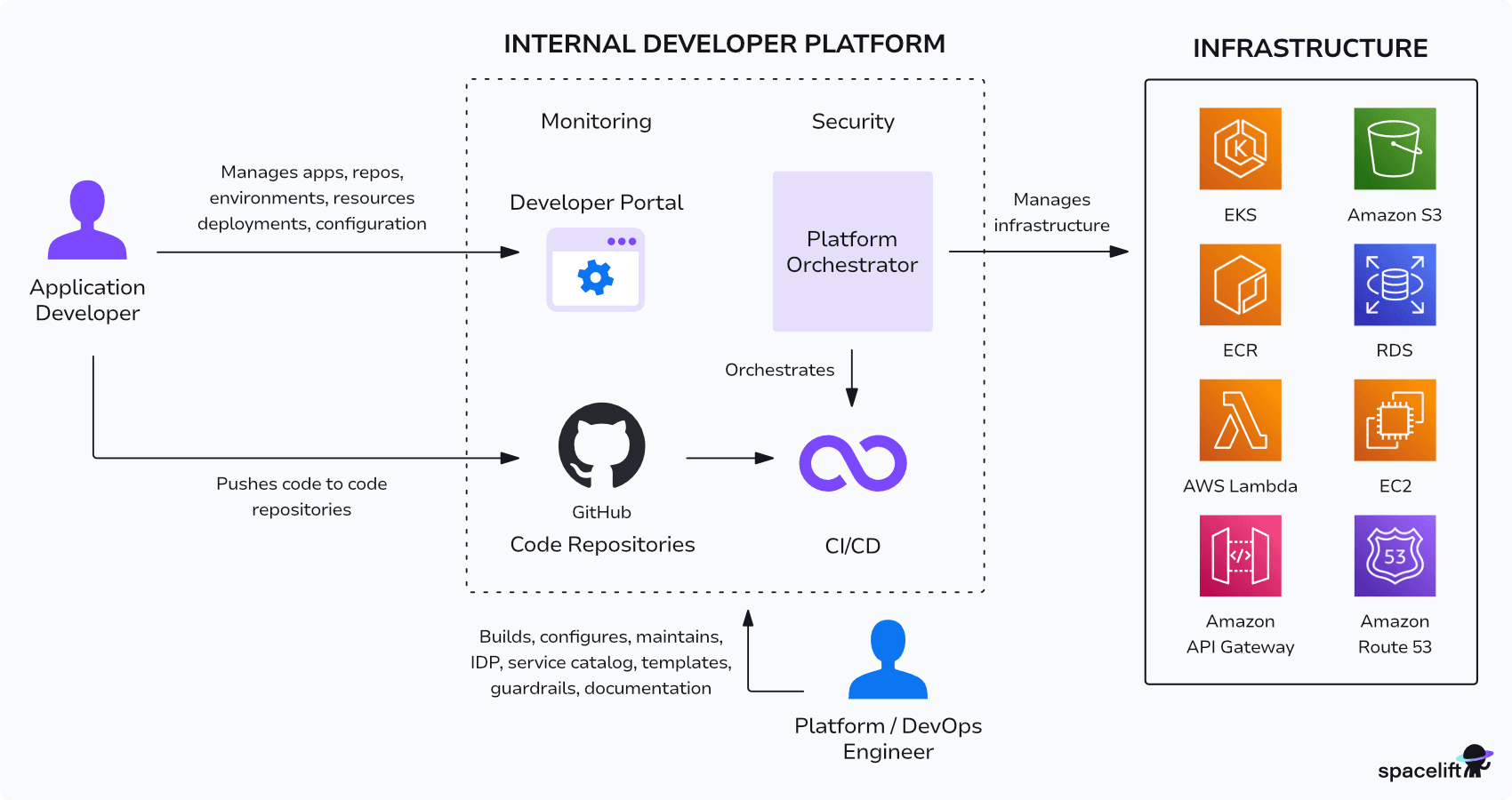
IDPs are typically built and maintained by dedicated platform teams. These teams create portals, APIs, CLI tools, and agents that allow developers to achieve their needs by following prepared golden paths.
For example, a platform team could create a simple portal that lets developers provision new staging infrastructure on demand. This would remove the need for developers to learn IaC tools or have their own cloud provider credentials.
Spacelift vs Internal Developer Platforms: Key differences
Spacelift is purpose-built to solve the specific challenges that arise when you’re managing infrastructure at scale. In comparison, IDPs are bespoke self-service layers that platform teams craft to solve various developer needs. Here are six of the key ways in which Spacelift differs from other IDPs.
A note on scope: when we say “IDP” in this article, we mean a platform a team builds and operates themselves, whether from scratch or on top of frameworks like Backstage, Port, Cortex, or Humanitec.
The comparison is against Spacelift’s standard feature set as of May 2026, including Spaces, Stacks, Blueprints, policies, drift detection, and Spacelift Intelligence (Intent and the AI assistant). If you’re evaluating a managed IDP product specifically, parts of this comparison will read differently.
1. Specialized for infrastructure use cases
At its core, Spacelift is like an IDP tailored for infrastructure use cases. It’s specifically designed to automate end-to-end infrastructure management, allowing DevOps engineers to focus on more meaningful tasks.
A general-purpose IDP can handle infrastructure too. But you build that capability yourself: state management, run orchestration, integrations with each IaC tool, the audit trail. That’s months of platform engineering work before a developer can self-serve a single environment. Spacelift does all this for you so you can ship your infrastructure faster.
2. Fully automated workflows
Spacelift’s workflow is driven by the events that happen in your IaC repositories, such as committing new changes. Spacelift then automatically runs your IaC tools to update your infrastructure resources, if your configured governance policies allow. The whole process is fully automated using GitOps principles.
A custom IDP can do the same thing, but every step gets implemented per tool: once for Terraform, once for Pulumi, once for Kubernetes. Three months in, automation looks consistent in the demo and inconsistent in practice. Developers stop trusting that the platform does what they expect.
3. Built-in IaC and cloud provider integrations
Spacelift supports the IaC tools you’re already using, including Terraform, OpenTofu, Pulumi, CloudFormation, Ansible, and Kubernetes. It also offers built-in platform-level integrations with your AWS, Azure, and GCP accounts.
The platform uses your cloud provider’s IAM system to generate short-lived credentials for each deployment, providing strong security by default.
You can integrate custom IDPs with any services you use, from IaC tools and cloud providers to your own internal orchestrators and project management systems. However, each integration must be built, tested, and maintained manually. This work can be a burden that detracts from the promised flexibility of running your own platform.
4. Integrated governance and access controls
Spacelift includes a policy-based governance system built on Open Policy Agent (OPA) and its Rego policy language. You configure policies as code to define when actions are permitted. For example, blocking unapproved infrastructure deployments or requiring extra approvals when targeting sensitive environments.
Spacelift’s Spaces also make it easy to set up role-based access control. Spaces let you organize resources into different logical environments, with each team and user getting just the access they require. This keeps your infrastructure secure at scale.
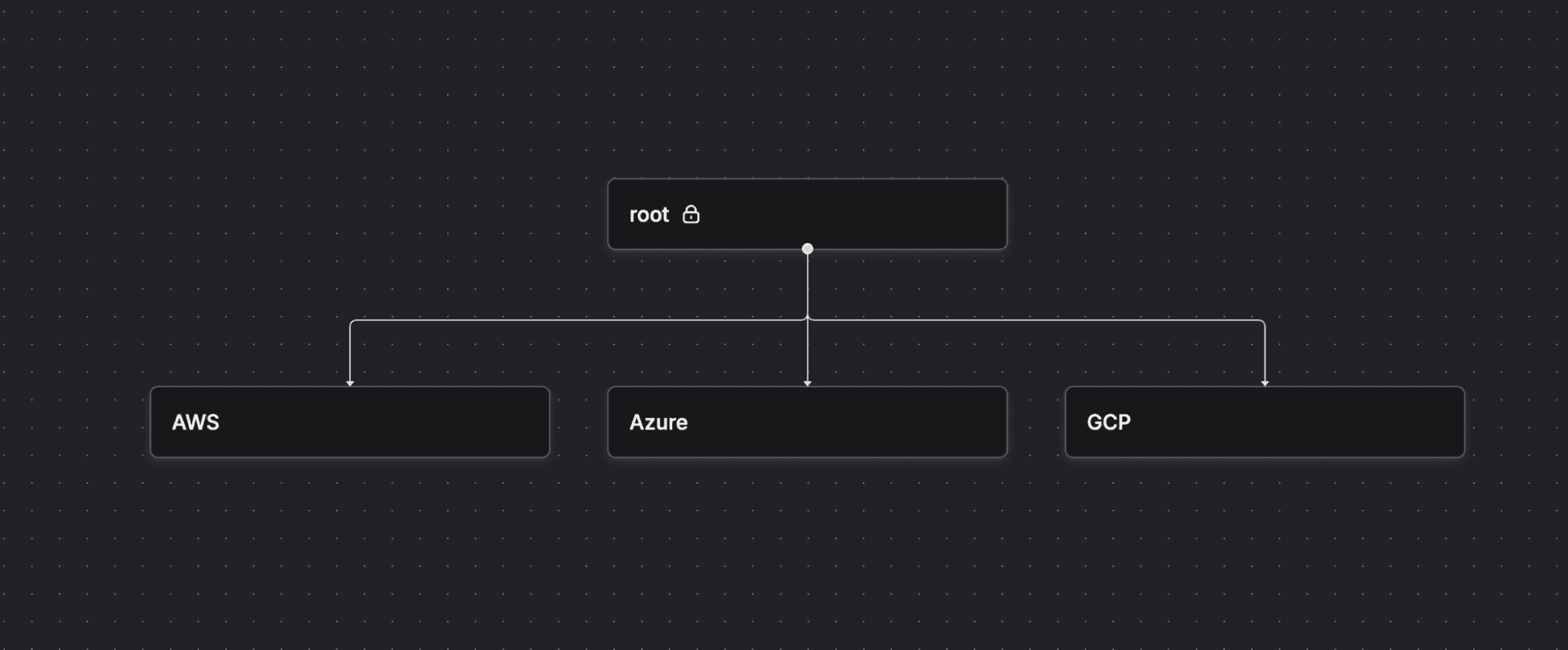
Implementing effective identity, access, and governance controls is often one of the most time-consuming tasks involved in building an IDP. Not only must you actually build your governance framework, but you also need to test it performs correctly in different scenarios.
IDP tools and frameworks can help simplify this process, but if you’re building from scratch, then you’ll need to integrate external IAM solutions or roll your own system.
5. Scales without you scaling it
Spacelift scales to enterprise infrastructure needs. It offers flexible deployment models for different use cases: you can run the platform in the cloud or on-premises, while support for private workers ensures stable performance at scale.
Spacelift’s flexible Stacks and Spaces also let you precisely model your team’s infrastructure architecture within your Spacelift account.
That scope is also the limit. If your platform needs to cover more than infrastructure (developer onboarding, incident response, service catalogs, internal app deployments), a general-purpose IDP gives you one surface for all of it. Spacelift is bounded to infrastructure orchestration.
Teams that want a single platform covering every developer workflow are going to build it, or adopt something broader like Backstage or Port and take on the integration work that follows.
The honest trade-off: own the platform and customize anything, or use Spacelift and skip the build for the infrastructure portion entirely.
6. Automatic drift detection and remediation
Automated drift detection and remediation is one of the Spacelift features that users find most valuable. You can enable scheduled drift detection scans with a single toggle, ensuring you’re alerted as soon as your infrastructure deviates from its expected state. This guards against inconsistencies that could cause downtime or security incidents.
Spacelift can also reconcile drift automatically. Using its access to your infrastructure, state files, and IaC configs, Spacelift reinstates the correct configuration by triggering a new run of your stack. This further reduces the time during which infrastructure can remain in an incorrect state.
Drift detection isn’t typically included in IDP frameworks because it’s relevant only to infrastructure environments. Implementing drift management within your own IDP can be complex and needs robust governance controls to prevent unsafe automated reconciliations.
Spacelift makes this easy by allowing you to use the platform’s existing policy system to detect drift reconciliation runs, then requiring approval for potentially risky changes.
When to use Spacelift?
Spacelift fits when infrastructure orchestration is the problem you need to solve, and you’d rather not spend a year building the platform that solves it.
It fits when your platform team writes more glue code than infrastructure code, when developers wait on Terraform PRs because they can’t self-serve, when you need policy, RBAC, drift detection, and audit on day one instead of after a build cycle, and when you want to run on-premises or in your own cloud without losing platform features.
You skip building a custom portal, a run engine, and integrations for AWS, Azure, Google Cloud, and every IaC tool you support. Those are the pieces that take longest to build and break first when something upstream changes.

Figma uses Spacelift to orchestrate hundreds of infrastructure stacks across AWS, bringing structure, visibility, and order to Terraform and OpenTofu workflows at scale. By centralizing infrastructure deployments and integrating them tightly with CI, Spacelift enables Figma’s platform teams to support hundreds of engineers without becoming a bottleneck and also buying the time needed to refactor deeply coupled infrastructure code.
When to use an Internal Developer Platform?
An internal developer platform (IDP) makes sense when infrastructure is one of several problems your platform needs to solve. If your developers also need app deployment workflows, service catalogs, on-call rotations, or onboarding paths, a custom IDP, or a framework like Backstage or Port, gives you one place for all of it.
Building or adopting one is the right call when you have a dedicated platform team that can own the system long-term, and when consolidating workflows beats the cost of integrating multiple specialized tools. That math usually works at scale, typically once the platform team has at least three to five engineers and the company is past a handful of internal services.
Spacelift and an IDP aren’t mutually exclusive. Many teams use Spacelift as the infrastructure layer behind a broader IDP, so they get the orchestration without building it, and the IDP without rebuilding the orchestration.
Key points
Spacelift and Internal Developer Platforms (IDPs) overlap in several ways, both of which make it easier to manage complex DevOps workflows. But whereas IDPs are custom systems that usually provide self-service access to many different tools and processes, Spacelift focuses on making infrastructure operations as effortless as possible.
In summary, IDPs have a broad scope and infinite customization, while Spacelift is a powerful, ready-to-use solution for managing infrastructure using internal platform principles. It gives developers, operators, and governance teams a proven solution for collaborating on infrastructure at scale. Teams using Spacelift ship infrastructure faster and more safely, without having to invest in expensive IDP development projects.
If you’d like to explore Spacelift’s features in more detail, try booking a demo with an engineer. You can also get started for free today.
Solve your infrastructure challenges
Spacelift is a flexible orchestration platform for IaC development. It delivers enhanced collaboration, automation, and controls to simplify and accelerate the provisioning of cloud-based infrastructures.
Frequently asked questions
Is Spacelift an internal developer platform?
Spacelift is an infrastructure orchestration platform, not a full IDP, though it provides many IDP-style capabilities for infrastructure, such as self-service provisioning, RBAC, policies, and Blueprints. It is often used as the infrastructure layer behind a broader internal developer platform.
Do I need an IDP if I use Spacelift?
Spacelift handles infrastructure self-service, governance, and golden paths through Blueprints, Templates, Spaces, and policies. You only need a dedicated IDP like Backstage or Port if you also want a unified developer portal covering services, docs, scorecards, and non-infrastructure workflows.
How does Spacelift handle self-service provisioning without a custom IDP?
Spacelift uses Blueprints and Templates to expose pre-approved infrastructure as form-based, parameterized workflows. Platform teams define guardrails through Spaces, policies, and RBAC, then developers provision resources via the UI, spacectl CLI, API, or the ServiceNow integration, no custom portal required.