
Internal developer platforms (IDPs) bring self-service to the DevOps lifecycle. They can improve productivity by reducing friction in the developer experience (DevEx), but the build-vs-buy decision is rarely straightforward.
In this article, we’ll break down the pros and cons of each approach. We’ll share the key questions to ask before you decide, then close with practical guidelines for when it makes sense to build, buy, or combine the two. We’ll also cover how a hybrid model lets you extend a purchased solution with your own workflows.
What we’ll cover:
TL;DR
Building an Internal Developer Platform (IDP) gives you maximum flexibility, control, and security fit, but it’s slower and more expensive because you own the build and ongoing maintenance. Buying an IDP speeds up developer self-service and standard workflows, but can limit customization and increase vendor lock-in.
Many teams use a hybrid build-vs-buy IDP strategy: buy a strong core for governance and orchestration, then extend it with custom golden paths and integrations via APIs and plugins.
What is an Internal Developer Platform (IDP)?
Internal Developer Platforms (IDPs) are the primary deliverables of platform engineering. They’re self-service platforms designed to solve common, everyday developer needs.
Platforms provide developers with a unified portal interface to access prebuilt automation. For instance, your platform could include a service that lets engineers launch new development environments with a single click. The platform team maintains these services as “golden paths” to ensure developers continually follow best practices.
Understanding the build vs buy for IDPs
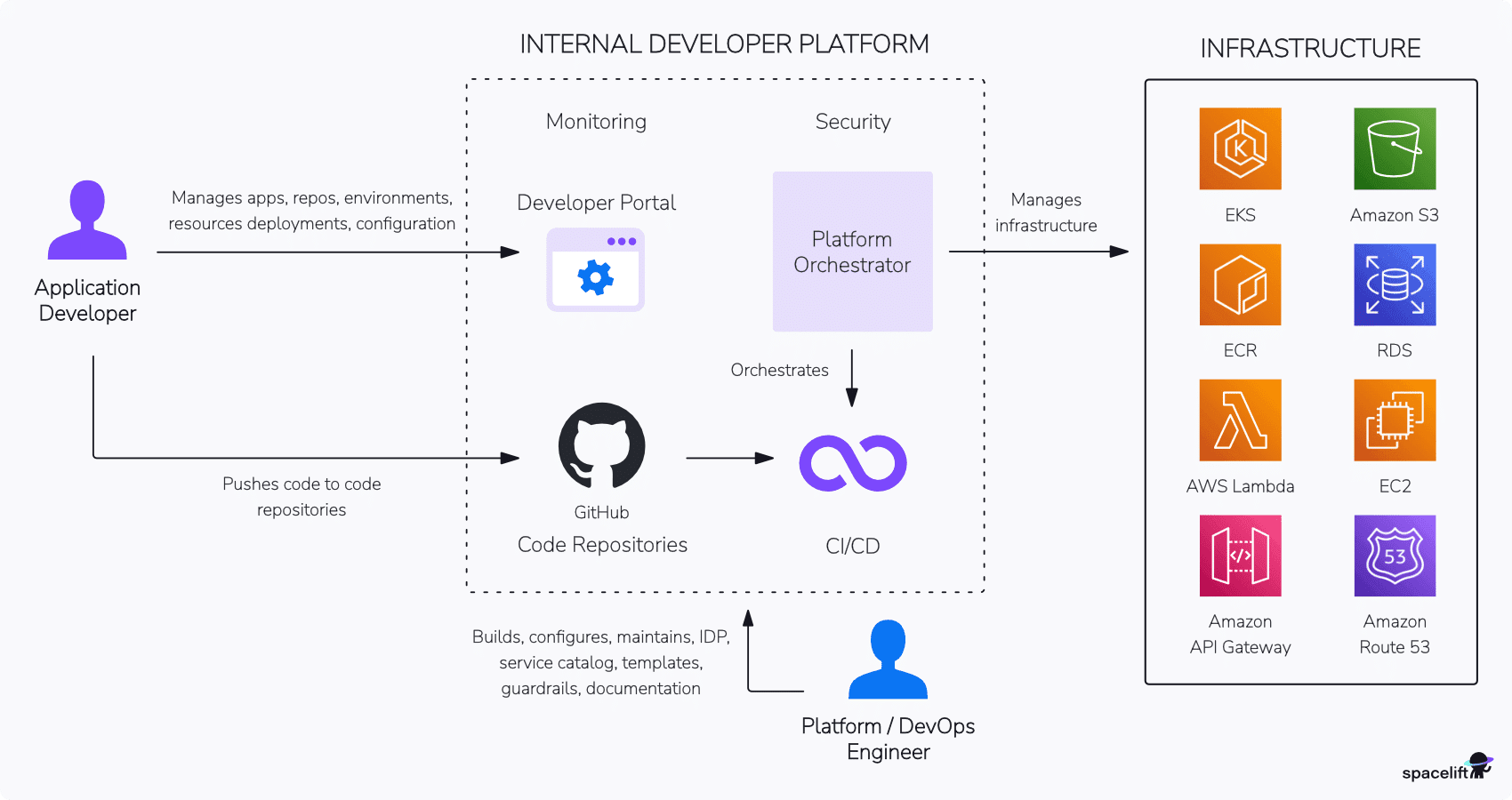
IDPs can be complex to implement. They involve several different tools and components working together:
- A self-service developer portal, providing access to the platform’s services
- Integrations with cloud providers, CI/CD solutions, and other developer tools
- Infrastructure management capabilities
- Deployment lifecycle management
- Workflow and process automation systems
- Robust observability, security, and audit layers
The relationships between these features are key to the choice between building or buying an IDP.
Building your own platform lets you tailor workflows to your existing operating model, but it also demands significant engineering time and ongoing maintenance. Buying a prebuilt platform helps you deliver self-service faster, but it can introduce constraints as your needs evolve.
To summarize the two models:
- Building an IDP gives you absolute power and flexibility, but carries a high upfront cost. You need to hire dedicated platform engineers to build and maintain your platform. It’s crucial to gain internal buy-in so the platform’s treated as a product that all stakeholders are fully committed to.
- Buying an IDP like Spacelift, Port, or Qovery means you might have to accept some opinionated workflows, but you can experience the value much faster. Buying may also offer scalability benefits, as you don’t have to maintain the platform yourself. Buying is not without risk, however: you could experience vendor lock-in, or struggle to integrate cloud solutions with legacy systems.
The appeal of each approach also depends on your organization’s scale and industry. For example, teams in regulated environments may lean toward building to meet stricter security and compliance requirements, even if implementation costs are higher.
By contrast, organizations that want to keep their focus on core product engineering often choose to buy an IDP that delivers value quickly.
How to decide between building vs buying: Key questions to ask
Here are seven key factors to consider when choosing between building and buying an Internal Developer Platform (IDP). Scoring each solution across these points should reveal which option best fits your team’s operational needs and strategic priorities.
1. What is your organization’s scale?
The overall size of your organization, as well as the structure of individual teams, usually determines the feasibility of building an IDP.
If your organization is small, you’ll need to assess whether you can commit enough engineering capacity to launch and sustain a platform on a practical timeline. Even large businesses with stable platform teams may not benefit from building an IDP unless it can quickly serve the needs of all developers.
2. What is your overall DevOps maturity?
Platform engineering builds upon DevOps fundamentals, so your ability to build a successful IDP is closely linked to your overall DevOps maturity. Without a strong DevOps foundation across automation, infrastructure orchestration, and governance, it’s challenging to implement platforms capable of supporting real-world workflows.
Buying a platform can help address this by providing opinionated processes that fill gaps in your DevOps systems.
3. Do you have any engineering constraints?
Buying an IDP eliminates most platform-level engineering work. You just need to implement any custom services you need, then configure integrations with your existing tools. This makes buying a convenient choice when constraints like team availability, technical inexperience, or restricted hosting environments make a self-build IDP unattractive.
There is a flip side, though: when you buy, you need to spend time becoming familiar with your chosen platform, potentially learning new technologies as you go. You’re also subject to the other constraints imposed by the platform itself, such as usage restrictions or API limitations.
Therefore, building may be the more effective option if you have specific engineering requirements around programming languages, data residency, security, or scalability.
4. Are there any required tooling integrations?
If you know your platform will need to integrate with specific tools, then it’s crucial you check that bought-in IDPs are actually compatible. Even where an integration is advertised, it might not support the specific workflows you depend on. Building avoids this problem because you can create the integrations you need, but you’re then responsible for maintaining them long-term.
The decision here may also pivot on how frequently you adopt new technologies. If you’re often revising your workflows to include cutting-edge tools, then building a platform gives you the flexibility to continue this pattern, limit-free. Bought platforms may be harder to use with emerging technologies like next-gen AI agents.
5. What are your security and observability needs?
IDPs must be both secure and observable to ensure reliable operations. When developer workflows are driven by a single platform, any security breach or missed alert has the potential to cause catastrophic disruption.
If you’re buying an IDP, then the vendor will be largely responsible for the platform’s security. Vendors won’t necessarily meet the regulatory standards you require, however, which could make buying a solution unviable.
Building your own platform means you can be certain your standards are met, including when they’re unusual or more stringent than SaaS solutions provide. Yet you’ll also be solely responsible if any breach occurs.
6. What are the budget constraints?
Building vs buying an IDP has huge cost implications. Building an IDP requires a large upfront investment to get your platform off the ground. The cost is mainly tied to the engineering time needed to successfully bring a new IDP into use.
While buying a platform means you avoid this initial spend, it commits you to paying the vendor indefinitely. With billing typically per seat, per month, or per pipeline run, bought solutions require a significant ongoing budget throughout their life. This means buying makes sense when your finances are tuned for ongoing operating costs, whereas building lets you treat the upfront implementation as a capital expense.
7. What are your platform team’s capabilities and skills?
Your platform team’s skillset can influence whether it’s best to build or buy an IDP. If you already have a mature team with plenty of experience, building a new platform around your existing processes can be relatively quick and easy.
On the other hand, buying a platform allows engineers to focus on creating developer-facing services, rather than assembling the basic platform infrastructure. This is a better fit for smaller teams where you’d otherwise have to hire new talent just to operate your IDP.
Build or buy: When to build an Internal Developer Platform (IDP)?
There’s no definitive answer for when it’s worth building an IDP. However, in general, it’s likely to be the best option if you’re a larger organization, have a mature platform team, and have many unique requirements for how your IDP should work.
In this scenario, building a platform gives you the customization and flexibility your operations need. It ensures you can apply custom security protections, integrate with all the other services you use, and keep your platform aligned with your existing ways of working. Nonetheless, you must be prepared for the upfront cost and ongoing maintenance involved.
Build or buy: When to buy an Internal Developer Platform (IDP)?
Buying an IDP is a pragmatic option for teams that can’t (or don’t want to) commit the engineering resources and financial investment required to build a bespoke platform. Bought platforms have many advantages of their own: they’re usually faster to implement, require less ongoing maintenance, and can help shift responsibility for security incidents onto the vendor.
Opting to buy doesn’t mean you’re getting an inferior IDP. On the contrary, bought solutions provide maximum value from day one, while DIY platforms may take months or years to mature.
Purchasing an IDP also means platform teams can focus more closely on core development tasks. This helps sustain productivity and improve your competitive edge.
Building and buying: The hybrid model
If you’re thinking of buying an IDP but are unsure about the limitations, then adopting a hybrid model could be the best fit for you. Both open-source and commercial IDP implementations are often customizable through plugins, extensions, and APIs. This lets you evolve from “buy” to “build” while optimizing costs, time-to-value, and engineering flexibility.
Under this model, your bought-in components act as a springboard that provides the core platform functionality. You then layer custom workflows, interfaces, and tools on top, without having to get involved with scaffolding the foundation.
For example, you could use Spacelift for your infrastructure orchestration needs, then build your own tooling to deeply integrate our platform with your existing systems.
Here’s a quick comparison table if you are still unsure:
| Factor | Build | Buy | Hybrid (Buy core + build on top) |
| Best fit when | Larger org, mature platform team, many unique requirements | Teams that can’t/don’t want to invest to build | Want to buy but need flexibility; avoid foundation work |
| Time to value | Slow (months/years) | Fast (value from day one) | Fast core + incremental customization |
| Engineering resources | High | Low | Medium |
| Ongoing maintenance | High (you own it) | Low (vendor handles more) | Medium (vendor core + your custom layers) |
| Customization & integrations | Maximum flexibility; deep integrations | Good, but within vendor limits | High via plugins/APIs + custom workflows on top |
How can Spacelift help you build your Internal Developer Platform?
Spacelift helps you manage infrastructure as code (IaC) at scale with purpose-built CI/CD across cloud providers — while preserving developer autonomy.
Because Spacelift supports Terraform, OpenTofu, Ansible, and Pulumi, you can standardize workflows across your internal developer platform (IDP), even when teams use different IaC tools. Spacelift also gives you clear visibility into your infrastructure resources and lets you enforce policies and guardrails.
You can use Spacelift as the foundation layer of your IDP by creating different stacks to support your development functions. Each stack encapsulates your source code, infrastructure state, and deployment configuration. In the Spacelift UI, stacks can be queued, triggered, canceled, and inspected, so you can check the health of your infrastructure at a glance.
Use stack dependencies to model complex environments and share outputs between stacks. And with Blueprints, you can add standardized self-service workflows to simplify self-service provisioning.

Global payments platform Checkout.com committed itself to the goal of “IaC for everything,” and Spacelift delivered, offering a platform that teams could start using independently with minimal configuration — all within the constraints of the regulated environment Checkout.com operates in.
Key points
Build or buy: it’s one of the biggest decisions to make when planning a new Internal Developer Platform (IDP). We’ve seen strong arguments on both sides, but the right choice is the one that aligns with how your teams operate now and how you expect them to operate next year.
Use the considerations above to identify the factors that will shape your platform’s success. Evaluate each option against your priorities, with an eye on long-term value. Whether you need the customization and flexibility of a DIY approach or the simplicity and lower maintenance of a ready-made platform, make a forward-looking decision, not one based only on today’s engineering needs.
If you want to use a product that greatly enhances the lives of your platform team members, create a free account with Spacelift today, or book a demo with one of our engineers.
Solve your infrastructure challenges
Spacelift is a flexible orchestration solution for IaC development. It delivers enhanced collaboration, automation, and controls to simplify and accelerate the provisioning of cloud-based infrastructures.
Frequently asked questions
How does an IDP differ from a PaaS?
An IDP (Internal Developer Platform) is a productized layer your organization builds to standardize how teams ship software, while a PaaS (Platform as a Service) is a vendor-managed runtime and deployment platform you consume. An IDP may be built on top of one or more PaaS or IaaS targets, adding consistency, governance, and UX across teams.
How long does it typically take to build an IDP from scratch?
Most teams take 3 to 12 months to build an internal developer platform (IDP) from scratch, with a thin but usable “v1” often possible in 6 to 10 weeks if scope is tight. The range depends mainly on how much you’re standardizing and how many integrations you need.
What are common mistakes teams make when building an IDP?
Common IDP mistakes are overbuilding a “platform product” without clear developer outcomes, and underinvesting in the boring parts like ownership, support, and documentation. The result is low adoption, fragmented tooling, and a platform that becomes a bottleneck instead of an accelerator.