
If you’re running Scalr, you’re already a level beyond generic CI/CD, and the question now is whether it still fits. Scalr handles Terraform, OpenTofu, and Terragrunt well with a remote backend, OPA policies, drift detection, and RBAC on every plan including the free one.
What usually changes is the estate around Scalr, and the accompanying requirements. Teams usually start investigating alternatives for one of three reasons: when they add Pulumi, Ansible, or CloudFormation and want one control plane for all of it; when a compliance review calls for running the control plane themselves; or when run volume grows to the point where a per-run model is worth remodeling against the alternatives.
This article covers what Scalr is built for, why teams look elsewhere, how to evaluate the options, and which one fits your setup.
The short answer: Scalr runs Terraform, OpenTofu, and Terragrunt only, so teams leave when they adopt a tool it doesn’t support, when compliance needs the control plane self-hosted, or when run volume outgrows per-run pricing.
Spacelift is the fit for multi-IaC estates, env zero for cost governance, HCP Terraform for staying HashiCorp-native, Terrakube for open source you run yourself, and Atlantis for pull request automation alone.
Note: Spacelift is the publisher of this article, so the Spacelift entry below carries a vendor perspective. We’ve included ourselves so you can compare directly, but treat that section as our pitch, not an independent ranking.
What is Scalr?
Scalr is a Terraform Automation and Collaboration Software (TACOS) platform built around a remote operations backend. It supports Terraform, OpenTofu, and Terragrunt, and targets platform engineers building self-service workflows for developers.
Scalr’s core features include:
- PR-native GitOps: You get PR slash commands, apply-before-merge, rich plan, and apply summaries posted to pull requests.
- State management: Scalr gives you the option to store your state in their product, or in your own bucket.
- Policy as code: You can enforce policies through Open Policy Agent (OPA).
- Drift detection and remediation: You can easily take advantage of built-in drift detection and remediation workflows.
- Self-hosted workers: You can run workflows on your own infrastructure.
Why do teams look for a Scalr alternative?
Scalr delivers what it promises, so most teams leave for structural reasons.
The biggest issue with Scalr is that it only natively supports Terraform, OpenTofu, and Terragrunt. This becomes a limitation, especially if your organization uses Pulumi, Ansible, or CloudFormation, or wants to orchestrate Kubernetes deployments through the same control plane. You typically end up using different tools for Pulumi, Ansible workflows, and Kubernetes workflows, leading to tool fragmentation.
The only self-hosting option you have with Scalr is using their SaaS with self-hosted agents. For organizations with strict data residency requirements that need the platform to be self-hosted as well, this simply won’t work, as they also need to self-host the control plane, which is currently not supported.
If you are building a highly customized platform, Scalr won’t help because it might not provide the level of orchestration you require. It does offer custom hooks, API-driven workspaces, and customizable execution environments, but these are designed primarily to extend Terraform and OpenTofu workflows.
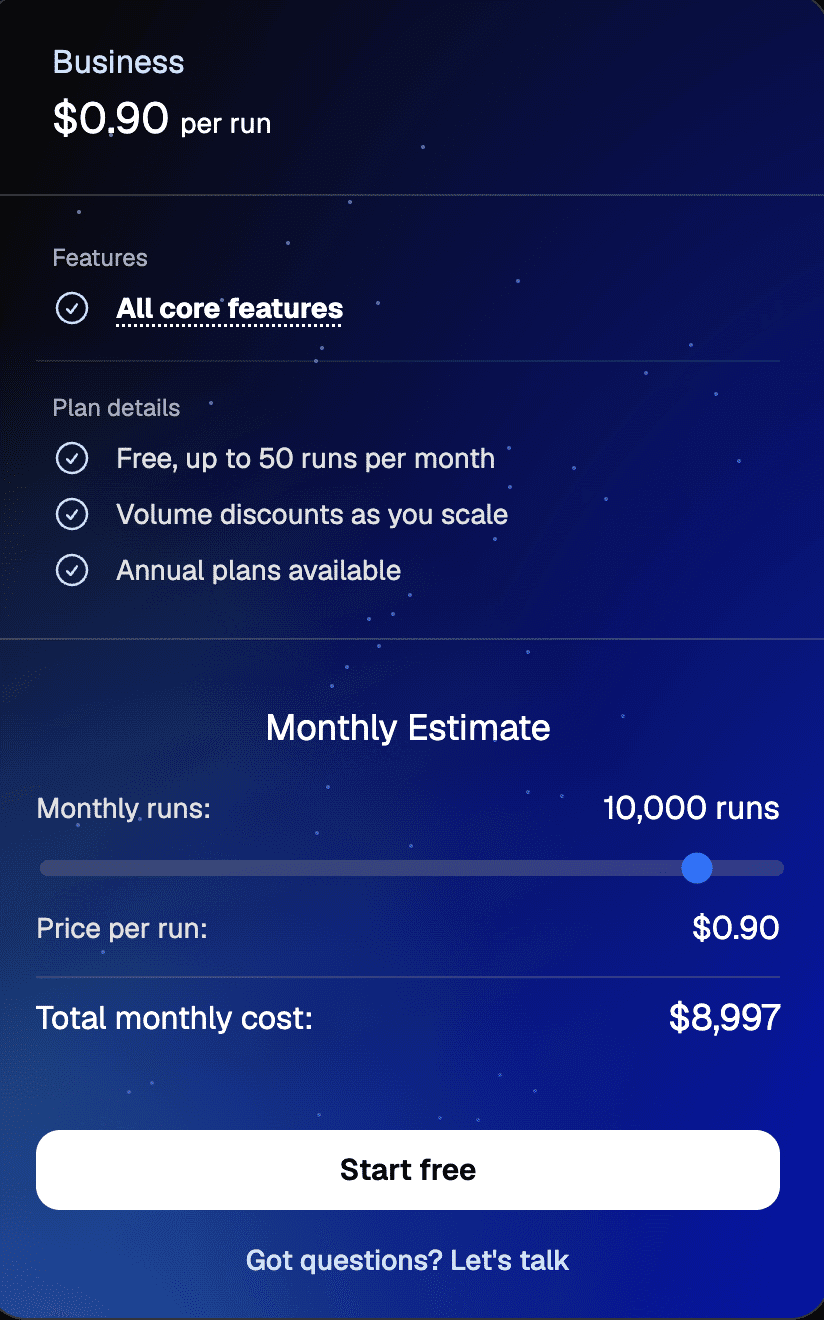
Scalr also has a per-run pricing model, which can be a great fit if your run volume is predictable and moderate. However, running a large number of automated plans can increase your bill significantly. While scheduled drift-detection runs are not billed, runs triggered to remediate detected drift count toward usage.
None of these apply universally. If you run Terraform and OpenTofu only and don’t expect that to change, your setup sits inside what Scalr is designed for. Its remote backend keeps terraform plan working unchanged from any engineer’s terminal, drift detection, OPA policies, RBAC, and SAML SSO are included on every plan, and Terragrunt run-all with dependency resolution is supported natively. Whether the reasons above matter depends on where your estate is heading.
How to evaluate a Scalr alternative
Comparing features might seem the most straightforward approach, but it can distract you from the factors that will affect your workflows and long-term operating costs most.
Here’s a list of questions you should ask yourself before selecting a Scalr alternative:
- How broad is my IaC strategy? If you are just using Terraform/OpenTofu/Terragrunt today, and that is likely to remain the case, you might not really need an alternative. However, if you are already using Pulumi, CloudFormation, Ansible, or Kubernetes, or you expect to adopt any of them, you should prioritize a different product now, rather than rebuilding your platform when you adopt a new tool.
- Self-hosted or SaaS? If you ever need a pure self-hosted environment, you definitely need a Scalr alternative, as the only way to self-host is actually SaaS + self-hosted agents.
- How much governance do you need? Investigate exactly what Scalr and the alternatives offer in terms of governance and RBAC, and match it with your organization structure. Also, check which pricing tiers offer these features.
- What kind of pricing model works for you? Per-run, per-resource, per-concurrency all behave differently under load. You should try to model your real usage against each. Keep in mind that a model that might seem cheap at a small scale can invert at a larger scale.
- How well can self-service workflows be implemented? You should see if the product you want to adopt integrates with what your developers use (e.g., ServiceNow, Backstage).
Note: Don’t choose based on today’s setup. You have to anticipate how your platform will look in 12 to 18 months.
Scalr alternatives comparison table
The table below compares different Scalr alternative options:
| Feature | Scalr | Spacelift | HCP Terraform | env zero | Atlantis |
| First class IaC support | Terraform, OpenTofu, Terragrunt | Terraform, OpenTofu, Terragrunt, Pulumi, Ansible, CloudFormation, Kubernetes | Terraform, Terragrunt (indirectly) | Terraform, OpenTofu, Terragrunt, Pulumi, CloudFormation, Kubernetes, Helm | Terraform, OpenTofu, Terragrunt |
| Policy as code | OPA | OPA across multiple decision points | Sentinel, OPA | OPA | Conftest and custom policy checks |
| Drift detection | ✅ | ✅ | ✅ | ✅ | None built in |
| Cost estimation | Cost estimation via Infracost | Cost estimation via Infracost | Cost estimation | Strong native FinOps, tagging, spend reporting | No |
| Self-hosted | SaaS control plane + Self-hosted agents | Self-hosted runners + fully self-hosted control plane | Self-hosted runners + fully self-hosted control plane (Terraform Enterprise) | SaaS control plane + Self-hosted agents | Fully self-hosted, no SaaS version |
| State management | Scalr backend, or your own S3/GCS bucket, or a non-Scalr backend with reduced functionality | Managed state, or bring your own backend | Managed state | Managed state | None. Bring your own backend |
| Pricing model | Per run. Free to 50 runs/month, then $0.99/run with volume discounts | Per concurrency (workers). Free plan, then Starter+ at $20,000/year; Business and Enterprise quoted | Per resource under management. Free to 500 resources, then $0.10 / $0.47 / $0.99 per resource-month | Per apply or environment. Free tier, paid tiers quote only | Free. You pay only for hosting |
| Best for | Terraform/OpenTofu teams seeking a HCP Terraform alternative with per-run pricing | Multi-IaC platforms needing deep policy + CI/CD control | Staying HashiCorp native | FinOps-led + multi-IaC governance | Single-team PR automation on a budget |
Note: Pricing models shift, and vendor tiers typically change what is included. Before committing to one product or another, reference the vendor’s own pricing page.
The best Scalr alternatives by scenario
All products have their own strengths and weaknesses, so there is no single best replacement for every organization. To get the right answer, you need to understand where your platform is heading.
Let’s explore the options according to various scenarios:
If your estate is multi-IaC or expanding → Spacelift
If you use more IaC tools than Terraform, OpenTofu, and Terragrunt, Spacelift is the most direct answer for your organization. With Spacelift, you get a multi-IaC orchestration platform that offers a single control plane for Terraform, OpenTofu, Terragrunt, Pulumi, CloudFormation, Ansible, and Kubernetes.
Spacelift also offers built-in dependencies between your stacks, making it easy to share outputs. These are directed acyclic graphs, and they can go on as many nested levels as you want, enabling you to easily understand what fails and where.
Spacelift’s policy engine runs at multiple decision points, which also sets it apart. You can control what kind of resources engineers can create, what kind of parameters these resources can have, how many approvals you need for runs, where to send notifications, and what happens when a PR is opened or merged.
If you want to learn more about Spacelift, check this article.

Student information system Infinite Campus serves 11 million K–12 students across 46 states, so its infrastructure must be reliable and secure. When the team started using Terraform, their immediate priority was to manage state files and roles across AWS infrastructure in a secure, coherent way. Spacelift provided the necessary governance, flexibility, and affordability to help them handle both cloud and on-premises deployments consistently and simply.
If you’re staying HashiCorp-native → Terraform Cloud (HCP Terraform)
If you want to stay in the HashiCorp ecosystem (the official registry, Sentinel policies, and the HashiCorp Roadmap), your best bet is HCP Terraform itself. This is the tool that Scalr set out to replace, so moving here would actually be a decision about the ecosystem alignment over the cost.
With HCP Terraform, you get Sentinel and OPA policies, as well as first-class support for your Terraform workloads.
However, HCP Terraform uses RUM pricing, and it scales with the size of your infrastructure rather than with deployment frequency or the number of workloads running in parallel. This is why some teams moved to Scalr’s per-run model in the first place.
If you’re FinOps-led and multi-IaC → env zero
env zero works if you need precise control over your infrastructure costs, not just your IaC platform costs. It has a powerful FinOps layer on top, and it also supports Terraform, OpenTofu, Pulumi, CloudFormation, Kubernetes, and Helm from a single control plane.
Cloud Compass, its IaC coverage and drift-risk layer, scans a connected cloud account and flags resources not managed by IaC, so you can pull ClickOps resources back under governance. It’s included on the free plan for one account.
Check the tiering first. The free plan covers 250 runs a month across 30 environments. But cost estimation, actual cost visibility, and budget thresholds sit on Cloud Pilot, the top tier, and both paid tiers are quote-only.
See also: env zero Alternatives: 6 IaC Platforms Compared
If you want the open-source Terraform Cloud model → Terrakube
If you want something that’s open-source and fully self-hosted, Terrakube is the closest match to HCP Terraform. It supports Terraform and OpenTofu, and it is Apache 2.0–licensed.
With Terrakube, you get a private registry for modules and providers, remote state management, scheduled and ephemeral workspaces, and dynamic provider credentials that are generated on demand and destroyed after use.
The trade-off is the usual one for self-hosted open-source products: You have to run, patch, scale, and support it. If you have a team that manages it and a strong preference for open source, this is as close as you can get to HCP Terraform without the platform fee.
If you just need PR automation for one team → Atlantis
If you don’t need a full infrastructure orchestration platform, and you have a single team that simply wants Terraform/OpenTofu runs driven from pull requests, Atlantis is the open-source answer.
Atlantis is minimalist when compared with other infrastructure orchestration platforms. For a small team, Atlantis is a good choice, but at scale, you might have several friction points that other products mentioned in this section would easily address.
Also worth knowing: OpenTaco (Digger), Terramate
There are two more tools that you should have on your radar:
- OpenTaco: Formerly known as Digger, OpenTaco is an open-source, self-hosted CI/CD tool for running Terraform and OpenTofu inside existing pipelines, rather than in a separate SaaS. If you want to keep execution in your own CI, and add a state and orchestration layer without adopting a new platform, OpenTaco might be a good choice.
- Terramate: With Terramate, you can manage Terraform, OpenTofu, and Terragrunt stacks with graph-based change execution: it detects what changed in a commit, and re-runs only the affected (or drifted) configurations in parallel, with state-aware retries. Typically, Terramate will sit alongside another platform rather than replacing it, as it makes large, multi-stack configurations run faster and more manageable, rather than being a one-for-one Scalr swap.
Which Scalr alternative should you choose?
To choose the best Scalr alternative means figuring out why you are leaving Scalr in the first place:
- If you need a multi-IaC platform that scales, Spacelift is the strongest choice, especially if you also require deep policy-as-code control, dependencies between configurations, and self-service workflows
- If you need a multi-IaC platform with FinOps built in, env zero is the strongest fit with cost governance and FinOps tools integrations
- If you want to stay in the HashiCorp ecosystem, HCP Terraform is your best choice, as long as you are comfortable with RUM pricing
- If you want an open-source HCP Terraform, Terrakube is going to be the closest you get, if you are comfortable with running it on Kubernetes
- If you are a small team and just need PR automation, Atlantis is your best choice, as it can get you up and running fast
- If you want to keep execution in your own CI, choose OpenTaco
- If you need to speed up a large multi-stack estate, Terramate should be your choice
Migrating infrastructure orchestration platforms should not be done lightly. It can be very expensive to go through multiple platforms in a single year, so it’s important to model your real usage and try to anticipate where you’ll go in the next year before committing to a new platform.
How hard is it to migrate off Scalr?
The work depends on which layer you are replacing, not on which product you pick.
- State is the first question. If you use the Scalr backend with your own S3 or GCS bucket, your state already lives in your cloud account and the move is mostly repointing the backend. If you use Scalr’s own blob storage, plan a state export and re-import per workspace.
- Policies mostly travel. Scalr and Spacelift both use Open Policy Agent, so your Rego library is largely portable. You will rewrite the integration points, not the policy logic. Moving to Sentinel on HCP Terraform means rewriting.
- Structure does not map one to one. Scalr’s account, environment, and workspace hierarchy does not translate directly to Spacelift’s stacks and spaces or to env zero’s projects and environments. Budget design time for that, not just migration time.
- What usually takes the longest is not the platform move. It is re-establishing the RBAC model and provider credential wiring in a new permission system.
Key takeaways
Scalr is a good HCP Terraform alternative, and it can be really cost-effective by comparison. It natively supports Terraform, OpenTofu, and Terragrunt only, which is one of the main reasons growing or multi-IaC teams start looking elsewhere.
Choosing an alternative depends on the problem you are trying to solve: multi-IaC support, deeper governance, FinOps-grade cost visibility, open-source self-hosting, or even being close to the Terraform ecosystem.
If you are currently evaluating a move off Scalr and your infrastructure spans more than one IaC tool, you need powerful self-service workflows and AI infrastructure support for your development environment; Spacelift would be a great fit.
Book a demo with one of our engineers to learn more about how we can help.
Solve your infrastructure challenges
Spacelift is a flexible orchestration solution for IaC development. It delivers enhanced collaboration, automation, and controls to simplify and accelerate the provisioning of cloud-based infrastructures.
Frequently asked questions
What's the difference between Scalr and Spacelift?
Scalr is a Terraform Cloud-style remote operations backend focused on Terraform, OpenTofu, and Terragrunt with per-run pricing, while Spacelift is a broader orchestration platform that also runs Pulumi, CloudFormation, Kubernetes, and Ansible with concurrency-based pricing.
Can Scalr be self-hosted?
The control plane runs only as SaaS, but Scalr supports self-hosted agents that execute Terraform runs and connect to private VCS entirely inside your own network, giving a hybrid deployment without the operational overhead of a fully self-managed platform.
What is the best Scalr alternative for multi-IaC teams?
Spacelift is the strongest fit, since it orchestrates Terraform, OpenTofu, Pulumi, CloudFormation, Kubernetes, and Ansible from a single control plane with OPA-based policy enforcement. env0 is a credible second option if FinOps and cost visibility are priorities.