
Change management in cloud computing is the process of structuring config updates, deployments, and operational tasks to achieve an organized approach to change. Instead of relying on brittle ad hoc updates, change management systems layer dependable processes that ensure changes are intentional, visible, and easy to govern.
This article explores the benefits of cloud change management for your operations. We’ll discuss some key components to include in a change management strategy and share tips for getting started in your own organization.
What we’ll cover:
TL;DR
Cloud change management is the governance and operational discipline for planning, approving, testing, and rolling out changes to cloud infrastructure, platforms, and applications without disrupting service.
It improves reliability, security, and cost control by reducing drift, preventing misconfigurations, and making deployments predictable and auditable.
A solid cloud change management strategy typically combines clear ownership and approvals, standardized change workflows, infrastructure as code, CI/CD with automated testing, risk and impact assessment, monitoring and rollback plans, and continuous documentation.
What is cloud change management?
Cloud change management is a disciplined approach to preparing, applying, and monitoring changes in your cloud environments. It uses automated deployment tools such as IaC and CI/CD, visibility mechanisms like labels, and integrations with policy-driven governance systems to ensure changes are made reliably and consistently.
The need for cloud change management stems from the high volume of changes in large cloud environments.
Cloud infrastructure offers high speed and flexibility, enabling you to dynamically create and delete short-lived resources on demand. But this makes it challenging to monitor what’s actually happening in your environments, or understand the downstream effects of different changes.
Cloud change management solves this problem by providing a structured framework for dealing with change. It defines how you make changes, monitors their effects, and centrally tracks crucial data such as each change’s source, who approved it, and your system’s state before and afterwards. This improves safety and reduces operating costs by minimizing the risk of changes failing.
What are the benefits of cloud change management?
Implementing a cloud change management strategy offers far-reaching benefits for cloud operations and the DevOps lifecycle. Its effects span from engineering-level advantages up to business-level improvements, such as increased service reliability.
Here are some of the key ways in which cloud change management creates operational value.
1. Visibility and governance
Deliberate cloud change management ensures clear visibility into changes across your environments. Using a single pipeline to apply each change improves transparency. You can centrally record each change’s details, ensuring each revision can be audited in the future.
The model also improves change governance opportunities. Structured change management systems allow you to easily enforce internal standards, such as requiring approvals from relevant stakeholders before sensitive systems are changed. This enables safer, more accountable operations at scale.
2. Reliability and predictability
Standardizing how you manage cloud changes makes your environments more predictable. With predictability comes reliability, allowing you to more easily attain your cloud service targets.
Cloud change management delivers these improvements through the use of repeatable, automated mechanisms to prepare changes.
For example, combining infrastructure as code (IaC) with CI/CD pipelines ensures infrastructure changes are deployed using a single consistent process. Not only does this eliminate human error, but it also allows you to be certain what state your environments will be in after the deployment completes.
Improved predictability also enables more accurate planning of new changes: Teams can be confident in how long it’ll take to deploy a change, or what the effects will be on existing components. This further helps to prevent unexpected disruption from occurring after deployments.
3. Reduced risk of incidents
Problems stemming from incorrect changes cause many real-world cloud incidents. From misconfiguring infrastructure resources to forgetting to enable crucial compliance policies, failure to properly govern the who, how, what, and when of change can lead to serious disruption.
Dedicated cloud change management systems neatly solve this issue by formalizing the exact conditions under which change can occur. Applying changes using a consistent process, then centrally enforcing security and compliance guardrails, prevents non-compliant configurations from reaching your environments. This makes it much less likely you’ll experience incidents caused by oversights and mistakes.
4. Increased deployment velocity
Structuring how you make cloud changes helps increase the pace of change. While implementing a change management system may mean there are more stages for changes to pass through, the consistency benefits it creates mean you’re less likely to experience failures. This eliminates time spent backtracking to revise past updates.
Standardizing the workflows for applying changes also allows developers to iterate quickly and confidently on small deployments. There’s no need to manually coordinate changes between teams because required approvals can be requested automatically, at the relevant points in the process. This aligns developer autonomy with governance needs, enabling high-velocity innovation without any loss of control.
5. Optimized cloud cost effectiveness
Practicing robust cloud change management creates opportunities to optimize costs at scale. For instance, insights gleaned from tracking the origins of changes can highlight where resources are being wasted.
Accurate visibility into the effects of changes lets you see exactly which infrastructure components are impacted, and ensure they’re cleaned up after use.
Similarly, centralizing governance controls within a change management framework lets you ensure that cost-related policies are properly enforced.
For example, you may only allow the use of resources from a certain hardware tier, or require each component to be precisely tagged so it’s visible in cloud cost analysis and budgeting solutions. Adopting a change management strategy prevents developers from bypassing these constraints and inadvertently increasing spending.
Key components of a cloud change management strategy
The actual implementation of a cloud change management strategy depends on the cloud providers, DevOps tools, and internal processes you use. However, all successful change management systems have the following four components in common:
- Automated change deployments: Automating how changes reach your cloud accounts is the bedrock of change management. IaC and CI/CD solutions decouple the process of applying changes from individual developers. They ensure all changes follow the same consistent workflow. This also creates opportunities to implement governance gates. For example, you could block your pipeline if a change uses non-compliant IaC configuration options or lacks required approvals.
- Change visibility: Change management systems must give you deep visibility into the changes happening in your system. This should cover both regular development, unplanned changes triggered by urgent fixes, and changes caused by drift. Link to source control repositories, CI/CD pipeline runs, IaC state files, and cloud logs to cross-reference the context surrounding each change.
- Policy-based control and governance: Policy-based guardrails, approvals, and risk classification frameworks let you reliably govern when and how changes reach your cloud accounts. These controls need to be deeply integrated with your change deployment process, typically within your CI/CD pipelines as well as at the cloud level.
- Audit and compliance integrations: Change management systems should create a continuous audit trail of everything that’s happened to your cloud environments. Integrating evidence collection and reporting systems allows you to document the full context of changes in real-time, including the people involved in the work and how each change has affected your cloud state. These records provide invaluable information if you need to investigate breaches or provide proof of compliance.
Including these mechanisms in your cloud change management plan ensures you’re able to efficiently take changes from idea through to production. You may already be using some of these tools in isolation, but managing change at scale requires them all to be integrated into a cohesive, self-supporting system.
Step-by-step guide to implement cloud change management
Implementing successful cloud change management systems requires you to implement and then integrate the components discussed above. But there’s more to the process than just technical tools. Change management also depends on team members being on board, so it’s important to start with people and their needs.
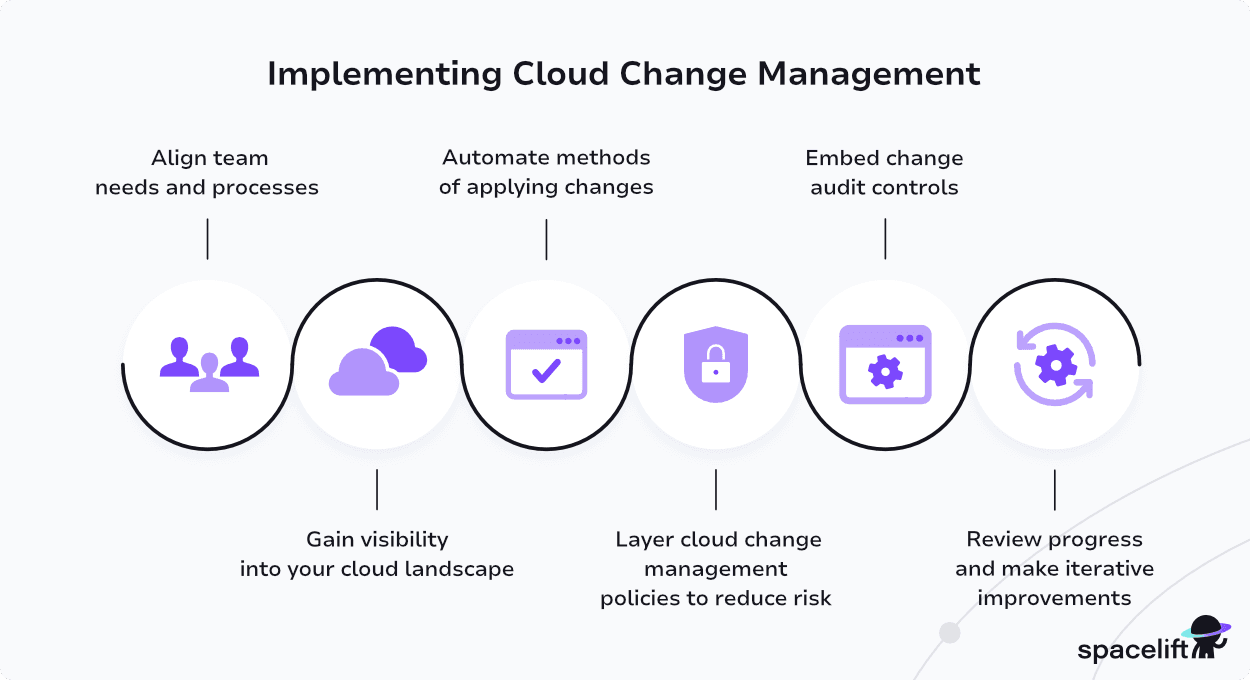
Here’s an overview of how to get started on your cloud change management journey.
1. Align team needs and processes
Start by consulting the different stakeholders who engage with your cloud environments. From developers to business leaders, it’s important to understand what changes each group makes and their unique needs. Identify differences in perspectives, such as how groups categorize what constitutes a change, or what level of risk they assign to various types of changes. You can then work to positively reconcile these differences into a unified process that’s ready to automate.
Focus on:
- Defining what constitutes a change
- Identifying required approvals and dependencies between stakeholders
- Unifying risk categorizations
- Removing roadblocks that prevent teams from aligning their approaches to change
2. Gain visibility into your cloud landscape
Next, you should catalog your existing cloud landscape. Understanding what you have is an important first step towards effectively managing it.
Compile an inventory of the assets in your cloud accounts, including infrastructure resources, deployed services, and existing automation pipelines and governance controls. This gives you the baseline you’ll build upon as you implement your change management system.
Focus on:
- Cataloging cloud assets
- Identifying visibility blind spots (e.g. unmonitored cloud accounts)
- Establishing team ownership of resources
- Removing any redundant or outdated components you find
3. Automate methods of applying changes
The next stage is to automate and unify as many of your cloud change deployment processes as you can. From the previous two steps, you should have already identified infrastructure components, services, and teams that aren’t yet fully automated.
Now’s the time to adopt IaC for these resources, then add CI/CD pipelines that eliminate the need for developers to perform manual deployment tasks.
Try using infrastructure orchestration platforms like Spacelift to simplify this process. Fully automated solutions allow you to increase velocity, ensure repeatability, and standardize change deployment processes across all your teams and projects. This is instrumental in evolving change management from ad hoc fixes to stable predictability.
Focus on:
- Increasing adoption of IaC and CI/CD solutions
- Unifying pipelines and tools across teams
- Documenting new workflows and training developers
- Adopting purpose-built infrastructure orchestration platforms
4. Layer cloud change management policies to reduce risk
Once you’ve automated your methods of applying changes, you can start layering in governance controls to prevent misconfigured or unauthorized updates from reaching your environments. Embed policy-as-code tools such as Open Policy Agent (OPA) and HashiCorp Sentinel into your pipelines to block non-compliant changes at their source. Start by creating policies that enforce your most crucial internal standards, then expand your rules as you identify new risks.
Focus on:
- Integrating policy checks with your change deployment pipelines
- Writing policy-as-code rules to enforce internal requirements
- Blocking misconfigured and non-compliant IaC configurations
- Requiring approval from relevant stakeholders before key changes can proceed
5. Embed change audit controls
Ensuring every change has a comprehensive audit trail lets you verify your standards are being met. You should instrument your deployment pipelines and policy systems so that audit logs are written at every point in a change’s lifecycle.
For instance, you could add a post-deploy CI job that gathers information about the commit, approvers, and pipeline, then saves it to a persistent audit database.
Focus on:
- Instrumenting your deployment processes to record audit logs at key times
- Automating the gathering of audit evidence, such as commit histories, approvers, and policy test results
- Implementing audit log analysis tools that can flag anomalies in real-time
- Making audit data easily accessible to relevant stakeholders
6. Review progress and make iterative improvements
Managing cloud changes is always an iterative process. After you’ve implemented your initial strategy, you’ll probably find some aspects don’t work quite as you expected. Over time, you should evolve your strategy to accommodate toolchain changes, new stakeholder requirements, and any anomalies revealed by monitoring audit data.
Regularly consult with different stakeholders to refine your process and design enhancements. This will create a positive feedback loop that makes your change management system even more resilient over time.
Focus on:
- Measuring the performance of your changes
- Investigating the causes of problems and anomalies
- Collecting feedback from different stakeholders, then addressing any concerns
- Designing improvements to improve governance and efficiency
Cloud change management: relevant tools
Cloud change management is easiest when your tools make changes visible, reviewable, and reversible. In practice, most teams end up with a small “toolchain” that covers approvals, automation, guardrails, and evidence.
| Tool category | What it covers in cloud change management | Examples |
| ITSM and approval workflows | Change records, risk classification, CAB approvals, scheduling, audit-friendly sign-offs | ServiceNow Change Management, Jira Service Management |
| Version control and change review | Makes every change reviewable and traceable through pull requests, required reviewers, and protected branches | GitHub, GitLab, Bitbucket |
| CI/CD and release orchestration | Automates build/test/deploy steps and standardizes release workflows after approval | GitHub Actions, GitLab CI, Jenkins, CircleCI |
| Infrastructure orchestration and infrastructure as code management | Plans/applies, state management, approvals, drift workflows, repeatable deployments | Spacelift, Terraform Cloud/Enterprise |
| GitOps for Kubernetes | Reconciles cluster state from Git to reduce manual changes and configuration drift | Argo CD, Flux |
| Policy as code and guardrails | Enforces standards as automated gates (before changes run or at admission time) | Open Policy Agent (OPA), Conftest, OPA Gatekeeper, Kyverno |
| Drift detection and configuration governance | Detects and helps remediate “out-of-band” changes made via ClickOps or scripts | AWS Config, Azure Policy, Google Cloud Organization Policy, Spacelift drift detection |
| Audit logs and evidence collection | Captures who changed what and when; supports audit and forensic investigations | AWS CloudTrail, Spacelift audit trail/run history |
| Security scanning in the change workflow | Prevents risky changes by scanning infrastructure as code and artifacts before deployment | Checkov, tfsec, Trivy |
Why use Spacelift to improve your cloud infrastructure management?
Spacelift is not exactly a cloud automation tool, but it takes cloud automation and orchestration to the next level. It is a platform designed to manage IaC tools such as OpenTofu, Terraform, CloudFormation, Kubernetes, Pulumi, Ansible, and Terragrunt, allowing teams to use their favorite tools without compromising functionality or efficiency.
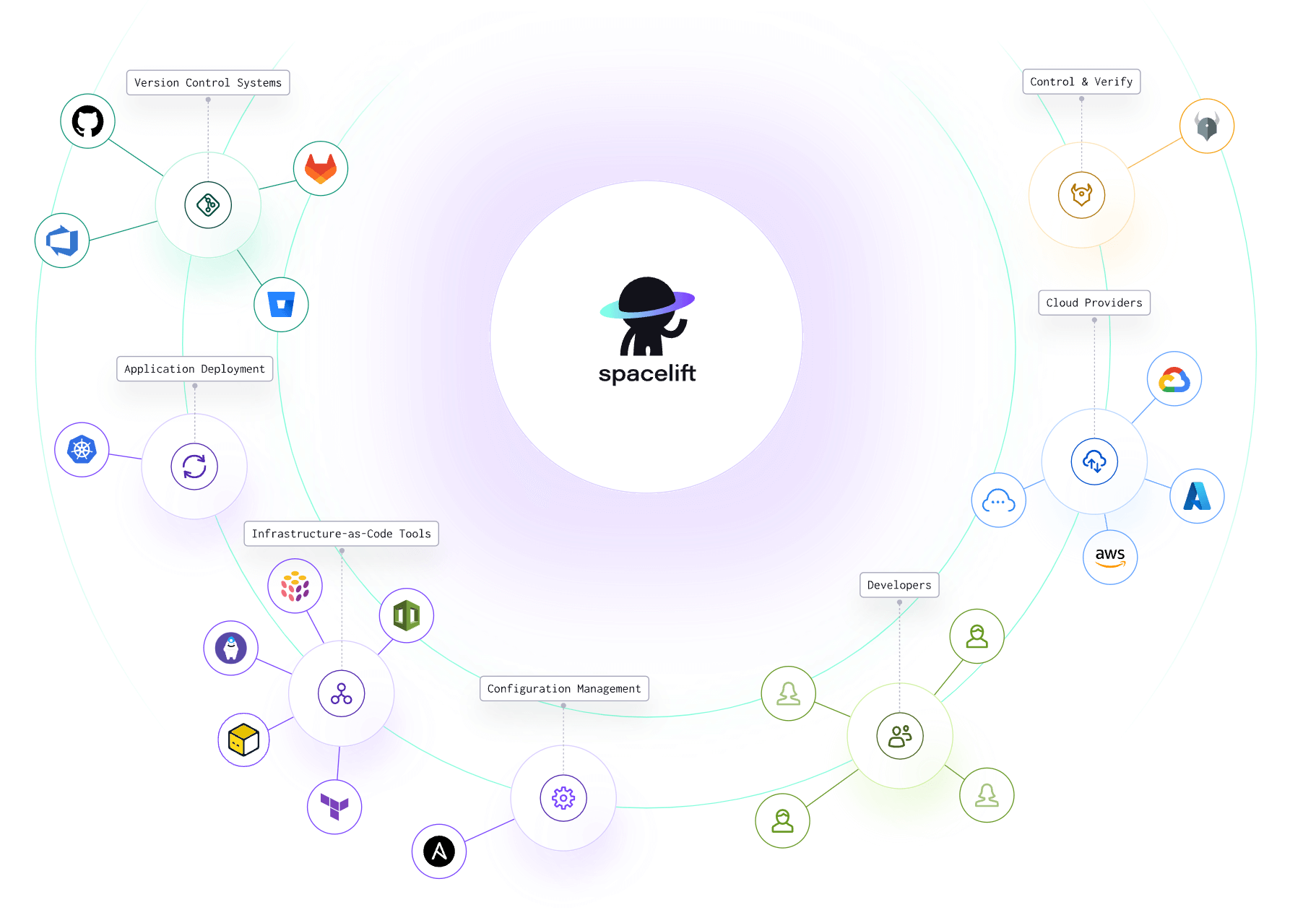
Spacelift provides a unified interface for deploying, managing, and controlling cloud resources across various providers. Still, it is API-first, so whatever you can do in the interface, you could do via the API, the CLI it offers, or even the OpenTofu/Terraform provider.
The platform enhances collaboration among DevOps teams, streamlines workflow management, and enforces governance across all infrastructure deployments. Spacelift’s dashboard provides visibility into the state of your infrastructure, enabling real-time monitoring and decision-making. It can also detect and remediate drift.
You can leverage your favorite VCS (GitHub/GitLab/Bitbucket/Azure DevOps), and executing multi-IaC workflows is a question of simply implementing dependencies and sharing outputs between your configurations.
With Spacelift, you get:
- Policies to enforce guardrails — what engineers can deploy, which approvals a run needs, what happens when a pull request is open, which tasks can run, and where notifications go
- Stack dependencies to orchestrate multi-step workflows — for example, provision EC2 instances with Terraform, then configure them with Ansible
- Self-service infrastructure via Blueprints, giving developers Golden Paths without sacrificing governance
- Reusable contexts for environment variables, files, and hooks — plus the ability to run custom code when you need it
- Drift detection with optional remediation
If you want to learn more about Spacelift, create a free account today or book a demo with one of our engineers.
Key points
Cloud change management is a structured framework of tools and processes that allows you to effectively operate fast-paced cloud environments. It de-risks cloud operations by standardizing deployment processes, enabling deep visibility, and embedding automated governance controls throughout the lifecycle of each change.
Implementing cloud change management systems builds additional support around your wider DevOps and infrastructure management workflows. It ensures teams can deploy changes autonomously without causing misconfigurations. This managed approach means you can increase the pace of innovation, boost service reliability, and save costs, making your organization more competitive in the marketplace.
Solve your infrastructure challenges
Spacelift is a flexible orchestration solution for IaC development. It delivers enhanced collaboration, automation, and controls to simplify and accelerate the provisioning of cloud-based infrastructures.
Frequently asked questions
How does cloud change management differ from traditional IT change management?
Cloud change management differs mainly in pace, automation, and shared responsibility. Changes are smaller and more frequent, often executed through code and pipelines rather than manual tickets and maintenance windows. Traditional IT change management typically assumes slower, infrastructure-centric changes on static systems with heavier upfront approvals and tightly controlled implementation steps.
How is change management for cloud migration different from on-premises?
Change management for cloud migration is more continuous, risk-driven, and service dependent than on-premises, because you are adopting a shared-responsibility model and a faster release cadence. On-premises change tends to be event-based and infrastructure-centric, while cloud change is product-like, policy-driven, and tightly coupled to vendor-managed services.
What are the key steps in a cloud change management process?
A solid cloud change management process is a controlled workflow to plan, validate, deploy, and verify changes while minimizing risk and downtime.
What approvals and guardrails should I use for production cloud changes?
Use a risk-based approval model with automated guardrails, so routine changes ship quickly while high-impact production changes require explicit review and evidence. Pair “who can approve” with “what must be true” (policy, tests, rollout, and observability) so approvals are about risk, not ceremony.
How do I measure the effectiveness of my cloud change management process?
Measure effectiveness by tracking whether cloud changes are delivered quickly and safely, with minimal customer impact, and whether failures are detected and reversed fast. In practice, you need a small set of outcome metrics (reliability and risk) plus flow metrics (speed and predictability), all segmented by change type and service criticality.