Multicloud infrastructure is the use of multiple cloud providers to operate software services. It improves resilience and flexibility at scale, but creates unique challenges for DevOps processes.
In this article, we will discuss the effects of multicloud infrastructure on the DevOps lifecycle. We’ll explain the benefits it provides, then take a closer look at the common challenges and problems you could face. Finally, we’ll wrap up with a summary of some best practices to follow when implementing multicloud DevOps workflows.
How does multicloud affect DevOps?
Multicloud DevOps extends standard DevOps workflows to work across multiple cloud providers such as AWS, Azure, and Google Cloud. Instead of working with only one provider, processes are overhauled so they seamlessly function across each of the clouds you depend on.
At a practical level, multicloud DevOps requires changes to both tools and operational processes:
- You need purpose-built IaC orchestration solutions to efficiently deploy across multiple clouds and apply consistent governance policies.
- Your DevOps workflows must also have awareness of the clouds they’re targeting so you can track where resources are being deployed.
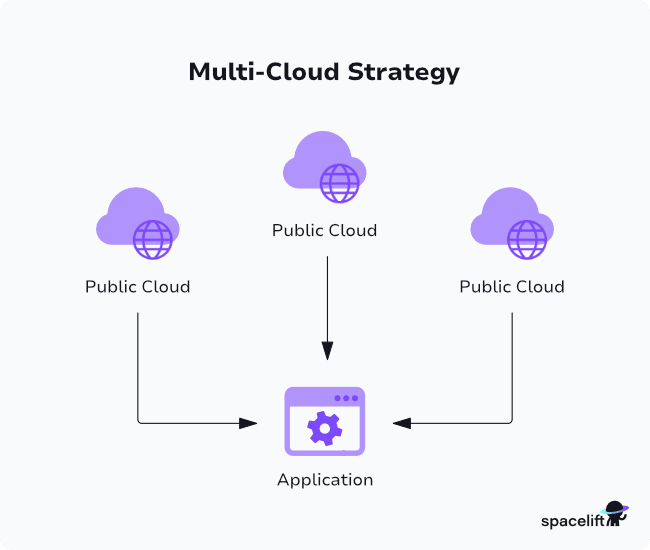
While a multicloud strategy gives you more options for operating your services, this comes at the cost of increased complexity. Robust automation is required to coordinate multicloud operations and prevent friction from appearing in the DevOps lifecycle.
Properly integrating multiple cloud providers into DevOps workflows requires various technologies, including GitOps, IaC, CI/CD, cloud orchestrators, and policy-as-code.
Each of these solutions has a configuration and maintenance cost, but combining them is the key to successful multicloud management. Together, they let you unlock long-term cost savings by enabling you to mix and match services from different cloud providers.
Benefits of multicloud DevOps
Beyond the advantages outlined above, adding multicloud support to your DevOps processes offers several notable benefits:
- Improved resilience and flexibility: Workflows that can target multiple clouds are more resilient to failures. If one provider suffers a problem, you can immediately redeploy the affected services in a different cloud.
- Enhanced scalability and high availability: Multicloud lets you scale replicas of your services across multiple geographic regions and physical data centers, improving fault tolerance when specific providers experience outages. Locating resources closer to users, with fallback options, may improve performance, save costs, and aid with compliance.
- Reduced risk of vendor lock-in: Adapting DevOps processes to support multicloud environments defends against the threat of vendor lock-in. You’ll end up building more modular workflows that make it easier to replace providers. Ordinarily, DevOps processes often assume a specific provider will always be used, preventing you from switching away without significant re-engineering.
- Encourages building portable microservices: Multicloud works best when you break your apps into smaller microservices that can be distributed across your clouds. This has broader DevOps benefits, too: it helps isolate faults within components, reduces build times, and enables scaling components individually.
These features mean multicloud is a potential route towards more powerful DevOps processes that better serve the needs of developers, operators, and users. But this doesn’t come without tradeoffs.
Organizational impact of multicloud DevOps
The technical benefits of multicloud are only half the story. The bigger shift is organizational, because once we deploy across multiple providers, we also inherit multiple sets of primitives, permission models, billing systems, and failure modes. If we don’t adjust how we work, multicloud quickly turns into tool sprawl, slower delivery, and more risk.
- Team structure and ownership changes: Multicloud forces clarity on who owns shared networking, identity, and baseline security controls across providers, and who owns application-level changes within each environment. Many teams end up formalizing a Cloud Center of Excellence or strengthening their platform team so standards are defined once and reused everywhere. Without that, expertise becomes tribal knowledge, and on-call rotations turn into “find the one person who knows Azure” — not an operating model.
- Standardization becomes a product, not a document: To keep developers moving, we need common workflows and Golden Paths that abstract provider differences where it makes sense. That usually means standard modules, consistent CI/CD conventions, and reusable templates for common environments. The goal it’s to keep 80% of requests boring and repeatable, so we only pay the complexity tax when we choose to.
- Governance and visibility have to scale across clouds: Multicloud increases the surface area for drift and shadow resources, especially when teams fall back to ClickOps to “just get it done.” The practical fix is to put guardrails in place: policy-as-code, consistent approvals, reliable audit trails, and clear resource visibility across environments. Done well, this supports developer self-service while giving security and compliance the evidence they need.
- FinOps and procurement get pulled into the loop: More providers mean more contracts, more tagging standards, and more cost allocation work. If we want multicloud to actually reduce risk and improve leverage, we need shared cost reporting, chargeback/showback rules, and a consistent way to evaluate tradeoffs across providers.
Multicloud DevOps: common challenges and problems
Multicloud creates new DevOps challenges. The following problems are common for organizations beginning their multicloud journey.
You’re most likely to experience these issues when you try to tack multicloud onto existing workflows rather than deeply integrating your tools and processes to build multicloud-native DevOps systems.
1. Workflows become more complex
Immature multicloud systems risk making workflows slower and more complex. As deployment processes grow to target multiple clouds, developers can be left waiting longer for new resources to become available.
Similarly, any extra steps inserted into workflows, such as having to manually duplicate configuration policies across each cloud, may create productivity-harming friction.
2. Too many tools cause sprawl
As we’ll discuss below, successful multicloud management requires several types of tools to work in unison. But if they’re not properly implemented, this can result in tool sprawl that’s just confusing and expensive.
Try to use as few solutions as possible to achieve your needs: dedicated infrastructure orchestration platforms like Spacelift can simplify your DevOps stack by combining IaC, CI/CD, and governance functions in one place, for example.
3. Requires specialist talent to configure and maintain
Managing multiple cloud environments requires skilled engineers who know the ins and outs of each provider. Finding the right talent can be difficult, while retraining existing operators takes time. These factors should be anticipated within your DevOps strategy.
4. Difficulty maintaining visibility and governance across clouds
Visibility is one of the biggest issues for multicloud DevOps. Adding more cloud providers, infrastructure components, and service deployments makes it hard to track how different resources link to each other. This can eventually lead to misconfigurations, wasted resources, and compliance failures.
5. Provider interoperability challenges
Cloud providers each have their own APIs, service offerings, identity systems, and data management tools. Reconciling the differences between providers can be daunting, potentially preventing multicloud ambitions from being fully realized.
True interoperability should allow workloads to seamlessly switch between clouds, but a degree of reconfiguration is often needed in practice.
6. Data becomes siloed in specific clouds
Failure to fully unify different cloud platforms can also cause data to become unexpectedly siloed. Having data stuck in a single cloud, perhaps due to a dependency on a particular service or missing migration options, erodes the other benefits of multicloud workflows. It leaves you with a collection of individual clouds that increase costs without significantly improving resilience.
Components to include in multicloud DevOps workflows
To succeed, multicloud DevOps workflows must be based on properly integrated automation. It’s not enough to rely on manual tasks when deploying infrastructure components or investigating problems. Manual workflows make it too easy to lose track of what’s running in each cloud, leading to inconsistent configuration.
Here are 13 key tool categories that work together to enable effective multicloud management throughout the DevOps lifecycle:
| Tool category | Example tools | What it enables in multicloud |
| Cloud providers | AWS, Azure (plus smaller/specialized providers) | The starting point for multicloud: pick providers that fit your scalability, geography, and budget needs, ideally combining services that complement each other or excel for specific use cases. |
| Infrastructure as code (IaC) tools | Terraform, OpenTofu, Pulumi, CloudFormation | Standardize multicloud deployments by defining cloud configurations as code, then applying changes consistently across environments without clicking through multiple provider consoles. |
| CI/CD pipelines | GitHub Actions, GitLab CI/CD, Azure Pipelines | Automate IaC execution to reduce rollout friction, keep workflows consistent across clouds, and still allow per-cloud customization when needed. |
| Container orchestrators | Kubernetes, OpenShift | Abstract provider differences by running portable containerized services across clouds, improving agility and enabling multicloud clusters as one logical architecture. |
| GitOps solutions | Argo CD, Flux CD | Make Git the source of truth: continuously synchronize infrastructure state to IaC definitions and deploy workloads across clouds using simple manifests (e.g., YAML). |
| Policy as code engines | Open Policy Agent (OPA), HashiCorp Sentinel | Add policy gates to DevOps workflows to standardize checks like permissions, access controls, and approvals across cloud deployment pipelines. |
| Observability platforms | Grafana, Prometheus, Datadog | Provide cloud-agnostic visibility into health and performance, helping you monitor resources and detect anomalies across providers at scale. |
| Cost monitoring solutions | Infracost, Vantage | Reduce the risk of runaway multicloud spend by tracking costs across providers and showing what’s driving budget consumption. |
| Disaster recovery systems | Backups, replication, restore automation (e.g., Velero for Kubernetes) | Multicloud can improve resilience, but complicates recovery, use reliable backup systems that aggregate data across clouds and support restoration into new environments. |
| Centralized identity and access controls (IAM/SSO/RBAC) | Okta, Azure AD (Entra ID), Keycloak | Centralize authentication/authorization so access rules are consistent across providers and teams, simplifying governance in multicloud setups. |
| Secrets management across providers | HashiCorp Vault, AWS Secrets Manager, Azure Key Vault, External Secrets Operator | Store and distribute sensitive values (tokens, keys, passwords) in a controlled way across clouds to avoid drift, leakage, and inconsistent handling. |
| Auditability across environments | AWS CloudTrail, Azure Activity Logs, GCP Cloud Audit Logs, SIEM (e.g., Splunk) | Ensure actions and changes are traceable across clouds so you can support compliance, investigations, and operational accountability end-to-end. |
| Infrastructure orchestration platforms | Spacelift, other orchestration/MCMP tools | Orchestrate provisioning and maintenance across connected clouds, visualize resources, and enforce governance/compliance centrally. |
Implementing these solutions gives you automated workflows, centralized governance, and cohesive visibility of your multicloud environments. They ensure multicloud is an inherent part of your DevOps stack, not a messy afterthought that could trip your teams up.
Best practices for multicloud DevOps
Following the best practices outlined below helps embed multicloud environments into DevOps workflows. Include these techniques in your DevOps strategy to strengthen your infrastructure architecture and reduce risk.
1. Leverage automation to keep workflows consistent
Trying to manually manage multicloud environments leads to inconsistencies, misconfigurations, and unclear visibility.
In comparison, leveraging IaC, CI/CD, Policy-as-Code, and infrastructure orchestration solutions enables you to work efficiently across cloud providers while ensuring consistent governance.
2. Try to use cloud-agnostic solutions
Adopting cloud-agnostic tools helps accelerate multicloud adoption. It makes your processes more flexible, allowing you to easily replace individual providers in the future.
For instance, using container orchestrators like Kubernetes makes it easier to move workloads between clouds.
3. Standardize cross-cloud monitoring and compliance controls
Standardizing monitoring and compliance controls, such as by implementing centralized observability platforms and policy engines, provides consistent protection for your cloud accounts.
Run policy tests in your CI/CD pipelines to prevent non-compliant configurations from reaching your providers. You can also use external identity providers to help unify access flows across clouds.
4. Enable automated drift detection to find and fix anomalies
Drift threatens all types of cloud infrastructure, but with multicloud, the stakes are even higher. More clouds mean more environments to audit for drift, then apply any needed fixes. The automated drift detection and resolution capabilities found in infrastructure orchestration platforms make this process manageable at scale.
For example, Spacelift’s scheduled drift scans automatically compare the resources in your cloud accounts to the IaC files in your repository. Spacelift can then reconcile the drift automatically, if allowed by your policies.
5. Prepare a disaster recovery plan to deal with multicloud incidents
Developing a detailed multicloud disaster recovery plan prepares you to deal with any incidents that affect your infrastructure.
Automation can help facilitate quick failovers to standby providers, while regular backup testing and clear recovery runbooks remove uncertainty from multicloud restoration processes.
Why use Spacelift to improve your cloud infrastructure management?
Spacelift is an infrastructure orchestration platform that helps you automate and govern cloud deployments with the tools you already use. You can manage infrastructure as code (IaC) and configuration workflows across OpenTofu, Terraform, CloudFormation, Kubernetes, Pulumi, Ansible, and Terragrunt, without forcing teams into a single tool or workflow.
Spacelift gives you a single place to deploy, manage, and control cloud resources across providers. It’s cloud-agnostic, so you can connect to the cloud of your choice from the platform. It’s also API-first, anything you can do in the web interface, you can do via the API, the command-line interface (CLI), or the OpenTofu/Terraform provider.
The platform improves collaboration for DevOps teams, streamlines workflow management, and enforces governance across infrastructure deployments. It also provides visibility into what’s running, where it’s running, and how it got there, plus drift detection and remediation to keep live resources aligned with your IaC.
You can connect your version control system (VCS), GitHub, GitLab, Bitbucket, or Azure DevOps, and orchestrate multi-IaC workflows by defining stack dependencies and sharing outputs across configurations.
With Spacelift, you get:
- Multi-IaC workflows: Orchestrate provisioning and configuration runs across your toolchain.
- Stack dependencies: Create dependencies between stacks and pass outputs between them to support environment promotion pipelines.
- Unlimited policies and integrations: Implement policy as code guardrails and integrate with the tools you already use. Control approvals, allowed resources and parameters, pull request behavior, and where notifications and run data go.
- Flexible workflows: Customize what happens before and after runner phases, bring your own runner image, and override default workflow commands when needed.
- Self-service infrastructure with Blueprints: Define Golden Path templates teams can deploy safely, with policies, integrations, contexts, and drift detection embedded.
- Drift detection and remediation: Detect drift and reconcile it to keep infrastructure consistent and auditable.
If you want to learn more about Spacelift, create a free account today or book a demo with one of our engineers.
Key points
Multicloud infrastructure increases operational agility, but your DevOps processes must be specially designed to support it. You need new orchestration systems, IaC tools, and observability platforms to standardize the differences between clouds. These solutions must be tightly integrated with your DevOps workflows to prevent inconsistencies, sprawl, and siloing.
Without this proper structure, multicloud is complex and difficult to govern. But by combining the tools and best practices discussed above, you can implement scalable multicloud DevOps processes that boost resilience without causing negative effects.
Just remember that multicloud isn’t suitable for every team: Adopting it unnecessarily can create friction that pulls engineers away from where they’re really needed.
Solve your infrastructure challenges
Spacelift is a flexible orchestration solution for IaC development. It delivers enhanced collaboration, automation, and controls to simplify and accelerate the provisioning of cloud-based infrastructures.
Frequently asked questions
What is the difference between cloud and multicloud?
Cloud refers to using computing resources such as servers, storage, and managed services from a single cloud provider, for example, AWS, Azure, or Google Cloud. Multicloud means using services from two or more different cloud providers simultaneously, often for different workloads or purposes.
What is an example of a multicloud architecture?
A common example of a multicloud architecture is a system where a company runs its customer-facing web application on AWS while using Google Cloud for data analytics and Microsoft Azure for identity management.
What are the best tools for multicloud infrastructure automation?
For multicloud infrastructure automation, the strongest core choices are Terraform (and its open-source fork OpenTofu) for declarative provisioning, Pulumi for using real programming languages, and Crossplane when you want Kubernetes to act as a multicloud control plane.
Which workloads benefit most from a multicloud approach?
Common workload categories that benefit from a multicloud approach include:
- Mission-critical systems that require cross-provider failover to reduce outage risk
- Regulated workloads where data residency or compliance rules differ by region or provider
- Global applications needing low-latency access across diverse geographies
- Analytics and batch processing that can arbitrage pricing across clouds
- SaaS platforms seeking to avoid vendor lock-in and strengthen negotiation leverage
Is multicloud always the right choice for DevOps teams?
No, multicloud is not always the right choice for DevOps teams, because its benefits often come with significant operational complexity. While multicloud can reduce vendor lock-in and improve resilience, it also increases tooling fragmentation, skill requirements, and integration overhead.
Multicloud is most effective when driven by clear requirements such as regulatory constraints, geographic coverage, or mergers, rather than as a default strategy. For most teams, simplicity and consistency deliver better long-term velocity and reliability.