

The choice between a monorepo and a polyrepo is one of the most consequential decisions you’ll make when you start a new software project. A monorepo keeps all your code in one repository, while a polyrepo splits code across separate repositories for each service.
That decision affects developer experience (DevEx), continuous integration/continuous delivery (CI/CD) complexity, scalability, and how teams collaborate. So it’s worth weighing the trade-offs against your organization’s needs early. Switching approaches later often means expensive, disruptive restructuring, so it pays to choose well up front.
In this article, we’ll break down the benefits, limitations, and best-fit use cases for both models. We’ll also call out common misconceptions that can lead teams astray. Let’s start with a closer look at each option.
What we’ll cover:
What is a monorepo architecture?
A monorepo is a single code repository that holds several independent projects. A monorepo bundles the frontend code, backend services, shared component libraries, infrastructure configurations, and documentation from all of your apps into one repository structure.
Building with monorepos means there’s a single destination to access every part of your organization’s code. This can simplify key tasks such as developer onboarding and toolchain updates, but the scale of active monorepos may slow down build processes and add complexity to continuous integration (CI) systems.
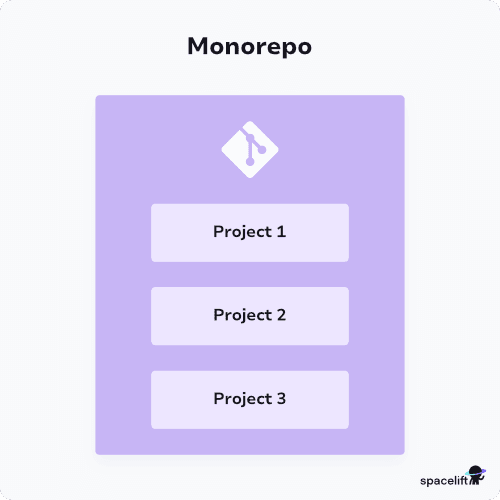
The monorepo architecture is often used by teams building large, closely related products. It can increase efficiency when developers regularly work across many different components, such as when you’re maintaining a family of apps that rely on a shared set of libraries and tightly coupled services.
Monorepos are easiest to implement when you use build tools and development workflows designed for them. Bazel, Lerna, and Lage are popular solutions for running individual tasks and build processes within a monorepo. They help solve key challenges, such as only rebuilding components that have actually changed.
Are monolith and monorepo the same?
A monolith is an application architecture, while a monorepo is a source-control layout. They describe different things and can be combined.
A monolith typically means one deployable unit where modules share a runtime and are released together, even if the code is internally well structured.
You can have a monolith in a monorepo, but you can also have many microservices in a monorepo, and a monolith can live in a single repo or be split across multiple repos. The key difference is runtime and deployment coupling (monolith) versus code organization and workflow (monorepo).
What is a polyrepo (multi-repo) architecture?
Polyrepo architecture is the use of one repository for each distinct service in your system. It’s where you create a new repository each time you start an app, library, or component. This keeps repositories smaller and provides cleaner separation of concerns.
Polyrepo-based development often aligns well with microservices architectures. Managing microservices within their own repositories allows developers to work independently on each service, without affecting neighboring components. Separating repositories also lets you apply unique security policies to each component.
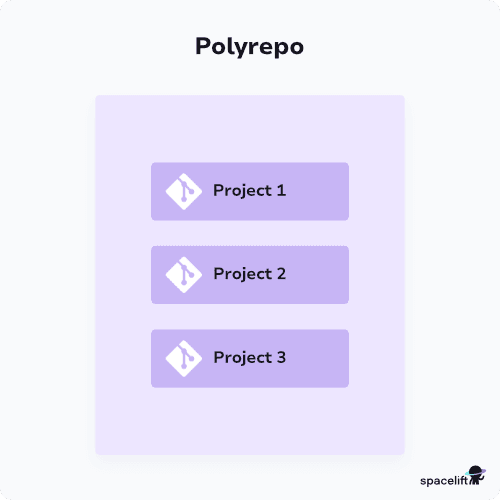
Polyrepo workflows need less dedicated tooling: the cross-project trigger build features in popular CI/CD services like GitHub Actions and GitLab CI can be used to start jobs in descendant repositories after an upstream project pipeline completes. Using Git submodules to nest repositories can also help manage the relationships between different components, while still separating their code.
What is the difference between a polyrepo and a multi-repo?
Polyrepo and multi-repo usually mean the same thing: a codebase split across multiple Git repositories instead of a single monorepo.
People say “polyrepo” to emphasize many small, independently versioned repos, while “multi-repo” is a more generic label for any setup with more than one repo, including tightly coupled “split” repos managed together.
Monorepo vs polyrepo: pros and cons
The different features of monorepos and polyrepos mean they each have compelling benefits to offer. However, they also carry their own drawbacks and limitations that you should be aware of before you commit.
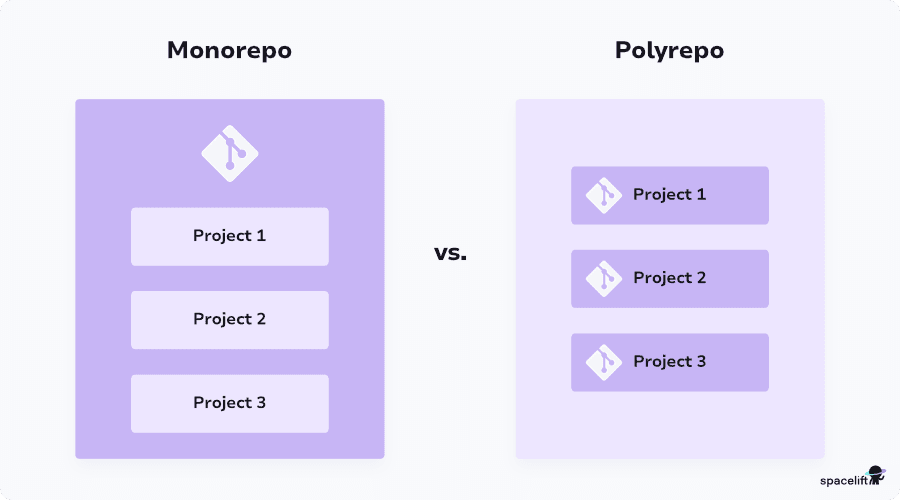
The next few sections summarize the main pros and cons of monorepos and polyrepos. You should consider how these factors will affect your development workflows as you evaluate each strategy.
Monorepo: Pros
A monorepo can simplify cross-service work by keeping code, configs, and tooling in one place:
- Simplified inter-project code sharing: Monorepos make it easy to share code. Because all libraries exist in the same repository, they can reference each other directly. You don’t need to publish new package versions each time you change a component.
- Easy atomic deployments: With all code in one repository, developers can deploy changes across multiple projects in a single commit. If the deployment causes a problem, then there’s also only one commit to revert.
- Convenient developer experience: Enabling developers to work in one repository helps reduce context-switching. It’s easy to switch between branches and search across your organization’s entire codebase.
- Standardized code quality controls: Using a single repository means linting, formatting, and testing rules only need to be applied once. This helps make code quality more consistent across all of your services.
- Clear visibility into your entire stack: Having every component in one place provides clear visibility into their relationships. Developers can more easily inspect the entire system, making it less likely that changes will cause unintended side effects in other components.
Monorepo: Cons
However, as the repo grows, monorepos add trade-offs — builds slow down, permissions get messy, and workflows sprawl.
- Potential scalability problems: Monorepos can become very large as your collection of projects, libraries, and services grows. This can cause long clone times, slow builds, and delays when calculating what has changed. Dedicated tooling is needed to enable efficient use of monorepos at scale.
- Complex CI/CD configurations: Monorepos require a specialist CI/CD configuration, so jobs only run for services that have actually changed. Pipeline config files may contain very large numbers of jobs to cover the bespoke parts of individual services.
- Creates security and access control risks: When all projects live in one repository, developers can access everything you’ve created — even if they only work on a few projects. Implementing precise access-control guardrails can be challenging, so monorepos may be unsuitable for teams with stringent security requirements.
- Depends on developer discipline: Developers need to follow strict rules and conventions to maintain the structure within monorepos. Unless you remain disciplined, it’s easy for repositories to become disorganized. This increases the risk that components will become tightly coupled or rely on spaghetti code.
- Limits private experimentation: Monorepos keep all code visible to everyone. This can create a feeling of restraint when teams are experimenting with new tools, projects, or processes that aren’t yet production-ready. Creating code in the open is often beneficial, but it’s sometimes undesirable for tentative experiments.
Polyrepo: Pros
Polyrepos give teams clear ownership, independent release cycles, and smaller repos that are easier to reason about.
- Simpler, faster CI/CD builds and repository maintenance: Each repository in a polyrepo setup contains the code for a single project. This means CI/CD builds are less complex and can run faster without needing special configuration. Smaller repositories also optimize the speed of Git clone, housekeeping, and maintenance operations.
- Stronger separation of concerns: Polyrepo architectures promote stronger separation of concerns. Using a different repository for each project naturally enforces boundaries between components, letting developers work on each one in isolation. Dependencies must be created deliberately by publishing packages and libraries; while this can create friction, it also means you’re less likely to end up with chaotic, tightly coupled structures.
- Can increase team autonomy: With polyrepos, teams can independently manage the repositories for the projects they control. They can manage their own CI/CD configs, release tooling, and branching strategies. This increase in autonomy may make the developer experience more satisfying.
- Enables fine-grained project access controls: Using multiple repositories enables each repository to have its own fine-grained access controls, permissions, and deployment policies. This allows you to reliably enforce required security and compliance requirements, including when some projects must be restricted to specific developers.
- Easier to maintain at scale: Polyrepo systems can be easier to keep running smoothly as you scale. Because the constituent repositories are smaller, self-contained, and have clearly defined relationships, you’re less likely to experience performance problems or complex dependency chains that prevent code being upgraded.
Polyrepo: Cons
On the other hand, polyrepos increase coordination overhead. Shared changes and dependency updates can become slow and repetitive.
- Need to coordinate deployments across repositories: One of the biggest challenges with polyrepos is the need to synchronize how deployments happen across repositories. For instance, changes to a support library may require you to redeploy all the projects that use it. You need dedicated strategies for publishing new releases, coordinating cross-project PRs, and triggering downstream CI pipelines in dependent projects.
- Risks code being duplicated in multiple repositories: Without careful library management, polyrepos risk code being duplicated across projects. Unless you have a friction-free process for creating, publishing, and consuming component libraries, developers may end up copying code to achieve their needs.
- Restricts system-level visibility into the effects of changes: Understanding the full effects of a change may require developers to navigate between several repositories in a polyrepo setup. Siloing code into repositories may also make it harder to see the links between them.
- Can complicate developer onboarding processes: With polyrepos, new developers need to clone and configure multiple repositories and their dependencies before they can become productive. There’ll also be separate environments to set up and maintain for each repository, adding overhead to everyday developer workflows.
- Projects may follow inconsistent standards: Different repositories may end up using separate code quality standards, dependency versions, or security systems. Fragmentation makes it harder to keep projects aligned with your operational requirements. You need external tooling to periodically audit each repository for misconfigurations and security risks.
What is the main difference between a monorepo and a polyrepo? Table comparison
A monorepo keeps multiple services, libraries, and shared tooling in one repository, while a polyrepo splits them into separate repositories per project, emphasizing isolation and independent ownership.
In practice, monorepos optimize cross-project changes and consistency, whereas polyrepos optimize autonomy, access control, and simpler per-project pipelines.
The table below summarizes the main differences between monorepos and polyrepos:
| Aspect | Monorepo | Polyrepo |
| Repo layout | Many projects in one repo | One project per repo |
| Dependency sharing | Direct, local imports/workspaces | Via published packages or vendoring |
| Cross-project changes | Single PR can update many projects | Multiple PRs across repos |
| CI/CD complexity | More complex, needs smart CI (scopes, caching) | Simpler per repo, scales by duplication |
| Versioning strategy | Often unified or coordinated | Typically independent per project |
| Tooling needs | Strong build system and dependency graph | Standard tooling per repo |
| Access control | Coarser, unless using path-based rules | Fine-grained per repo |
| Best for | Tight coupling, shared libraries, platform teams | Independent services, distinct lifecycles |
Choosing between them usually depends on how tightly coupled your components are and how much coordination your organization can tolerate.
How to decide between a monorepo and a polyrepo?
In general, monorepos are a good fit for large-scale environments where code’s heavily shared between multiple projects and services. Monorepos deliver system-wide visibility, easy component reuse, and simple cross-project standardization of code formatting rules and security policies. On the other hand, polyrepos are the usual preference when agility, autonomy, and robust security boundaries are the top priority.
There are no set rules for when to use a monorepo or polyrepo structure. Selecting the right choice for your workflows starts with careful analysis of your team’s DevOps processes, collaboration style, and operational requirements. Either solution can work well, so it’s best to examine both approaches in your own unique context.
It’s important not to be swayed by myths and misconceptions. Critics of monorepos often claim they’re only suitable for smaller teams and projects, for instance, but in fact, monorepos have proven success at massive scale.
Google and Microsoft famously use monorepos to store billions of lines of code. Similarly, while polyrepo detractors highlight the risk of repositories drifting into inconsistent configurations, you can manage this risk by implementing automated repository audit processes.
Make your decision by focusing on what you’d like your DevOps processes and DevEx to look like. You can then consider constraints such as the maturity of your teams, operating scale, and CI/CD infrastructure capacity. These may all affect the suitability of each approach.
Finally, plan out how you’ll implement your chosen strategy, such as by identifying tools for managing monorepos or synchronizing policies across per-project repositories.
How to solve your infrastructure challenges with Spacelift
Spacelift is an IaC orchestration platform that uses GitOps to automate CI/CD for your infrastructure components. It supports OpenTofu, Terraform, Terragrunt, CloudFormation, Pulumi, Kubernetes, and Ansible.
The power of Spacelift lies in its fully automated hands-on approach. Once you’ve created a Spacelift stack for your project, changes to the IaC files in your repository will automatically be applied to your infrastructure.
Spacelift’s pull request integrations keep everyone informed of what will change by displaying which resources are going to be affected by new merges. Spacelift also allows you to enforce policies and automated compliance checks that prevent dangerous oversights from occurring.
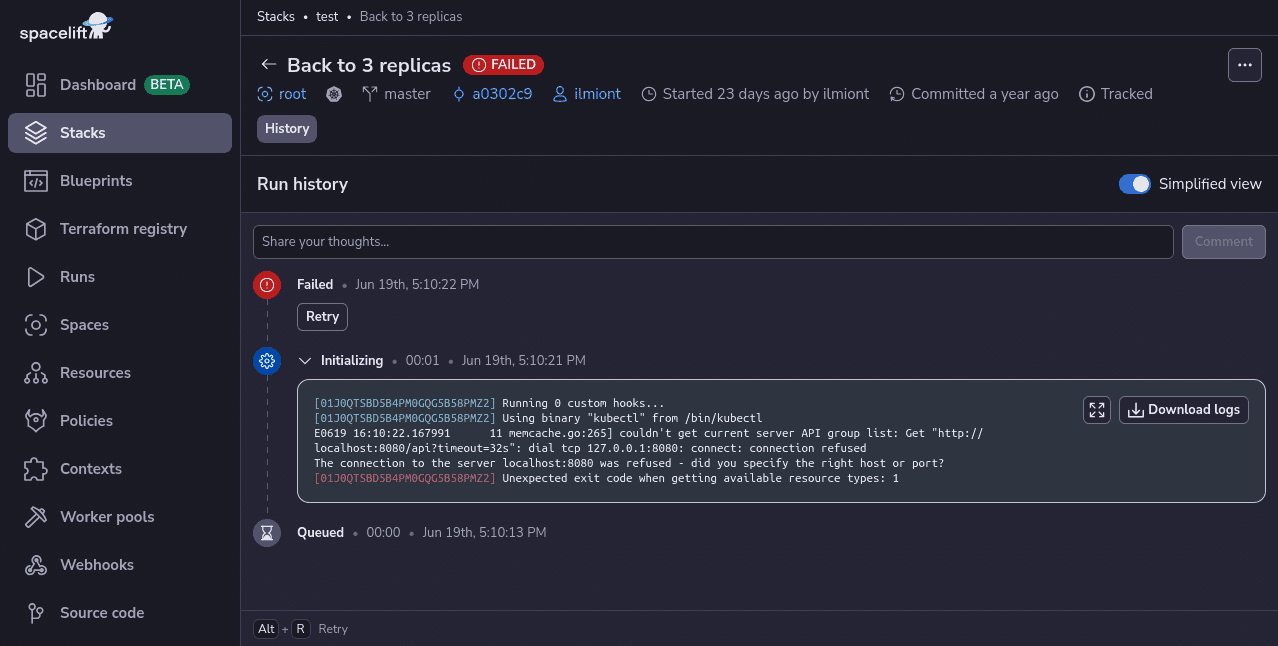
Spacelift includes drift detection capabilities that periodically check your infrastructure for discrepancies compared to the state of your repository. It can then launch reconciliation jobs to restore the correct state, ensuring your infrastructure operates predictably and reliably.
With Spacelift, you get:
- Policies to control what kind of resources engineers can create, what parameters they can have, how many approvals you need for a run, what kind of task you execute, what happens when a pull request is open, and where to send your notifications
- Stack dependencies to build multi-infrastructure automation workflows with dependencies, having the ability to build a workflow that, for example, generates your EC2 instances using Terraform and combines it with Ansible to configure them
- Self-service infrastructure via Blueprints, enabling your developers to do what matters – developing application code while not sacrificing control
- Creature comforts such as contexts (reusable containers for your environment variables, files, and hooks), and the ability to run arbitrary code
- Drift detection and optional remediation
If you want to learn more about Spacelift, create a free account today or book a demo with one of our engineers.
Key points
Monorepo and polyrepo architectures are the two main ways to structure the source code belonging to different projects, teams, and services. The monorepo architecture keeps everything in one Git repository, while polyrepo strategies divide code between multiple repositories.
Monorepos excel in scenarios where you need extensive code-sharing and a consistent set of standards. However, poorly configured monorepos can quickly become unwieldy, causing slow CI build times. Polyrepos avoid this problem and help enforce strong per-project security boundaries, but they restrict visibility and may lead to code duplication.
Ultimately, the right choice depends on how you want to run your workflows. Both monorepos and polyrepos are used by teams of all sizes, so it’s best to analyze your deployment processes, collaboration needs, and security requirements to find the best fit for your projects.
Remember to allocate enough time to complete this process thoroughly: moving from a monorepo to a polyrepo strategy, or vice versa, is complex, so you should only commit once you’re sure your chosen model meets your needs.
Solve your infrastructure challenges
Spacelift is a flexible orchestration solution for IaC development. It delivers enhanced collaboration, automation, and controls to simplify and accelerate the provisioning of cloud-based infrastructures.
Frequently asked questions
What is the difference between monorepo and polyrepo in GitLab?
A monorepo keeps multiple projects in a single GitLab repository, while a polyrepo splits projects across multiple GitLab repositories. The core difference is how you scope versioning, CI/CD, permissions, and change coordination.
When not to use a monorepo?
Avoid a monorepo when teams need fully independent release cycles, strict access control boundaries, or different compliance and retention rules per product. It is also a poor fit if your build and CI tooling cannot scale (slow full-test pipelines, flaky dependency graphs), or if repository size, large binaries, and frequent wide-reaching changes create costly clone times, noisy code ownership, and coordination overhead.
Which companies use a monorepo strategy?
Several large engineering organizations that have publicly documented a monorepo approach include Google, Meta, Microsoft, Uber, Airbnb, and Stripe.
What is the largest monorepo in the world?
The largest monorepo that has been publicly documented is Google’s internal monorepo (often called “Google3”), managed by its Piper version control system. Public descriptions put it at “billions of lines of code” and on the order of 80-plus terabytes of repository data, which is far beyond other commonly cited corporate monorepos.
That said, “largest in the world” cannot be verified conclusively because the biggest candidates are private and companies measure “size” differently (lines of code, files, history, or storage).
When to choose a monorepo over a polyrepo?
Choose a monorepo when teams need tight coordination across many related packages and you benefit from atomic, cross-project changes with consistent tooling. Choose a polyrepo when services are loosely coupled, teams ship independently, or you need strong isolation for security, compliance, or release velocity.
Is monorepo better for AI?
A monorepo can be better for AI when multiple services share model code, feature engineering, data contracts, and evaluation tooling, because you can refactor and version changes atomically with consistent dependencies and reusable pipelines. It can hurt when repo size, access control, and CI costs explode, especially if you try to store large datasets or model artifacts in Git.